

A context-aware AI reply is an answer built from more than the player’s last message. It draws on the conversation so far, the player’s account details, your knowledge base and your business rules, so the player does not have to repeat themselves and the answer fits their situation. In a regulated casino, it also needs a human check before it goes out. This guide explains how context-aware replies work, what to feed them, how to handle the awkward moments and how to measure whether they help.
TL;DR
- Context-aware replies combine conversation history, player status, retrieved knowledge and business rules, where a scripted bot reacts only to a predefined input.
- Good context management means retrieving what matters and summarising the rest, not stuffing every past message into the prompt.
- Regulators such as the Malta Gaming Authority and the Dutch Ksa expect documented human review and accountability where AI touches player protection.
- Handle topic changes, missing context and low confidence with clear rules: ask, escalate or hand over, never guess.
- Measure the result with accuracy, escalation quality and player outcomes, not response speed alone.
Table of Contents
- What context-aware AI replies actually are
- What context a casino support reply can use
- How retrieval, memory and prompt design fit together
- Rolling it out across player-support channels
- Handling topic changes, missing context and uncertainty
- Why human review belongs in regulated support
- How to tell whether it is working
- See context-aware replies in one workspace
- Personalisation without overstepping
- A worked example
- FAQ
- Sources
What context-aware AI replies actually are
Traditional chatbots follow scripts and decision trees. A player types a phrase, the bot matches it to a branch and returns a canned answer. Salesforce describes context-aware AI as using real-time signals, user history and business logic to produce relevant, personalised responses, where older conversational tools respond to predefined inputs.
The everyday difference is continuity. Grammarly’s explanation of AI chat gives a simple example: a follow-up such as “make it shorter” works because the system remembers the previous request. In casino support the same principle looks like this:
- A player writes: “My withdrawal is still pending.”
- Ten minutes later they add: “It’s been three days now.”
- A context-aware system reads the second message as part of the first, checks the status of the withdrawal and the verification state of the account, and replies about that withdrawal.
- A scripted bot treats the second message as a new, ambiguous query and asks “How can I help you?”
Players notice the second experience immediately, and so do your agents when the thread lands in their queue.
What context a casino support reply can use
Context is anything supplied to the model that shapes and grounds the answer. Peter Lasne’s account of chatbot context notes that in a one-to-one conversation this commonly includes the current conversation until the user changes subject, plus information stored from earlier conversations when the bot is set up to use it. Support-focused write-ups add more layers: SupportMe lists conversation history, customer status, product knowledge, tone-of-voice preferences and operational business rules.
For an online casino, that translates into six practical layers.
| Context layer | Casino example | Why it matters |
|---|---|---|
| Current conversation | The last few messages in the live chat | Keeps the reply on the actual question |
| Earlier contacts | A previous email about a bonus dispute | Avoids asking the player to start again |
| Account status | Verification stage, VIP tier, language | Decides what can be said and in which tone |
| Knowledge base | Withdrawal times, bonus terms, payment methods | Grounds the answer in your own rules |
| Business rules | Which topics need a human, which wording is banned | Keeps replies inside policy |
| Player-protection signals | Distress wording, self-exclusion requests, limit changes | Triggers escalation and stops promotional messages |
The last row deserves special care. A reply that is perfectly relevant but promotes a bonus to someone who has just asked to close their account is the wrong reply. Context has to include what the system must not do as well as what it can say.
How retrieval, memory and prompt design fit together
You do not need to be an engineer to run this well, but you should understand the moving parts, because they decide what your agents see in a draft.
Retrieval grounds the answer in your content
Microsoft Research describes a customer-service pattern in which knowledge-base documents are split into chunks and embedded. The customer’s query is embedded too, the closest chunks are retrieved by similarity, and those passages are inserted into the prompt alongside the conversation history and system instructions. The model then answers from your material rather than from general knowledge.
For a casino this is the difference between “withdrawals usually take a few days” and your actual processing times by payment method. Keep the source documents current: retrieval is only as good as what it retrieves.
Memory has two horizons
Short-term memory is the running conversation. Long-term memory is what you keep about the player across contacts. Redis’s explanation of context assembly says a production prompt typically combines system instructions, retrieved knowledge, short-term history, long-term memory, tool definitions and the current query, and that history may be trimmed or summarised once it outgrows the context window.
That last point matters in practice. Agentkit’s guidance says effective context management retrieves relevant information and summarises the conversation around decisions, rather than retaining every token. A VIP player with two years of history does not need two years of chat pasted into every prompt. They need the three facts that bear on today’s question.
Prompt design is now context design
Anthropic’s research on context engineering argues that reliable behaviour depends on curating the whole set of information available when the model generates, not only on wording one instruction well. For support teams the lesson is plain: spend your effort on what goes into the window (policies, account facts, tone rules) rather than hunting for a magic phrasing.
Rolling it out across player-support channels
A casino rarely has one channel. Players write by email, open live chat, text and message on Telegram. Context-aware replies only feel intelligent if the context follows the player from one channel to the next. A practical rollout looks like this.
- Map the questions. Pull a sample of recent tickets and sort them into routine (payment status, verification steps, bonus terms) and sensitive (complaints, distress, limits, self-exclusion). Our guide to automating five routine queries and escalating risk walks through this split.
- Build one identity for the player. Link the email address, chat session, phone number and Telegram handle to a single record, so the thread is unified rather than four separate conversations.
- Prepare the knowledge base. Rewrite bonus terms, payment rules and verification steps as short, current, self-contained passages. Remove contradictions before the AI finds them.
- Write the business rules. State which topics always go to a person, which words or promises are never allowed and when marketing must be suppressed.
- Set the tone per segment. A VIP host’s style differs from a first-week player’s. Define personas and language per segment.
- Put review in front of every reply. Start with all replies reviewed by staff, then study the edit patterns before changing anything.
- Check by channel. SMS needs shorter replies than email, and Telegram invites informal phrasing. Test each one separately.
If you want to see what a review step looks like in detail, our six-stage AI reply review workflow sets it out stage by stage.
Handling topic changes, missing context and uncertainty
These three moments separate a dependable system from one that merely sounds fluent. Treat them as design requirements, not edge cases.
When the player changes subject
Players jump between topics: a question about a bonus, then a complaint about a payment. The system should recognise the switch and stop applying the old context. Practically, the new message should be matched against the knowledge base afresh, while old details are kept only if they are still relevant. Where a message contains two issues, a good reply answers both in order or says clearly that one will be handled separately. A human reviewer should see the split in the draft so they can correct it.
When context is missing
Sometimes the account has no verification record, the payment reference is absent or the knowledge base has no passage that covers the question. The safe behaviours are:
- Ask one specific clarifying question, not a list of five.
- Say what you can already see, so the player knows you are not starting from zero.
- Never fill a gap with a plausible guess about money, limits or eligibility.
When the answer is uncertain
Set a rule that low-confidence or no-source drafts are flagged to the reviewer, not sent. Where retrieval finds no matching passage, the draft should say so to the agent rather than improvise. Where the topic touches player protection, the route is a person every time. The Dutch regulator’s position is clear on this: according to reporting on the Ksa guidance, chatbots and AI may supplement but not replace employees in discussions about addiction prevention or limits, and an employee must be available to take over.
Sentiment detection helps here. Frustration, repeated contact on the same issue and distress language are signals to move a thread up the queue, and for VIP players to move it to the named host.
Why human review belongs in regulated support
Regulators are converging on the same expectation: AI can assist, but accountability stays with the operator. IGamingBusiness’s summary of the MGA’s vision says the proposed framework stresses documented human review for high-impact decisions affecting players, together with monitoring, bias testing and traceability. It adds that human review is essential where AI informs interventions or player-protection measures, to prevent unintended harm and keep accountability clear.
The Ksa reporting makes a related point about transparency: operators should be able to explain why an AI system produced a given output and remain accountable for it, even when a vendor supplies the technology. In practice, that means you need a record of what the AI saw, what it drafted, who reviewed it and what was sent.
The rules differ by jurisdiction, and the Malta and Netherlands positions above are not a universal standard. Check what your own licensing authority requires, and bring your compliance officer into the design from the start. Our compliance playbook for human-reviewed AI covers the audit side in more depth, and our page on responsible gambling automation explains how detection and outreach suppression fit into the same workflow.

How to tell whether it is working
Faster replies are easy to count and easy to over-rate. A better scorecard looks at quality first.
- Accuracy of drafts. What share of drafts do reviewers send unchanged, lightly edited or rewrite? Track the reasons for edits.
- Groundedness. Does each factual statement trace back to a knowledge-base passage or account field?
- Escalation quality. Are the right threads reaching people, and are any sensitive ones slipping through?
- Repeat contact. Do players come back about the same issue less often?
- Player outcomes. Satisfaction, complaint rates and retention among those who used support.
There is evidence that grounding helps. A 2026 study on a context-aware language model for customer support reported that retrieval-based chatbots improved context precision by 7.5 times and reduced hallucinations by 73.20% against random-retrieval baselines, with responses judged by an LLM. That is a research setting, not your casino, so treat it as a reason to invest in retrieval and then confirm the effect against your own tickets.
Our view: context without oversight is just a faster mistake
We build Pitbot on a simple belief: in a regulated casino, a smart reply that nobody checked is a liability, not a feature. Context is what makes an answer relevant. Review is what makes it safe to send.
That is why our platform combines several AI providers with human review of every reply before it reaches the player. Drafts are shaped by conversation history, channel and persona, then pass to your staff, with an audit trail of each decision. Sentiment detection and escalation route sensitive cases to people, and responsible gambling detection suppresses marketing outreach where it should not go.
We would rather our customers say “the AI drafted it and my team approved it” than “the AI sent it”. Speed matters, and with this design you get it without giving up control.
pitbot
See context-aware replies in one workspace
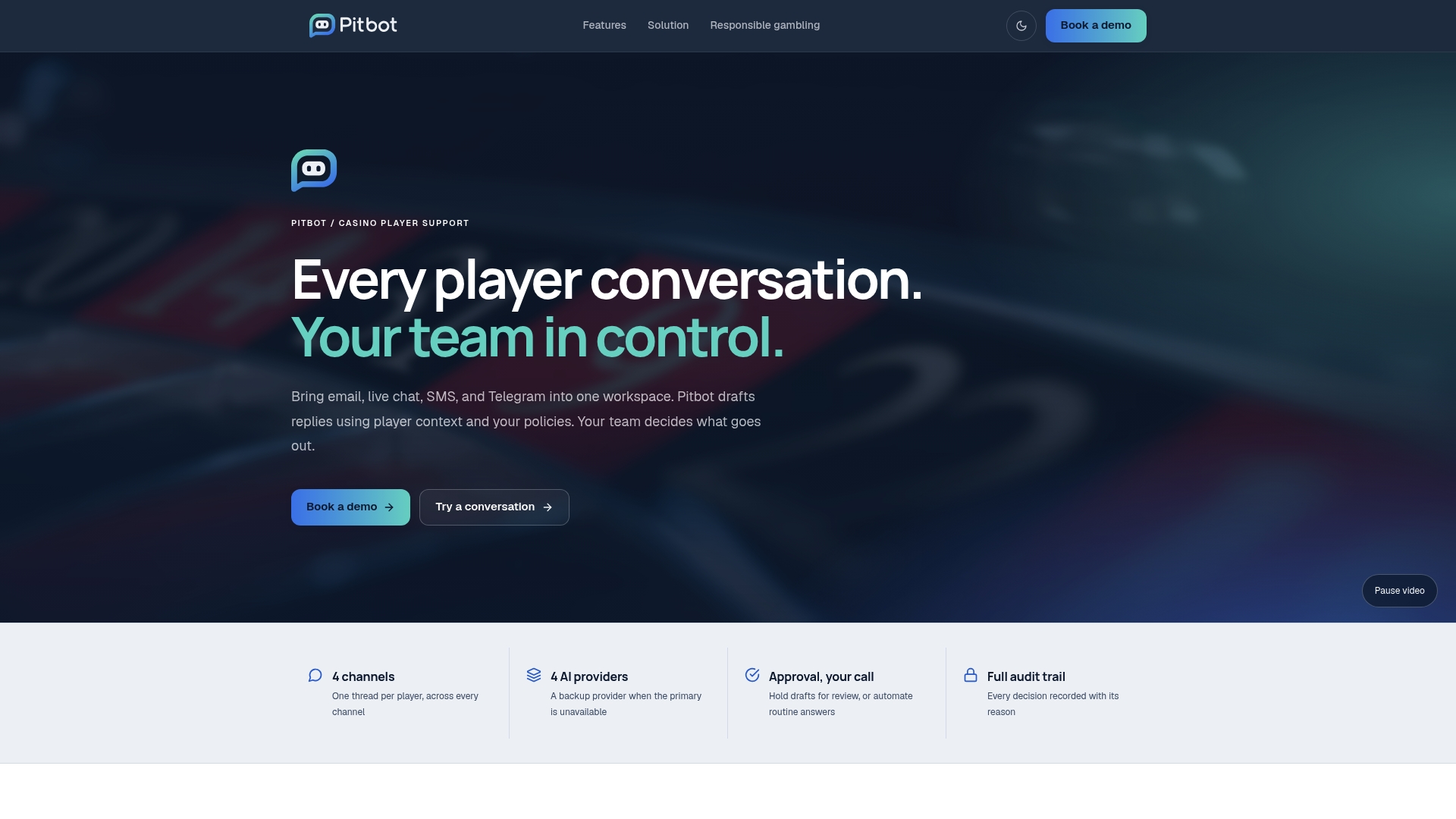
Pitbot is an AI player-support platform for online casino operators. It brings email, live chat, SMS and Telegram into one dashboard, drafts context-aware replies with multiple AI providers, and puts every reply through staff review before it is sent. VIP queue management, multilingual support, virtual personas and analytics sit alongside it. If you want to see how it would handle your own tickets, look at the Pitbot features or read about AI customer support for online casinos.
Personalisation without overstepping
Context also drives personalisation, and that needs limits. Using a player’s name, language and VIP status is expected. Using inferred behaviour to push offers at the wrong moment is not. Make “who may be contacted, and about what” an explicit rule that the AI cannot override, and keep a suppression list tied to responsible gambling signals. Our guide to personalised player messaging sets out how to keep it helpful rather than intrusive.
A few habits keep personalisation honest:
- Reference facts the player has given you or that sit on their account, not guesses.
- Keep the tone consistent with the persona you have defined for the segment.
- Never let a retention goal override a protection signal.
- Review samples regularly, especially for VIP conversations where the stakes and expectations are higher.
A worked example
Imagine a player writes to live chat on Friday evening: “Still waiting on my money.” The conversation history shows a withdrawal request made on Tuesday, and the account shows verification documents awaiting review. The knowledge base has a passage on verification timelines. The business rules say any message with frustration signals gets reviewer priority, and any mention of limits or self-exclusion goes to a person.
The AI drafts a reply that names the withdrawal, explains that verification is the current step, gives the stated timeline and offers to flag the case. The sentiment score is raised, so the draft goes to the front of the review queue. The agent checks the facts against the account, adjusts one sentence and sends. The audit record shows what the AI saw, what it proposed and what changed.
Nothing in that sequence is magic. It is context, retrieval, rules and review working together, which is exactly why it can be tested and improved.

FAQ
What is the difference between a context-aware reply and a chatbot reply?
A scripted chatbot matches the latest message to a predefined path. A context-aware reply also uses conversation history, account status, retrieved knowledge and business rules. The result is an answer that fits the player’s actual situation rather than a generic one.
Does context-aware AI replace support agents?
No. In a regulated casino the safer model is AI drafting and people reviewing, especially on player protection. Regulators such as the Ksa say AI may supplement employees but not replace them in limit and addiction-prevention discussions, and an employee must be able to take over.
How much conversation history should the AI see?
Enough to answer the current question, not everything. Good practice is to keep the recent turns in full, summarise older history around the decisions made and retrieve only the facts that bear on the topic. This keeps replies focused and prompts manageable.
What should happen when the AI is not sure?
The draft should be flagged for the reviewer, not sent. The system can ask the player one clear clarifying question or pass the thread to a person. It should never invent details about payments, bonuses or limits.
How do we know the replies are improving player experience?
Track how often reviewers accept drafts, how many players contact you again about the same issue, whether the right cases escalate, and complaint and satisfaction trends. Compare these against your pre-AI baseline rather than relying on response time alone.
Sources
- What is AI Context, and How Does it Work? (Salesforce)
- What Is AI Chat? (Grammarly)
- Conversational Context for Chat Bots (Peter Lasne)
- How to Keep AI Support Context Between Replies (SupportMe)
- Prompt Engineering: Improving our Ability to Communicate with an LLM (Microsoft Research)
- Context assembly: building the prompt the model sees (Redis)
- Chatbot Customer Context (Agentkit)
- Effective context engineering for AI agents (Anthropic)
- Understanding the MGA’s vision for AI in iGaming (IGamingBusiness)
- Richtlijnen Ksa: toezicht bij gebruik chatbots en AI (Casinonieuws)
- Context-Aware Large Language Model for Customer Support (ICCK)

