

The most effective VIP retention messaging strategy combines precise segmentation, personalised triggers delivered across the right channels, and responsible-gambling controls built into every touchpoint. A 5% improvement in retention can lift profits by 25 to 95% (Bain & Company research, across industries), which is why operators are tightening VIP messaging rather than abandoning it. The sections below walk through segmentation, channel strategy, personalisation and the compliance safeguards that keep these programmes inside regulatory lines.
TL;DR:
- VIP segmentation should incorporate behavioral and risk indicators, such as self-exclusion or deposit spikes, not just spend thresholds.
- Channel timing and type must align with message urgency, with suppression rules preventing multiple contacts about the same offer.
- Personalised triggers like expenditure feedback, expiry alerts, and post-loss check-ins significantly boost retention efforts.
- Compliance requires automatic suppression during vulnerability, safety prompts, and full audit trails for every contact.
- Investment in real-time infrastructure, automation, and a disciplined development sequence enhances retention without regulatory risk.
Table of Contents
- How to define and maintain VIP segments
- Channel strategy: which channels to use and when
- Personalisation and trigger tactics that move the needle
- Compliance and responsible-gambling safeguards to build into VIP messaging
- Measurement: KPIs and experiments for proving ROI
- Technology and real-time infrastructure: a practical checklist
- Author perspective: prioritisation and common pitfalls
- How Pitbot helps implement compliant, personalised VIP messaging
- FAQ
- Sources
How to define and maintain VIP segments
A VIP segment only earns its name when it blends monetary thresholds with behavioural and risk data, not spend alone; a player who deposits heavily but shows signs of distress is not a retention target, but a safeguarding case.
Build segments around:
- Spend thresholds: net deposits or losses over a set amount within a rolling 30- or 90-day window.
- Frequency and recency: sessions per week and days since last activity, which flag early drift before churn becomes visible in revenue.
- Engagement depth: game variety, average session length and response to past offers.
- Product affinity: concentration on slots, live tables or sports, which shapes which rewards and messages land.
- Risk markers: self-exclusion history, sudden deposit spikes, or chasing patterns that should exclude a player from VIP treatment regardless of value.
Refresh memberships weekly or on a rolling basis rather than monthly: VIP value decays faster than most CRM calendars assume. A practical workflow onboards a new VIP automatically once thresholds hold for two consecutive weeks, and removes them immediately, not at the next review cycle, if a risk marker triggers. Automation handles the addition and removal rules; a human reviews edge cases before any message goes out.
Channel strategy: which channels to use and when
Channel choice should match the urgency and sensitivity of the message, not just what is cheapest to send. Mismatched channels either get ignored or feel intrusive, and both outcomes damage retention.
- Email: detailed loyalty updates, policy changes and monthly statements that reward unhurried reading.
- SMS: urgent, time-limited notices such as expiring points, which work best when the message is short and unambiguous.
- Chat or phone: high-touch moments such as a VIP manager call after a significant loss.
- In-session pop-ups: immediate behavioural nudges while the player is still active.
- RCS or WhatsApp: richer, interactive reward catalogues, worth testing where adoption is high but not yet a default channel for regulated messaging.
Sequencing matters as much as channel choice. A VIP who received an email this morning should not also get an SMS and a pop-up about the same offer: suppression rules need to cap total daily contacts and prevent channel stacking, which both overwhelms players and raises safer-gambling concerns.
Pro Tip: Match urgency to channel: save SMS for genuinely time-sensitive messages, or players start ignoring it entirely.
Personalisation and trigger tactics that move the needle
Generic loyalty blasts underperform because VIPs expect messages that reflect their own account activity, not a tier-wide template. The strongest flows pair a specific trigger with a specific, individually calculated message.
- Expenditure feedback: a brief, factual summary of recent spend against the player’s own history, which personalised feedback interventions have shown can reduce subsequent wagering and deposits in the weeks that follow.
- Points balance reminders: triggered when a reward is close to expiry, using the player’s actual balance and redemption options.
- Tailored reactivation offers: sent after a dormancy threshold, built from the player’s prior game preferences rather than a blanket promotion.
- Loss-weariness check-ins: a supportive, non-promotional message after a losing streak, timed to arrive before frustration turns into chasing behaviour.
Trigger logic should watch for dormancy windows, deposit or session anomalies, and post-big-win or post-big-loss events, each routed through an escalation rule that pulls a human into sensitive cases rather than letting automation handle them alone. Message templates work best with dynamic tokens: first name, last activity date, current points balance and the next reward tier, pulled live rather than batch-refreshed.
Test every flow with a holdout group that receives no message, not just an A/B split between two message versions. VIP cohorts are small, so even modest holdouts, often 10 to 15% of the segment, give a usable read on incrementality. Success looks like a measurable lift in retained deposits or session frequency in the holdout comparison, not simply a higher open rate.

Compliance and responsible-gambling safeguards to build into VIP messaging

VIP messaging sits under direct regulatory scrutiny, and the rules are specific rather than general good practice. The BGC code of conduct for high value customer VIP reward programmes states that reward programmes must not be presented as aspirational incentives, and operators must run affordability checks, ongoing risk assessments and keep complete audit trails for every VIP contact.
Build these controls into the messaging layer itself:
- Suppression during vulnerability: any risk marker, including a flagged deposit spike or a self-exclusion request, halts promotional messages automatically.
- Mandatory safer-gambling prompts: inserted at key touchpoints such as big-win or big-loss moments, not left to a quarterly email.
- Reward framing: describe VIP perks as service or convenience benefits rather than status to chase, which keeps messaging aligned with the non-aspirational standard.
- Full audit trails: every decision and every contact, across every channel, logged and reviewable.
A 5% improvement in retention can lift profits by 25 to 95%, according to Bain & Company’s cross-industry research (Frederick Reichheld), a figure worth holding alongside the Gambling Commission’s finding that VIP scheme enrolment dropped sharply after 2020 regulatory tightening. The lesson is not to chase retention at any cost, but to pursue it through the narrower and better-documented channel that regulators now expect.
Measurement: KPIs and experiments for proving ROI
Retention programmes need numbers that separate genuine incrementality from players who would have stayed anyway.
- Core KPIs: retention rate, churn rate, lifetime value, average revenue per user and net revenue retention.
- Message-level metrics: open and click rates matter less than deposit frequency and session recency in the days after contact.
- Experiment design: run holdout tests within VIP cohorts rather than comparing VIPs against non-VIPs, since the groups differ too much on baseline behaviour to compare directly.
- Attribution: VIP offers often have delayed or multi-touch effects, so report on a 30 and 90 day window rather than next-day performance alone.
The business case rests on the same retention to profit relationship: cutting churn from 10% to 5% roughly doubles a cohort’s lifetime value, which is why even a small, well-targeted retention lift justifies the investment in better segmentation and measurement.
Technology and real-time infrastructure: a practical checklist
Nightly batch syncs are the quiet failure point in most VIP programmes. A player’s deposit pattern or dormancy signal can shift within hours, and waiting for an overnight CRM update means the intervention window has already closed by the time the message goes out.
A workable technical stack needs:
- Unified player identity across channels, so a VIP’s email, SMS and chat history inform the same decision.
- Message orchestration that enforces suppression and sequencing rules automatically.
- Human-in-the-loop review for anything touching compliance or sensitive cases.
- Complete audit trails covering every automated and human decision.
- Multilingual and omni-channel coverage for operators serving players across markets.
Our own AI player support platform covers several items on this checklist: multi-provider AI drafts responses, and with auto send off, AI-drafted replies on email, live chat, SMS and Telegram wait for staff approval before they reach a player. The provider and model used are logged, along with who approved each reply that was signed off, so the review step leaves a record.
Pro Tip: Treat audit trail completeness as a go-live requirement for any VIP messaging tool, not a feature to add later.
Author perspective: prioritisation and common pitfalls
The sensible sequence is a 90-day build: segment the VIP base and launch one disciplined SMS flow in the first weeks, put audit trails and affordability checks in place by month two, then layer in real-time triggers once the compliance foundation holds. Teams that reverse this order, chasing real-time personalisation before they have suppression logic, tend to build fast systems that regulators later force them to slow down.
The most common mistakes are aspirational tier language, data that lags behind player behaviour by a day or more, and suppression rules bolted on after launch rather than designed in from the start. None of this removes the need for human judgement: automation should handle the volume, while people handle the exceptions.
— pitbot
How Pitbot helps implement compliant, personalised VIP messaging
Most of the groundwork in this guide, segmentation discipline, suppression logic, audit trails, comes down to having one system that can act on player data fast enough to matter and keep a record a compliance team can review. That combination is what we built our platform around.
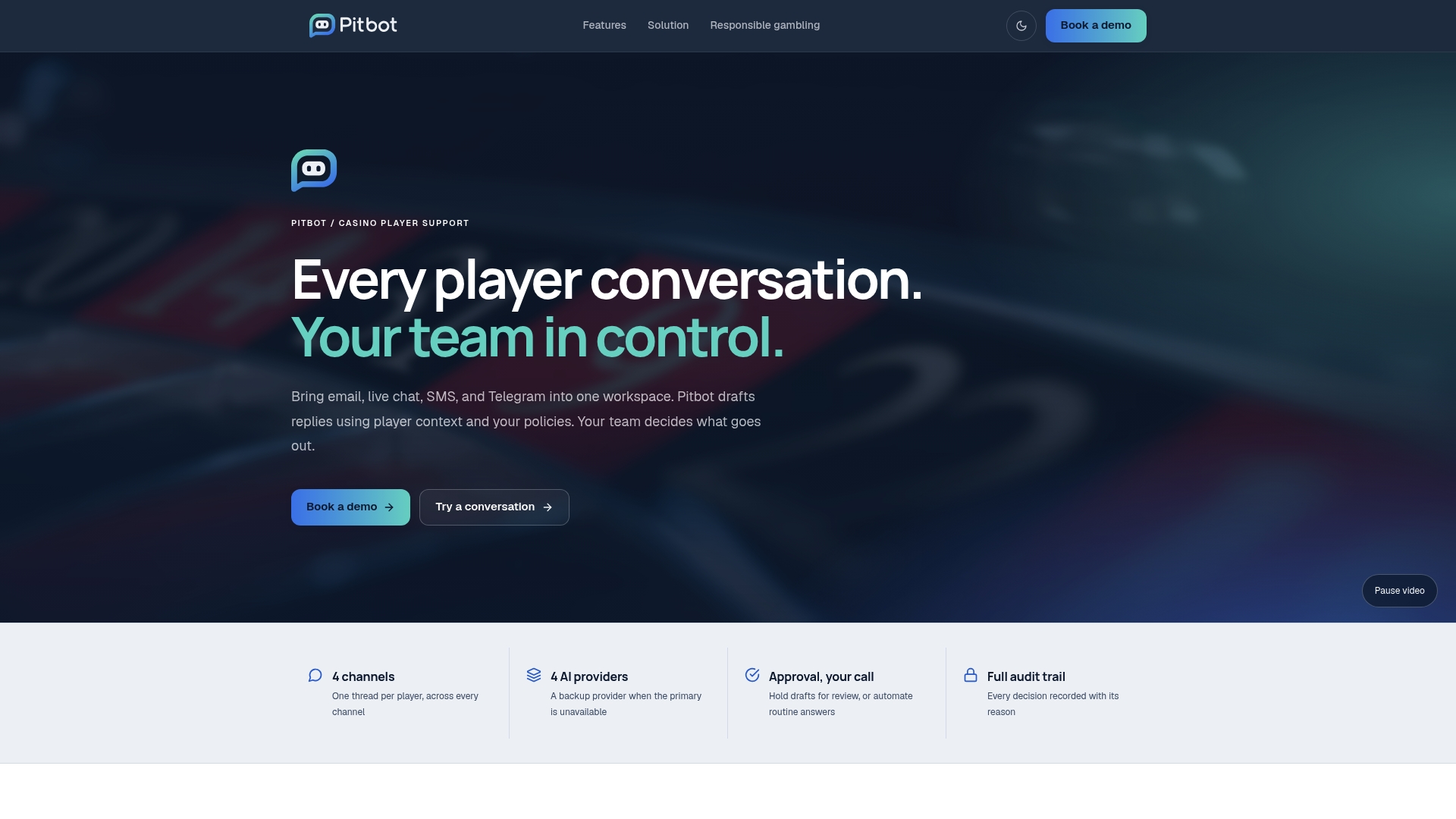
- Multi-provider AI with staff approval: you can hold AI-drafted replies for staff approval; with auto send off, AI-drafted replies on email, live chat, SMS and Telegram wait for staff approval before they reach a player.
- Omni-channel coverage: email, live chat, SMS and Telegram managed from one workspace.
- Thread assignment and VIP level: thread assignment keeps a VIP’s conversation with a named owner, with handover history, and VIP level sits on the player profile as an attribute you can filter segments and analytics by.
- Responsible gambling suppression: self-excluded and cooling-off players, and anyone with an open sensitive case, are kept out of marketing outreach. Responsible gambling and regulator flags on email, live chat, SMS and Telegram are a hard stop: the thread is escalated to a person instead of answered, and a sensitive case opens for someone to pick up.
- Audit trails: an append-only log of CRM changes, campaign approvals that record who approved and when, and a record of who approved each reply that was signed off.
If you are weighing up how to move from manual VIP handling to a system that automates the routine work without losing oversight, our online casino customer support platform is built for exactly that handover. You can see the detail on our features page or book a demo to walk through how it fits your current VIP workflow.
This article is general information, not a substitute for advice from a qualified lawyer. Consult a qualified legal professional about your own circumstances before acting on anything here.
FAQ
What counts as a VIP for retention messaging purposes?
A VIP segment typically blends spend thresholds over a rolling window with frequency, recency and engagement signals, not deposit size alone. Risk markers such as self-exclusion history or sudden deposit spikes should exclude a player from VIP treatment regardless of value.
Which channel works best for urgent VIP offers?
SMS suits urgent, time-limited notices such as expiring points because short, unambiguous messages perform best in that format. Email and chat suit longer explanations, policy updates and high-touch conversations.
How do responsible-gambling rules affect VIP reward messaging?
Regulatory guidance requires that VIP rewards never be framed as aspirational incentives, and operators must run affordability checks and keep full audit trails, as set out in the BGC code of conduct for VIP reward programmes. Messaging should describe perks as service benefits rather than status to chase.
How much can better retention actually improve profit?
A 5% improvement in retention can increase profits by 25 to 95%, according to Bain & Company’s cross-industry research by Frederick Reichheld; it is not a gambling-specific figure. That outsized impact is why even modest, well-targeted retention gains justify investment in segmentation and compliance infrastructure.
Does Pitbot help operators manage VIP messaging compliantly?
Our platform combines multi-provider AI drafting with the option to hold AI-drafted replies for staff approval, and thread assignment keeps a VIP’s conversation with a named owner. Suppression rules keep self-excluded and cooling-off players, and anyone with an open sensitive case, out of marketing outreach, and who approved each reply that was signed off is recorded. You can read more on our features page.
Sources
- High value customers: industry guidance - Executive summary
- BGC code of conduct: high value customer VIP reward programmes
- The impact of personalized feedback interventions by a gambling operator on subsequent gambling expenditure in a sample of Dutch online gamblers
