

Yes, AI can run inside licensed online casino operations, but only under one condition: every AI-generated decision needs a human reviewer, an auditable log, and a documented escalation path before it touches a player. Regulators including the UK Gambling Commission accept automated monitoring, but never as a substitute for individual case review. Platforms built around that principle, such as Pitbot, are the ones that survive an audit.
TL;DR:
- Regulators require every AI decision in licensed casinos to be reviewed manually, logged with detailed data, and have a documented escalation process.
- Effective workflows must assign risk tiers, enforce mandatory review actions, and capture override reasons to ensure accountability during audits.
- Scaling AI involves staged pilots with conservative thresholds, tracking overrides for continuous improvement, and regular model validation against current regulations.
- Operational and safety metrics, such as override rates and harm indicator reductions, are essential to prove human oversight is actively managing AI decisions.
- AI systems should integrate audit logs directly with regulatory reporting schemas, facilitate cross-channel data consolidation, and include clear procedures for incident response and data retention.
Table of Contents
- What regulators expect from AI in regulated markets
- Audit-ready compliance checklist for AI-driven player support and VIP workflows
- Designing human-in-the-loop workflows that actually work
- How to roll out AI safely from pilot to full deployment
- Metrics that prove human oversight is real
- Connecting AI outputs to your regulatory reporting systems
- Building a risk assessment framework for AI in online casinos
- Keeping AI models validated as regulations evolve
- What to do when an AI system causes a compliance breach
- Handling player data under regulated-market privacy rules
- A provider’s honest view on human oversight in iGaming AI
- Pitbot: built for AI in regulated markets from day one
- Primary guidance to keep in your audit pack
- Sources
What regulators expect from AI in regulated markets
LCCP Social Responsibility Code Provision 3.4.3 sets the baseline for anyone deploying AI in regulated iGaming operations, and the Gambling Commission’s separate formal guidance on customer interaction (June 2022) spells out how it expects licensees to meet it. Both are stricter than most operators assume. Licence holders must monitor customers for indicators of harm, act on those indicators without delay, and never let an automated system make the final call on an individual case. The rule is not “use AI carefully.” It is “use AI, but keep a person accountable for what happens next.”
The code provision names seven categories of indicators operators must take into account:
- Customer spend
- Patterns of spend
- Time spent gambling
- Gambling behaviour indicators
- Customer-led contact
- Use of gambling management tools
- Account indicators
The June 2022 formal guidance adds a practical nuance: automated blocks are acceptable when harm indicators are severe enough, provided the block triggers manual review and gives the customer a route to appeal. Speed matters, but so does the paper trail behind the speed.
Separately, UK GDPR Article 22 gives individuals the right not to be subject to a solely automated decision that significantly affects them, and to contest one. That requirement rules out any AI system that resolves harm cases without a reviewer attached, no matter how accurate its predictions are.
Audit-ready compliance checklist for AI-driven player support and VIP workflows
Auditors don’t ask whether your AI works. They ask whether you can prove a human was accountable for every decision it made. Build the following into your governance model before you scale anything.
- Assign a risk tier to every AI action. Match oversight mode to impact: HITL (human-in-the-loop, synchronous approval) for anything touching account blocks, VIP concessions, or responsible gambling flags; HOTL (human-on-the-loop, monitored with alarms) for moderate-impact actions like tone adjustments in chat replies; HOOTL (human-out-of-the-loop, sampled audit only) for low-risk tasks such as FAQ deflection.
- Log every AI decision with a fixed field set. A defensible audit trail captures the prediction ID, model version, input data, generated output, confidence score, reviewer identity, override rationale (if any), and a timestamp. Miss one field and the log stops being evidence.
- Document reviewer competency, not just reviewer existence. Regulators expect proof that reviewers hold system-specific AI literacy and are re-tested periodically, not a one-off induction session.
- Schedule post-deployment model reviews. A model that passed validation in January can drift by June. Build a recurring review into the calendar, not a one-time sign-off.
Pro Tip: Keep your audit log queryable by override rate, not just by individual case.
Codebridge’s research on audit controls makes the point sharply: audit trails only earn their keep when used for pattern analysis, spotting automation bias or reviewer disengagement before an inspector does.
Designing human-in-the-loop workflows that actually work
Most “human-in-the-loop” systems are performative. A reviewer clicks “approve” fifty times an hour without reading anything, because the interface makes approval one click and override ten. Regulators and auditors are increasingly wise to this. What they inspect is not the label, but the evidence that review changes outcomes.
Get the interface right and the label becomes true:
- Use progressive disclosure so reviewers see the AI’s reasoning and confidence score before the recommended action, not after.
- Force an affirmative action for every approval; never let a default “accept” sit pre-selected.
- Make override and confirmation cost the same number of clicks. The reason is simple: if overriding takes more effort than approving, reviewers will approve, and you’ve built a rubber stamp with extra steps.
- Route low-confidence outputs to a second reviewer automatically, rather than trusting the first reviewer’s judgement alone on borderline cases.
Evolve AI’s research into human-in-the-loop patterns recommends confidence-threshold routing as the backbone of this design: anything below your set threshold gets flagged for synchronous review, anything above moves through faster, monitored channels. Add workload safeguards too. A reviewer handling 300 escalations a shift will start rubber-stamping regardless of interface design, so cap queue depth per reviewer and rotate high-stakes cases.
When an override happens, capture the reasoning in structured fields, not free text nobody reads later: what the AI recommended, what the reviewer decided instead, and why. That justification field is often the single most valuable line in the entire audit trail during a regulator’s inspection.
How to roll out AI safely from pilot to full deployment
Scaling AI in a licensed casino operation without a staged plan is how operators end up explaining a compliance breach to a regulator instead of a growth number to a board. Move through stages deliberately.
- Pilot with conservative thresholds. Run the AI system in shadow mode or with a small live sample, keeping HITL review on every single output regardless of confidence score. Define your acceptance metrics before the pilot starts, not after you see the results.
- Track overrides as design input, not noise. Every override a reviewer makes during the pilot should feed back into your standard operating procedures and, where relevant, into model rules. If reviewers consistently override VIP tone recommendations, that’s a signal to retrain, not a rounding error.
- Set numeric gates for loosening oversight. A system should earn reduced oversight only after it demonstrates sustained accuracy against documented safety KPIs, not after a subjective “it seems fine” review.
- Document every governance decision. When you move a task from HITL to HOTL, write down what evidence justified the move, who approved it, and what would trigger reverting it. Auditors will ask for this record specifically.
- Sample-audit even fully scaled tasks. Once a task earns HOOTL status, it still needs periodic sampled review. A defensible structure has three tiers: synchronous HITL, alarmed HOTL, and sampled-audit HOOTL, each with its own documented acceptance criteria and sampling methodology.
Metrics that prove human oversight is real
A governance model without metrics is a policy document nobody checks. Track these on a fixed cadence, weekly at minimum for high-risk tiers.
Operational metrics tell you whether the system is efficient: AI resolution rate, override rate, corrected error rate, time-to-resolution, and reviewer queue depth. Safety metrics tell you whether it’s actually safe: reduction in harm indicators following an intervention, false-negative and false-positive rates on responsible gambling flags, and escalation latency from flag to human action.
- Run sampled audits on approved (not just overridden) decisions, since reviewer agreement drift often hides in the cases nobody questioned.
- Track reviewer agreement rate against a second reviewer on a rotating sample.
- Flag any reviewer whose override rate falls to near zero. That is often the first sign of rubber-stamping, not competence.
Codebridge’s analysis of audit and approval controls treats override-rate and agreement-rate analytics as the real evidence that governance is active, distinct from the log simply existing on file.
Connecting AI outputs to your regulatory reporting systems
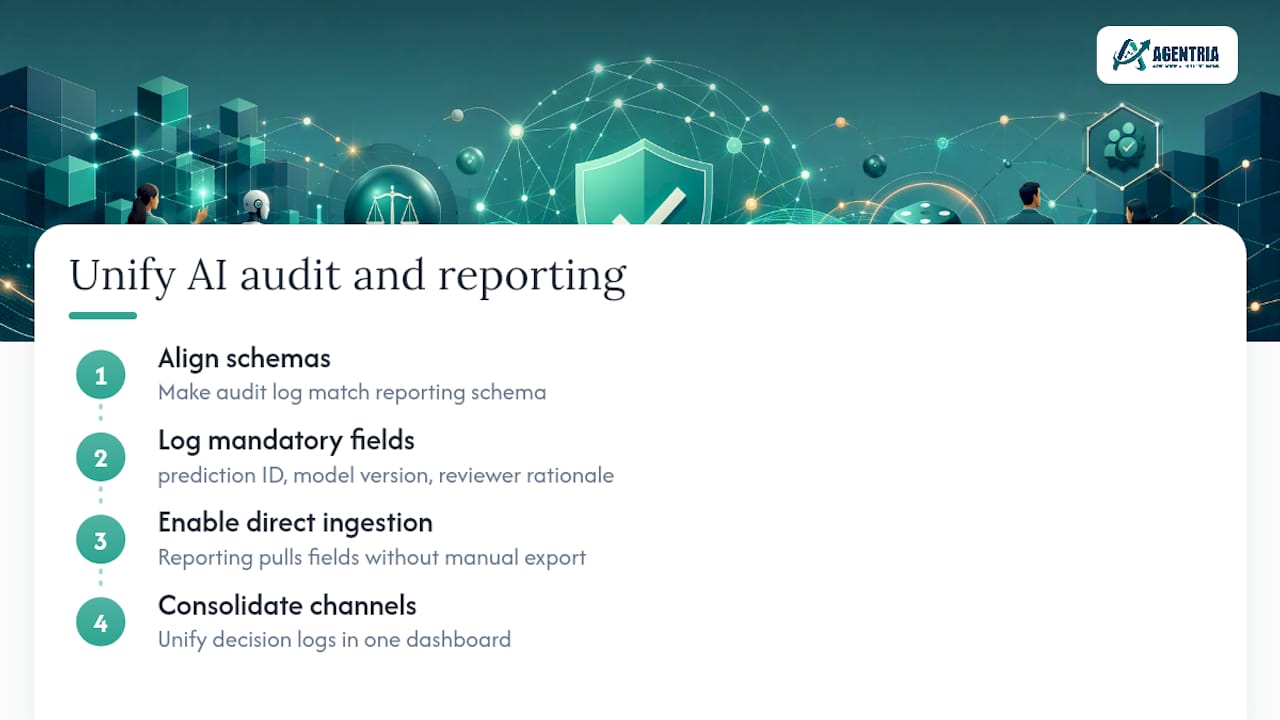
An AI system that generates decisions your reporting stack can’t ingest creates a second compliance problem on top of the first. Regulatory reporting for licensed operators typically expects structured, timestamped records tied to individual customer accounts, and your AI audit trail needs to feed that structure directly rather than sitting in a separate log nobody reconciles.
The practical fix is treating the audit log schema and the regulatory reporting schema as the same document from the start. If your AI logs a prediction ID, model version, and reviewer rationale, your reporting system should be able to pull those fields without a manual export-and-reformat step, because that manual step is exactly where records go missing before an inspection.
This matters most for responsible gambling interventions, where the Gambling Commission expects a coherent record of what was flagged, what action was taken, and who approved it. If your AI platform and your regulatory reporting tool don’t share a data model, you end up reconstructing that record under time pressure during an audit, rather than exporting it in minutes.
Operators running multi-channel support, email, live chat, SMS, and messaging apps, face a variant of this problem: each channel can generate its own decision log unless the platform consolidates them. A single dashboard that unifies channel-level AI decisions into one reportable structure removes the reconciliation step entirely, which is one of the more overlooked advantages of consolidating support tools rather than running channel-specific point solutions.
Building a risk assessment framework for AI in online casinos
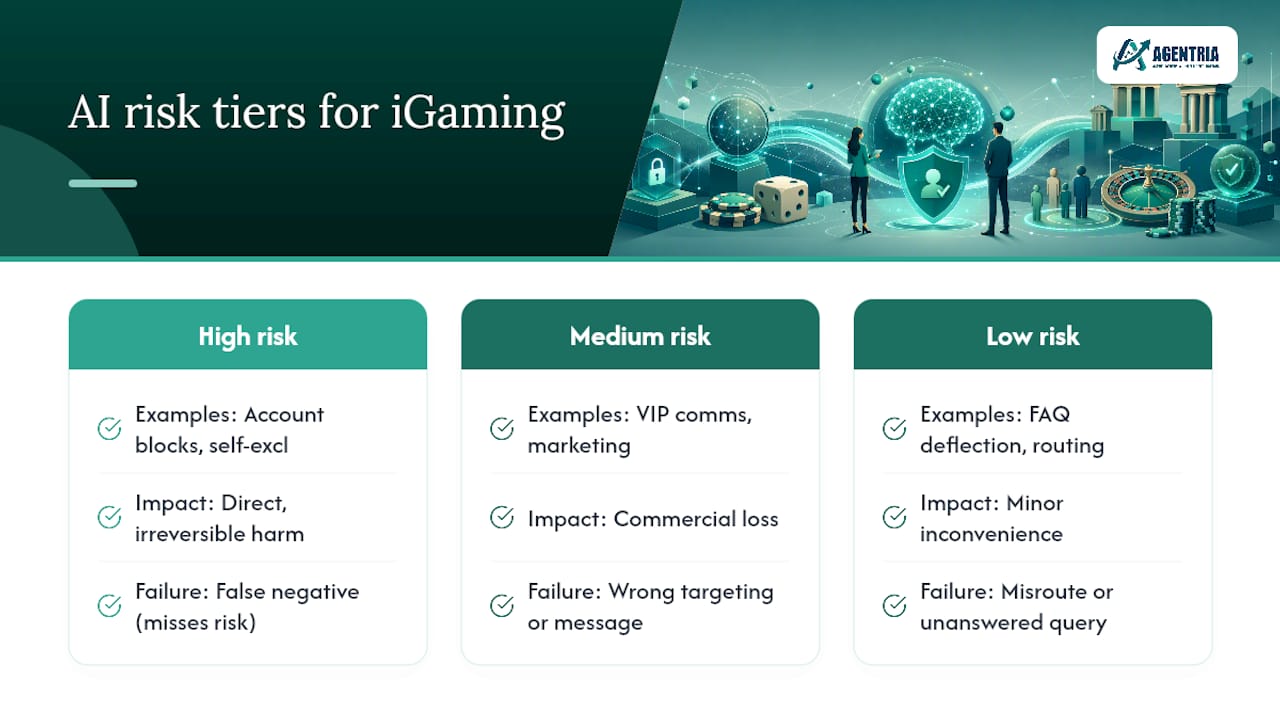
Generic AI risk frameworks don’t map cleanly onto iGaming, because the harm categories are specific: financial loss, gambling harm escalation, and regulatory breach sit alongside the usual data and model-drift risks. A workable framework scores each AI use case against impact and reversibility, not just technical accuracy.
Start by classifying every AI-touched workflow into the same risk tiers used for oversight design. Account blocks and self-exclusion handling sit at the top, because an error there causes direct, sometimes irreversible harm to a vulnerable customer. VIP communication and marketing personalisation sit in the middle, where errors are commercially costly but rarely harmful in the regulatory sense. FAQ deflection and basic query routing sit at the bottom.
For each tier, document the failure mode you’re actually worried about. For account-block decisions, the failure mode is a false negative that lets an at-risk customer keep gambling, not a false positive that inconveniences a safe customer. That asymmetry should shape your confidence thresholds directly, not just your general policy language.
Reassess the framework whenever you change model provider, add a new channel, or expand into a new licensing jurisdiction, since risk profiles shift with each of those changes even if the underlying AI logic doesn’t. A risk framework written once at deployment and never revisited is close to useless by the second regulatory cycle.
Keeping AI models validated as regulations evolve
Gambling regulation doesn’t sit still, and a model validated against last year’s guidance can quietly fall out of compliance without anyone changing a line of code. Continuous validation means testing the model against current rules on a fixed schedule, not just checking accuracy metrics.
Build two separate validation tracks. The first tests model performance: is the AI’s confidence calibration still accurate, is drift showing up in override rates, are false-negative rates on harm indicators creeping upward? The second tests regulatory alignment: does the model’s behaviour still match the current version of the Gambling Commission’s guidance, and have any new indicator categories or reporting requirements been added since the last review?
Reviewer override data is your earliest warning signal on both tracks. A rising override rate on a specific decision type usually means either the model has drifted or the underlying regulatory expectation has shifted, and distinguishing between those two causes is exactly what a documented review process is for.
Set a minimum cadence, quarterly for high-risk decision types, semi-annual for lower-risk ones, and treat any regulatory guidance update as an automatic trigger for an out-of-cycle review regardless of where you are in that schedule. Waiting for the next scheduled review after a rule change is how operators end up compliant on paper and non-compliant in practice for months at a time.
What to do when an AI system causes a compliance breach
An incident response plan for AI failures needs to exist before the first incident, not get drafted during one. The plan should answer four questions immediately: what happened, which customers were affected, what the audit trail shows about who approved the AI’s action, and what needs to change to stop it recurring.
That last point is where the audit trail earns its cost. If every AI decision carries a prediction ID, model version, and reviewer identity, tracing a breach back to its source takes minutes rather than a forensic reconstruction. Without that structure, operators often can’t even establish whether a human reviewed the decision that caused the breach, which turns a fixable process failure into a much harder credibility problem with the regulator.
Define escalation ownership in advance: who notifies the compliance team, who notifies the regulator if required, and within what timeframe. Build a rollback procedure for the specific AI feature involved, whether that means reverting to a previous model version or pulling a decision type back into full HITL review until root cause is confirmed.
Run a post-incident review that updates your SOPs and, where relevant, your model rules, and log that update itself. A breach that doesn’t change a documented process is a breach you’re likely to have again.
Handling player data under regulated-market privacy rules
AI player support systems process sensitive data by design, deposit histories, session behaviour, communication logs, and sometimes health-adjacent signals tied to gambling harm indicators. Regulated markets typically layer data privacy law on top of gambling regulation, and the two don’t always align neatly.
The practical friction point is retention. Gambling regulators often expect long retention windows for audit and dispute purposes, while general data protection frameworks push towards minimisation and defined retention limits. Resolve this by documenting your retention justification per data category rather than applying one blanket policy, since the audit-log fields tied to a responsible gambling intervention likely need a different retention rationale than routine support chat logs.
Cross-border operators face a second layer: player data captured in one jurisdiction, processed by an AI provider hosted in another, reported to a regulator in a third. Map that data flow explicitly and confirm your AI vendor’s data processing location and provider chain, because “the AI provider handles it” is not an answer a regulator or a data protection authority will accept during an inquiry.
Multilingual support introduces its own wrinkle: translated chat logs often lose nuance that matters for harm-indicator review, so retain the original-language version alongside any translation rather than discarding it once a reply goes out.
A provider’s honest view on human oversight in iGaming AI
Governance changes what a reviewer’s job actually is. It stops being “check the AI’s homework” and becomes “own the decision the AI drafted.” Pitbot was built around that distinction: AI drafts are quality-scored and logged against an append-only audit trail, and lower-confidence drafts wait in the review queue for a person to own. Operators who prioritise that readiness over marginal speed gains are the ones who pass their next audit without a scramble.
Pitbot: built for AI in regulated markets from day one
If the checklist above feels like a lot to build in-house, that’s because most operators try to bolt compliance onto an AI tool after the fact instead of starting with it. Pitbot does it the other way round: with auto send off, AI-drafted replies on email, live chat and Telegram wait for staff approval before they reach a player, with the decision and the reasoning behind the draft captured automatically.
That structure maps directly onto the governance model this article has walked through. Risk-tiered oversight shows up as thread assignment: any thread can be routed to a named owner, with handover history, on-shift logic, and a guard that keeps assigned threads with that owner instead of cycling back into automation. The audit trail requirement is native, not bolted on, giving you a queryable log of every prediction, override, and reviewer decision without building that infrastructure yourself. Responsible gambling detection flags harm indicators and suppresses marketing outreach automatically — an open responsible-gambling case is a hard guard no campaign can override — with every suppression recorded in the Suppression Log for review.
If you’re weighing whether to build this governance internally or adopt a platform already designed around it, book a demo and see how the audit trail, VIP workflows, and reviewer dashboard work together on a live account.
Primary guidance to keep in your audit pack
- Gambling Commission — LCCP Social Responsibility Code Provision 3.4.3, remote customer interaction
- Gambling Commission — customer interaction formal guidance for remote gambling licensees (June 2022)
Keep both in your SOPs and evidence pack; auditors expect to see them referenced directly.
Sources
- Gambling Commission — remote customer interaction (LCCP Social Responsibility Code Provision 3.4.3)
- Gambling Commission — customer interaction formal guidance for remote gambling licensees, June 2022 (PDF via Yogonet)
- Codebridge — Human in the Loop AI: approval loops for regulated workflows
- Evolve AI — human‑in‑the‑loop patterns for agentic AI