
Agent assist for casinos is AI that helps your support team answer players faster, instead of replacing the team. It reads the player’s message and account context, drafts a reply, flags sentiment or risk, and leaves a person to approve, edit or escalate. For regulated operators, that human step is the point: you get speed without sending words to a player that nobody accountable has seen.
This guide covers what the term means in an online casino, which queries suit it, how to connect it to your systems, which measures show whether it works, and where human judgement must stay.
TL;DR
- Agent assist means AI prepares the work (context, draft, sentiment, escalation) and a human agent decides what reaches the player.
- It fits high-volume, fixed-procedure queries such as login help, bonus eligibility, payment status and KYC guidance. Responsible gambling, complaints and suspected fraud should be prepared by AI and decided by people.
- Integration depth sets the ceiling: a tool linked only to a help centre can answer questions, while one linked to your operator systems can help close tickets.
- Judge it on verified resolution, time to resolution, escalation quality and repeat contacts, not on deflection alone.
- Our platform, Pitbot, is built on this model: every AI-generated reply is reviewed by your staff before it is sent, and each decision leaves an audit trail.
Table of Contents
- What agent assist means in an online casino
- How agent assist works during a player interaction
- Which queries suit agent assist, and which need a person
- Capabilities worth looking for
- Integrating with your existing systems and channels
- Measuring whether it works
- Responsible gambling and vulnerable players
- Data protection, security and the regulatory picture
- Our perspective
- Where Pitbot fits
- A practical checklist before you start
- FAQ
- Sources
What agent assist means in an online casino
In a general contact centre, agent assist is software that listens or reads alongside a human agent and suggests answers, next steps and summaries. In an online casino the idea is the same, but the context is richer and the stakes are higher. A player asking “where is my withdrawal?” is asking about money, identity checks and possibly a bonus condition, all at once.
Industry material describes the more capable versions as software that connects to operational systems such as the player account management platform and the CRM. It can then check account status or apply a bonus, rather than just return a paragraph of text (Agentic AI Support in iGaming). The same source separates these tools from simple chatbots, which typically match a message to a knowledge base article and reply with text.
That gives you a useful spectrum:
| Approach | What it does | Who decides |
|---|---|---|
| Basic chatbot | Matches the message to a help article | Nobody, the reply goes straight out |
| Agent assist (draft and review) | Reads context, drafts a reply, flags sentiment and risk | A human reviews every reply |
| Autonomous agent | Acts in your systems without a person in the loop | The software, within defined rules |
For a regulated casino, the middle row is where most operators are comfortable starting. It captures the speed gain on the routine work and keeps a named person accountable for what players are told.
How agent assist works during a player interaction
The sequence is short, and each step is a place where time is saved or risk is caught.
- The message arrives. It might come by email, live chat, SMS or Telegram. Players use all of these, and answers should not depend on which one they picked.
- The AI reads the request and the context. It looks at who the player is, what they have recently done and whether there are open tickets. According to the industry description above, the stronger tools pull live data to understand the player’s history.
- It works out what kind of query it is. A password reset follows a fixed procedure. A complaint about a self-exclusion does not.
- It drafts a reply in the right language and tone, following the operator’s rules for that type of query.
- It flags what a person needs to know: sentiment, VIP status, signs of distress, anything that suggests a responsible gambling concern.
- A human approves, edits or escalates. Only then does the message go to the player.
The agent never starts from a blank screen, and never has to hunt through three systems to find out whether a deposit cleared. What they do is judge: is this right, is this the right tone, is this a case for someone senior?
Which queries suit agent assist, and which need a person
Not every ticket deserves the same treatment. The most useful way to plan is to sort your queue by how procedural it is.
High-volume, fixed-procedure queries
The industry source above lists password and login help, bonus eligibility, deposit and withdrawal status, and KYC document guidance as the typical high-volume, procedure-driven tickets (Agentic AI Support in iGaming). These are the queries where a draft is almost always right and a reviewer can approve it in seconds. They are also the ones that fill a queue on a Friday night.
Judgement-heavy queries
The same source says responsible gaming signals, complaints, suspected fraud and licence-specific escalations are usually assisted rather than automated: the AI prepares the case and a human decides. We agree, and we would go further for operators in regulated markets: those are the cases where the preparation matters most. A good summary of the player’s recent activity, the history of contact and the relevant policy can turn a ten-minute investigation into a two-minute decision.
If you want a worked view of how to split a queue between routine and risky, our article on automating routine queries and escalating risk goes through five typical cases.
Capabilities worth looking for
When you compare tools, check the capabilities against the real work of a casino support desk:
- Account context in the reply. The draft should reflect the player’s actual situation, not generic wording.
- Defined workflows for bonuses, payments and verification, so replies follow your rules every time.
- Sentiment detection and escalation. An angry or distressed message should jump the queue and reach someone senior.
- VIP queue management. High-value players expect a different pace and tone, and agents need to see that at a glance.
- Multi-channel handling. Email, live chat, SMS and Telegram in one workspace, so context is not lost between channels.
- Multilingual drafting, because player bases rarely speak one language.
- Responsible gambling signals that can also suppress marketing outreach to the player concerned.
- An audit trail showing what the AI drafted, who approved it and what was sent.
- Analytics by channel, query type and agent.
The last two are easy to undervalue at purchase and hard to live without at audit time. For the compliance angle in detail, see our playbook on human-reviewed AI in regulated markets.
Integrating with your existing systems and channels
The integration question decides how much value you get. One industry description puts it plainly: an agent connected only to a help centre can deflect questions, while connections to operator systems can help it close tickets (Agentic AI Support in iGaming). In casino terms, that means thinking about three layers.
Knowledge. Your policies, bonus terms, payment guides and tone-of-voice rules. This is the minimum, and it is where most projects start.
Player data. Account status, verification state, recent transactions, open tickets and VIP tier, usually held in your player account platform and CRM. This is what makes drafts specific rather than generic.
Channels. Wherever players already talk to you. Adding a channel should not mean adding a new inbox for the team to watch.
A sensible rollout order is: start with one or two channels and your most procedural query types, keep every reply under human review, check the draft acceptance rate for a few weeks, and only then widen the scope. Our features page shows how channels, personas, queues and analytics sit together in a single dashboard.
Measuring whether it works
The worst way to judge agent assist is by how many conversations the AI “handled”. A deflected ticket is not a solved one. A support analytics article from a helpdesk software company makes this point and suggests a broader set of measures: verified automated resolution, time to resolution, human response time on escalated cases, customer satisfaction, repeat-contact and reopen rates, and the quality and accuracy of escalations (Helpshift on AI support metrics).
For a casino desk, here is a practical scorecard:
| Measure | Why it matters | What to watch |
|---|---|---|
| First response time | Players waiting on a withdrawal get anxious fast | Split by channel and VIP tier |
| Time to resolution | Shows whether drafts really close issues | Compare routine and complex queries |
| Draft acceptance rate | How often reviewers send the draft unchanged | Falling rates point to knowledge gaps |
| Reopen and repeat-contact rate | Reveals answers that sounded right but were not | Spikes after policy changes |
| Escalation accuracy | Did the right cases reach the right people? | Review a sample weekly |
| Satisfaction score | The player’s own verdict | Track against a pre-rollout baseline |
Operators sometimes ask what improvement is realistic. One published example: a US betting and gaming company reported that its multi-agent support system achieved roughly a 56% improvement in containment and 53% in resolution rates within two months of deployment (AWS Machine Learning Blog). That is one company’s own report on its own set-up, so treat it as an illustration of what is possible and set your own baseline before you compare.
If your team works to UK licensing expectations, our guide to casino support KPIs shows how to tie these measures to compliance, and our piece on support accuracy benchmarks covers how to test draft quality.
Responsible gambling and vulnerable players
This is where agent assist earns or loses trust. A tool that is quick but blind to a distressed player is a liability. Three principles help.
Detect early, and route to a person. Signals in the message itself, such as frustration, mentions of losses or talk of being unable to stop, should lift the ticket to a trained agent with the context ready. The AI prepares, the human decides.

Pause the marketing. A player flagged for concern should not receive promotional messages while the case is open. Linking detection to outreach suppression closes a gap that separate support and marketing tools often leave open.
Keep the record. If you ever need to show why a player was treated in a particular way, the draft, the reviewer and the final message all need to be on file.
We cover this in more depth in our guides to responsible gambling automation and high-risk player monitoring in the UK.
Data protection, security and the regulatory picture
Regulators are paying attention to AI in gambling, and operators in any market can learn from the direction of travel. In May 2026, the Malta Gaming Authority and the Malta Digital Innovation Authority opened a public consultation on a proposed voluntary, principles-based AI Gaming Charter. The proposed guidance encourages safeguards for personal data, and regular testing and monitoring of algorithms for errors, unintended outcomes or discriminatory patterns (Yogonet).
When the charter was later published as a voluntary framework, coverage highlighted risks operators should weigh: risk models may reflect commercial interests, fraud models may wrongly flag legitimate customers, and customer-facing models may say things the operator never authorised (iGaming Times).
The charter is Maltese and voluntary, so it is not a rule for UK-licensed operators. But the three risks translate into practical checks for any operator:
- Unauthorised statements. The simplest control is for a person to read every outgoing reply. Review also gives you a place to catch invented promises about bonuses or withdrawal times.
- False flags. Treat any automated risk or fraud signal as a prompt for a human decision, and measure how often the decision overturns the flag.
- Personal data. Decide what player data the AI may see, where it is processed, and who can read the logs. Ask your vendor and your data protection lead before go-live, not after.
- Ongoing testing. Sample drafts every week, track errors by query type, and re-test after any policy or bonus change.
Check the current requirements of your own licensing authority for anything binding. They differ by jurisdiction and change over time.
Our perspective
We built Pitbot on a simple conviction: in a regulated market, speed and accountability are not a trade-off, provided a person stays in the loop.
Most of the pressure on a casino support desk comes from a small set of procedural questions, and most of the risk comes from a different, smaller set of sensitive ones. Treating them the same way is what goes wrong. So in Pitbot, AI from multiple providers drafts the reply, and your staff review every reply before it reaches a player. Routine queries move quickly because the reviewer is approving, not writing. Sensitive ones arrive already summarised, with sentiment and context attached, so the human can spend their time on judgement.
We also think the record matters as much as the reply. Every decision leaves an audit trail, and responsible gambling signals can suppress marketing outreach, so support and compliance work from the same facts. For compliance officers, that turns “how do we know what was said, and why?” into a question with a ready answer.
Agent assist should make your best agents more effective and your newest agents safer. That is the standard we hold the product to.
pitbot
Where Pitbot fits
Pitbot is an AI player support platform for online casino and iGaming operators. It combines email, live chat, SMS and Telegram in one dashboard, with human review of every AI-generated reply, sentiment detection and escalation, VIP queue management, customisable support personas, multilingual replies, audit trails and analytics. If you are weighing up agent assist for your own desk, the quickest way to see it is through your own queue types. Start with AI customer support for online casino and iGaming operators or visit the Pitbot homepage to book a demo.
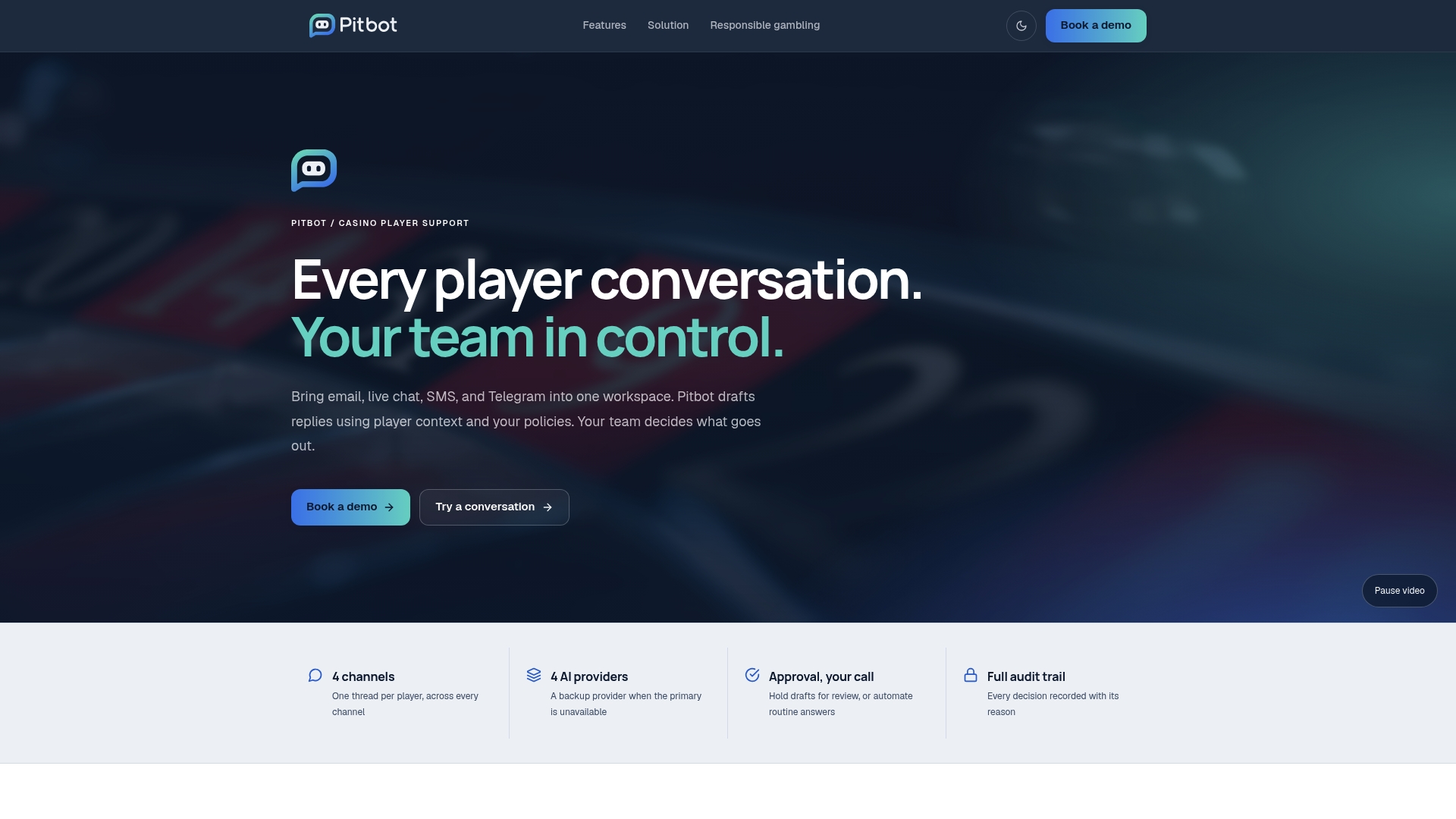
Bring your five most common query types and your current response-time figures to the demo. That is enough to map where drafts would help first.
A practical checklist before you start
- List your top ten query types by volume and mark each as procedural, mixed or judgement-heavy.
- Set a baseline for response time, resolution time, reopen rate and satisfaction on those types.
- Decide the review rule. Who approves what, and who handles escalations out of hours?
- Write down the red lines: topics the AI must never answer on its own, such as self-exclusion, complaints and suspected fraud.
- Choose the pilot scope: one or two channels, the procedural query types, and a fixed period before widening.
- Agree the audit requirements with compliance: what is logged, for how long, and who can retrieve it.
- Review weekly. Sample drafts, read the corrections agents make, and feed them back into the knowledge and rules.
Teams that do this groundwork tend to find the technology the easy part. The harder, more valuable work is deciding what good looks like for your players.
FAQ
Is agent assist the same as a casino chatbot?
No. A basic chatbot matches a message to a help article and replies with text, usually with no one checking it. Agent assist prepares context and a draft, and a human agent reviews it before it reaches the player. In a regulated market that difference matters.
Can agent assist handle responsible gambling cases?
It can help by spotting signals, summarising the player’s history and putting the case in front of a trained person quickly. The decision should stay with a human. Industry guidance describes these cases as assisted rather than automated, and we build Pitbot on that basis.
Which channels can it cover?
In Pitbot, the channels are email, live chat, SMS and Telegram, managed from one dashboard so that context follows the player between them. When you assess any tool, check that each channel you actually use is supported and that replies in every channel go through the same review.
How do I know if it is working?
Track verified resolution, time to resolution, reopen and repeat-contact rates, escalation accuracy and satisfaction against a baseline taken before launch. Do not rely on deflection alone, because it does not show whether the player’s problem was actually solved.
Sources
- Agentic AI Support in iGaming
- Helpshift: key metrics for AI-enhanced support
- AWS Machine Learning Blog: multi-agent customer support for betting and gaming
- Yogonet: Malta Gaming Authority opens consultation on AI Gaming Charter
- iGaming Times: Malta’s regulator publishes a voluntary AI charter

