
Context-aware support means an AI system that remembers what a customer already told you, where they are in your product, and what your policies allow, before it answers. The payoff is concrete: fewer repeat explanations, faster resolution, and responses that feel personal rather than scripted. In research on retrieval-based dialogue systems, models that adapt to the context of a multi-turn conversation select better responses than models that ignore it, and platforms like Pitbot apply the same principle to regulated player support.
TL;DR:
- Effective context-aware support systems must manage multi-turn conversations, customer profiles, page awareness, and grounded knowledge sources simultaneously.
- Grounded responses rely on clever retrieval, query rewriting, and response rephrasing to maintain accuracy, speed, and tone control, but increase latency and staleness risk.
- Cross-channel consistency requires a single canonical identity store, scoped memory with decay, and sharing summaries when escalating to human support.
- Starting with a narrow pilot focused on one workflow and layer-specific context schemas helps avoid delays and enables measurable improvements.
- Key metrics to evaluate success include ticket deflection, customer satisfaction, first contact resolution, and low latency, with enterprise platforms emphasizing auditability and compliance.
Table of Contents
- What makes a support system genuinely context aware?
- The technical stack behind context-aware responses
- How do you keep context consistent across channels?
- Building a context-aware support pilot: a practical checklist
- Which metrics actually prove context-aware support works?
- How Pitbot applies these patterns in regulated iGaming support
- What operators consistently get wrong first
- A practical next step for regulated operators
- Sources
What makes a support system genuinely context aware?
Most “smart” support tools recognise keywords. Genuinely context-aware systems recognise situations. The difference shows up in four capabilities, and a system missing any one of them will produce answers that feel technically correct but practically useless.
- Conversation history and multi-turn management. The system tracks what was said three messages ago, not just the last one, so a customer does not have to repeat their account number after switching topics mid-chat.
- Customer profile and account data integration. Tier, purchase history, open tickets and previous resolutions all feed into the response, so a VIP customer doesn’t get a generic script.
- Page or workflow awareness. The system knows which screen a customer is stuck on, or which step of checkout failed, without being told.
- Grounding against knowledge bases and documents. Policy answers come from a verified source rather than a model’s best guess.
A retail chatbot that remembers a customer mentioned a delayed order two messages earlier, then automatically surfaces the tracking number without being asked, is doing multi-turn management correctly. An in-app help widget that changes its suggested articles based on which settings page is open is doing workflow awareness correctly. Neither trick is exotic. Most support tools simply never build them.
The technical stack behind context-aware responses
Underneath the conversational polish sits a fairly standard architecture, and understanding its pieces matters if you’re planning an integration rather than just buying a demo.
Session memory holds the active conversation state, tied to a resolved customer identity so the same person is recognised whether they arrived via chat, email or SMS. Retrieval systems, usually built on embeddings and vector search, pull relevant knowledge base articles or policy documents and rank them by relevance before the model ever sees them. One study of an omnichannel conversational search system combining session memory with retrieval-based grounding reported better context continuity across voice and web channels, which is exactly the problem enterprise teams run into when channels don’t share state.
Three refinements sit on top of that base layer:
- Query rewriting cleans up ambiguous or incomplete customer input using session context before it hits retrieval, which improves the accuracy of everything downstream.
- Response rephrasing takes a templated, compliant answer and adjusts its tone using conversation context, an approach Rasa’s documentation recommends specifically because it preserves controllability rather than letting a model free-write.
- Function calling lets the system actually do something, such as pulling a live order status, rather than describing what it would do.
None of this is free. Every additional retrieval call adds latency, and every cached response risks going stale. Teams need to decide, deliberately, where the cost of a fresh lookup is worth the wait.
Pro Tip: Cache grounded answers to static policy questions aggressively, but never cache anything touching account balance, bonus eligibility or KYC status. Stale money-related answers are the fastest way to generate a compliance incident.
Privacy sits underneath all of it. Session stores need field-level redaction and data loss prevention controls, particularly when conversation logs contain payment details or identity documents, because a retrieval system will happily surface anything it was allowed to index.

How do you keep context consistent across channels?
Most cross-channel failures aren’t a model problem. They’re an architecture problem: nobody built a canonical store that every channel writes to and reads from. Few organisations preserve full context across channels, and the difference between fragmented and unified support shows up directly in customer satisfaction and, over time, in customer lifetime value.
Four patterns fix this reliably:
- Single canonical identity with write-through memory. Every channel writes updates to one shared store keyed to a resolved customer ID, rather than maintaining its own local memory that other channels can’t see.
- Scoped memory with temporal decay. Not every past interaction deserves equal weight; older context should compress and fade rather than bloating every prompt indefinitely.
- Handoff summaries for human escalation. When a case moves to a live agent, that agent needs a compressed summary of what the AI already tried, not a raw transcript dump.
- A channel-consistency controller. Something has to reconcile conflicting updates when a customer messages support on Telegram while a live chat session is still technically open.
A write-through memory store keyed to canonical identity is the single highest-leverage fix here, because it’s the architectural decision every other pattern depends on. Get identity resolution wrong and no amount of clever retrieval will paper over it.
Building a context-aware support pilot: a practical checklist
Enterprise teams almost always overreach on the first attempt, trying to context-enable every channel and every workflow at once. That’s the fastest way to produce a system that’s slow, expensive and hard to debug. Scope down instead.
- Pick one surface and one contained workflow. Live chat handling deposit queries, for instance, not the entire support estate.
- Design a context schema with distinct layers. Separate policy knowledge, customer profile, current conversation and prior history, and ground retrieval against each layer explicitly rather than dumping everything into one prompt.
- Set a history budget. Decide how many turns or tokens of past conversation actually enter each prompt, and apply compression once you exceed it.
- Implement grounding with semantic chunking and re-ranking. Break knowledge base documents into meaningful chunks rather than arbitrary page splits, then rank retrieved chunks by relevance before the model sees them.
- Add query rewriting for ambiguous inputs, using session context to refine the query rather than passing raw customer text straight to retrieval.
- Define your test suite before launch. Deflection rate, CSAT delta versus the current process, and p95 latency, measured on the same cohort.
- Set roll-out gates. Move to the next channel only once the pilot clears its own thresholds, not on a calendar date.
Pro Tip: Start with page or product awareness before you touch full profile integration. Progressive context enrichment proves value fastest because it’s low risk and the improvement is immediately visible to whoever is funding the project.
Which metrics actually prove context-aware support works?
Four numbers matter more than the rest: ticket deflection, CSAT (or NPS), first contact resolution, and average handle time. Deflection tells you whether customers are solving problems without a human at all; the other three tell you whether the humans who do get involved are working faster and leaving customers happier.
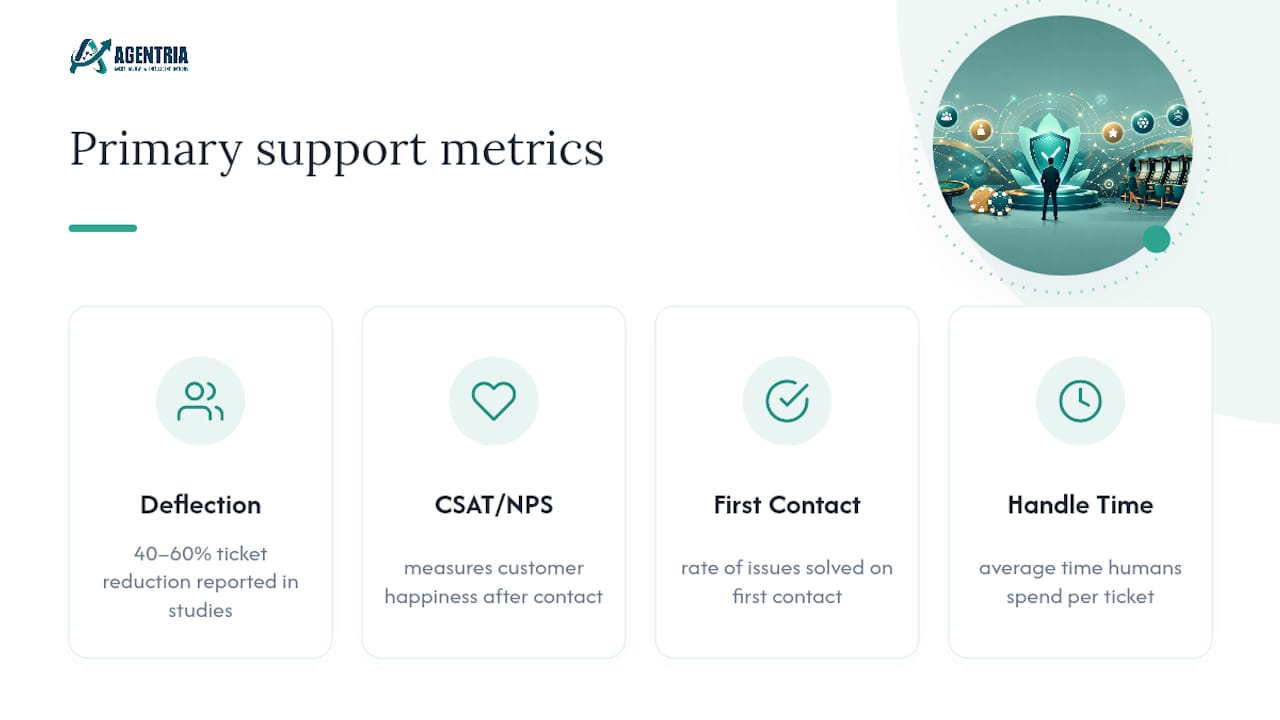
Published case studies on in-app contextual help report ticket reductions in the 40 to 60% range, though that figure comes from vendor-reported cases and varies heavily by industry and baseline maturity, so treat it as a plausible target range rather than a guarantee.
Operationally, track p95 latency (not average, which hides the slow tail that frustrates users most), cost per solved query, and a context utilisation rate, meaning how often retrieved context actually gets referenced in the final answer rather than ignored. Run improvements as proper A/B tests with a held-out control group, and build compliance guardrails into the test itself, not as a review step afterwards.
How Pitbot applies these patterns in regulated iGaming support
Regulated markets add a constraint most context-aware support guides skip entirely: every AI-generated answer needs an audit trail explaining why it was allowed to go out. Pitbot’s human-in-the-loop review is built for that: with auto send off, AI-drafted replies on email, live chat and Telegram wait for staff approval before they reach a player, and the decision is logged for compliance review.
That same context layer feeds Pitbot’s omnichannel support across email, live chat, SMS and Telegram, so a VIP player’s history follows them regardless of which channel they use next. Multilingual handling and automated sentiment detection draw on the same profile and conversation context, flagging escalations or responsible gambling concerns before they become a retention or compliance problem. The full feature set maps closely to the architecture checklist above: identity resolution, grounded retrieval, and human oversight, built for an industry where getting an answer wrong carries regulatory consequences, not just an annoyed customer.
What operators consistently get wrong first
Three priorities matter more than the rest. Fix identity resolution and grounding before anything else, because every other pattern depends on them. Pilot narrowly, measure honestly, and let the data decide whether to expand. Build for auditability from day one, since retrofitting a human-review trail onto a live system is far harder than designing it in.
The failure mode worth watching for isn’t a rude AI response. It’s an ungrounded one: a system confidently answering a policy question from training data instead of your actual terms, or a context window so bloated with irrelevant history that it quietly drops the one fact that mattered.
A practical next step for regulated operators
Pitbot was built specifically for casino operators who can’t afford to choose between speed and compliance. You can hold AI-drafted replies for staff approval before they reach a player, which means faster response times without handing regulatory risk to an unsupervised model. That design choice, human oversight paired with AI drafting, addresses a gap many generic support platforms do not close for regulated markets.
Across email, live chat, SMS and Telegram, Pitbot keeps a player’s context intact from first contact to VIP escalation, with a full audit trail attached to every decision. If you’re running player support across multiple channels and need both personalisation and a defensible compliance record, the online casino support platform is worth a closer look, and you can book a demo to see how the review workflow fits your existing team.
Sources
- Adapting to Context-Aware Knowledge in Natural Conversation for Multi-Turn Response Selection (WWW 2021, ACM)
- Omnichannel Conversational Search: Maintaining Context and Consistency Across Voice and Web Interfaces (IJAM)
- Context Engineering for Customer Support Bots | Context Patterns
- Contextual Response Rephraser | Rasa Documentation
- AI Helps In Customer Support: Context-Aware Agents That Cut Tickets By 70% | CustomGPT