
AI casino support uses source-grounded assistants to answer routine player questions, summarise tickets and flag sensitive cases for a human to review. The right setup for a regulated operator pairs that automation with human-in-the-loop sign-off on outgoing messages, so teams get faster replies without losing the compliance record regulators expect.
TL;DR:
- Start with two or three low risk intents, such as payments, verification, or ticket status, and keep self exclusion and financial harm cases human only.
- Under UK rules, operators must manually review automated decisions involving strong indicators of harm and provide players with a route to contest account decisions.
- Log prompts, cited sources, drafts, risk scores, and reviewer decisions; set retention limits and mask personal data before sending information to providers.
- Because sector wide risk benchmarks are still lacking, audit daily random and risk weighted samples, tracking false positives and false negatives by player cohort.
- A six to twelve week pilot should start with two or three intents and one or two channels, then expand only after monitored live testing.
Table of Contents
- Which player queries can AI actually handle today?
- Integrations and architecture: channels, connectors and data flows
- Workflows for safety and quality: human review, escalation and routing rules
- Responsible gambling and regulator expectations operators must meet
- How to measure success: KPIs, validation and benchmarking
- Implementation checklist and pilot plan for support teams
- Applied example: a human-reviewed model for casino support
- Deployment lessons and governance advice worth taking seriously
- How Pitbot can help your support team
- FAQ
- Sources
Which player queries can AI actually handle today?
Most support teams waste pilot time trying to automate everything at once. The better approach picks a handful of high-volume, low-risk intents first and builds confidence before expanding scope.
The clearest wins sit in account administration and transactional questions, where the answer rarely varies and rarely touches a player’s wellbeing:
- Account and verification: password resets, KYC document status, login troubleshooting.
- Payments: deposit and withdrawal timelines, failed transaction explanations, payment method queries.
- Game help: rules clarification, RTP questions, how a bonus round works.
- Promotions: eligibility checks, wagering requirement explanations, expiry dates.
- Ticket status: “where is my request” updates pulled straight from the ticketing system.
VIP players need a different lens. Sentiment-aware triage can flag a frustrated high-value player and route them to a dedicated host within seconds rather than leaving them in a general queue, while a routine VIP query about a reload bonus can still be answered automatically with the same guardrails as any other player.
Some intents should stay human-only during early rollout, particularly anything touching responsible gambling actions such as self-exclusion requests, deposit-limit disputes or a player disclosing financial harm. These require judgement and, in many markets, a documented manual review step before any action is taken.
A workable prompt template for a pilot intent includes the player’s question, the relevant knowledge base article reference, and an explicit instruction to decline and escalate when the query falls outside the approved intent list. Guardrails worth building in from day one: a confidence threshold below which the system escalates automatically, a list of banned topics the assistant must never advise on (legal, medical, financial hardship), and a hard rule that any message mentioning self-harm, debt or exclusion routes straight to a person.
Integrations and architecture: channels, connectors and data flows
Scoping an AI deployment properly means mapping every channel and system it needs to touch before writing a single prompt.
On the channel side, each medium brings its own constraints. Live chat needs low latency and session continuity across page reloads. Email threads require the assistant to parse quoted history without repeating itself. SMS carries strict character limits and no rich formatting, so answers need to be shorter and clearer. Telegram and other messaging apps often carry attachments (screenshots of a failed transaction, for example) that the assistant needs to read or hand off for a human to review.
Behind the scenes, a working deployment typically connects to:
- CRM and player profile systems, so the assistant knows account tier, VIP status and history.
- Ticketing platforms, to read and update ticket status without duplicating records.
- Payment providers, to check transaction status rather than guessing from policy text alone.
- Player ledger and KYC systems, for verification-related queries.
- Knowledge base and compliance documentation, as the grounding source for every answer.
The grounding pattern matters as much as the connectors. A reliable setup indexes the knowledge base into embeddings, retrieves the most relevant passages for each query, and has the model cite which source it used for its answer. That citation, together with the retrieved passage and the model’s response, should be logged. The LCCP condition 3.4.3 expectation that customers can contest automated decisions only works in practice when there is a full audit log, recording the input prompt, the knowledge sources used, the model’s response, any risk score, and the reviewer’s decision.
Data governance deserves its own line item in the project plan. Player data crossing into a third-party AI provider needs contractual data-handling terms, retention limits, and clear rules on what personally identifiable information the model is allowed to see versus what gets masked before the prompt is built. Teams should also decide early whether payment card details or full KYC documents ever reach the model layer at all, or whether those stay strictly in human-reviewed workflows.
Workflows for safety and quality: human review, escalation and routing rules
The single most important design decision is where the human sits in the loop. For regulated markets, that means gating outbound messages rather than only gating the model’s reasoning.
A practical escalation design works through four steps:
- Detect a risk signal, whether that is a keyword, a sentiment score, or a behavioural flag from the player ledger.
- Score the signal against a defined threshold so the system knows whether this is routine or elevated risk.
- Route elevated cases to the right destination, a responsible gambling specialist, a VIP host, or a payments agent, depending on the signal type.
- Log the decision, the reviewer and the outcome for audit purposes.
For routine queries, the assistant can draft a reply, attach a suggested action and a confidence score, and let the agent approve with one click rather than typing from scratch. That ticket auto-summary and prompt card approach keeps agents fast without removing their judgement from the final message.
Example flows look different by category. A payments dispute above a set value threshold routes to a senior agent with the transaction history pre-attached. A message containing language associated with financial distress or a request to self-exclude routes immediately to a responsible gambling specialist, with the AI draft suppressed rather than sent. A VIP player flagged as frustrated by sentiment analysis jumps the queue to their dedicated host, with the AI’s draft reply available as a starting point only.

Pro Tip: Set your escalation thresholds conservatively for the first few weeks of any pilot, then loosen them gradually as your human audit sample confirms the model’s judgement is reliable.
Responsible gambling and regulator expectations operators must meet
Regulators in markets such as the UK expect responsible gambling to be a lifecycle, not a one-off check. LCCP condition 3.4.3 sets out an identify, act and evaluate model: operators must monitor indicators such as spend, time spent, pattern changes and customer-led contact, take timely action when those indicators appear, and then evaluate whether that action worked.
That same condition requires manual review of automated decisions in individual cases where strong indicators of harm have been applied, and it gives customers the right to contest an automated decision that affects their account. An AI system that suppresses marketing to a flagged player or restricts a deposit limit cannot be the final word; a person has to be able to look at that specific case.
Several controls follow directly from this:
- Contestability: a clear path for a player to challenge an automated restriction.
- Marketing suppression: automatic exclusion of at-risk players from promotional messaging.
- Recordkeeping: a complete log of the signal, the action taken and who reviewed it.
- Manual review gates: a human checkpoint before any strong automated action reaches the player.
AI genuinely helps on the detection side. Peer-reviewed research on machine learning models trained on player tracking data shows they can predict self-reported problem gambling with AUCs ranging from roughly 0.65 to 0.84 depending on the features used, with deposit frequency, session length and in-session deposit bursts among the stronger predictors. That is a meaningful signal for prioritising which accounts need attention first, not a replacement for a trained reviewer’s judgement.
AI-generated nudges, such as deposit-limit prompts, show promise for early intervention, but research on generative AI and foundation models in gambling is clear that long-term effectiveness evidence is still emerging and that governance has to keep pace with the technology. This is why screening, nudging and referral suggestions are reasonable tasks for AI, while the decision to restrict an account or discuss a player’s finances stays with a trained person.
How to measure success: KPIs, validation and benchmarking
Two sets of metrics matter for an AI casino support deployment, and conflating them is a common mistake. Operational KPIs tell you whether the system is fast and useful. Quality KPIs tell you whether it is right.
| Metric category | Example metric | What it tells you |
|---|---|---|
| Operational | First response time | How quickly players get an initial reply |
| Operational | Deflection rate | Share of tickets resolved without agent intervention |
| Operational | First contact resolution | Whether the player’s issue is closed in one interaction |
| Quality | Answer accuracy | Whether the AI’s response matched the correct policy |
| Quality | Citation rate | Whether answers are grounded in a real knowledge base source |
| Risk detection | Precision and recall | How well the model distinguishes true risk signals from noise |
| Risk detection | Time to intervention | How quickly a flagged case reaches a human reviewer |
Validation should combine holdout testing on historical tickets, live A/B comparison against the existing human-only process, and ongoing human audit sampling of both approved and escalated AI drafts. Retraining on a regular cadence keeps the model aligned as promotions, games and policies change.
Industry analysis points out that standardised benchmarking for player-risk detection is still lacking across the sector, which makes it harder for any single operator to prove efficacy to a regulator using only their own numbers. Until sector-wide benchmarks mature, a combined sampling plan, a daily random sample plus a risk-weighted sample, for human auditing gives a defensible, regulator-ready evidence base while tracking false positive and false negative rates by player cohort.
Implementation checklist and pilot plan for support teams
A pilot that stays scoped and measured can run in six to twelve weeks without disrupting live support.
- Scope the pilot: pick two or three intents, one or two channels, and write down the success criteria before building anything.
- Collect and label data: pull six to twelve months of ticket history and knowledge base articles, tag them by intent, and flag any that touch responsible gambling for exclusion from the automated set.
- Test before launch: run the assistant against historical tickets in a sandbox, have agents score accuracy, and tune the escalation threshold until false escalations and false approvals both sit at an acceptable level.
- Launch with monitoring: start with a small percentage of live traffic, keep a human reviewing every outbound message, and track the KPIs from the previous section daily for the first two weeks.
- Expand scope deliberately: once accuracy and escalation behaviour hold steady, add intents or channels one at a time rather than all at once.
Pro Tip: Keep your first pilot small enough that one support manager can personally review every escalated case each day. That visibility catches edge cases faster than any dashboard.
Applied example: a human-reviewed model for casino support
Our platform was built around the human-in-the-loop principle this guide describes. We combine multiple AI providers to draft replies across live chat, email, SMS and Telegram, and you can hold AI-drafted replies for staff approval before they reach a player. That review step leaves a record: each AI draft is stored with the pipeline’s agent outputs, and the outgoing message is stamped with the staff member who approved it and when.
Responsible gambling and regulator flags on email, live chat, SMS and Telegram are a hard stop: the thread is escalated to a person instead of answered, and a sensitive case opens for someone to pick up. An open sensitive case also blocks marketing outreach to that player, and any thread can be assigned to a named owner with a record of every handover. Operators using this approach typically track reduced response times and clearer operational analytics as the measurable outcomes of combining automation with review rather than replacing one with the other.
Deployment lessons and governance advice worth taking seriously
The most common mistake teams make is automating too much too fast, then discovering the escalation rules were never tested against real edge cases. A close second is treating AI governance as an IT project rather than a cross-functional one; compliance, support operations and product all need a seat at a monthly review forum that checks accuracy, escalation volume and any contested decisions. Three months in, success looks less like a lower headcount and more like agents spending their time on the cases that actually need a person, with a clean audit log behind every automated reply.
— pitbot
How Pitbot can help your support team
We built our platform specifically for operators who need speed without giving up the compliance record a regulator will ask for. With auto send off, AI-drafted replies on email, live chat, SMS and Telegram wait for staff approval before they reach a player, so your team gets faster first responses while keeping oversight of what actually goes out.
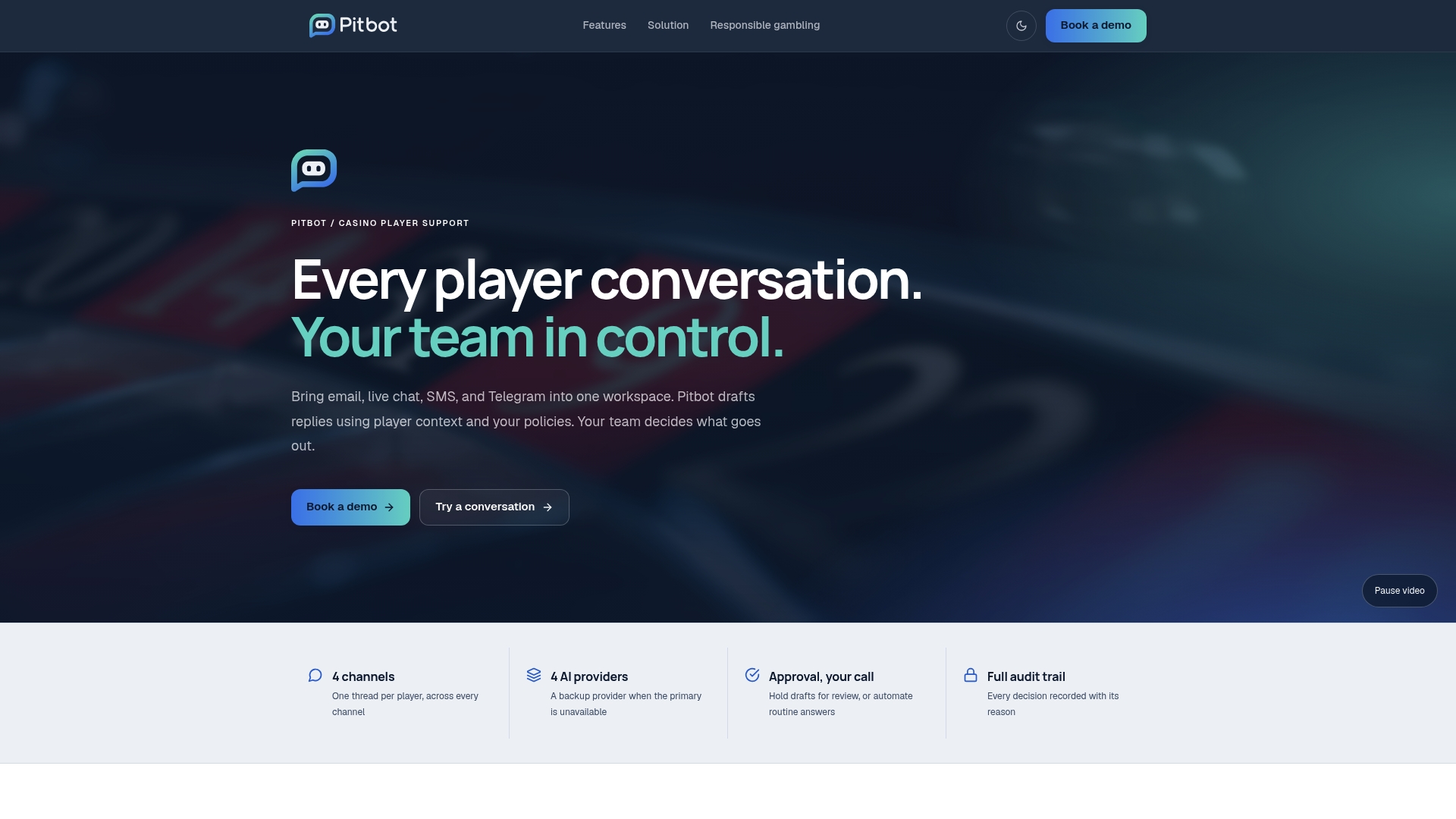
In a demo, it is worth asking about the specifics that matter for a regulated rollout: how the audit trail captures each decision, what integration APIs connect to your existing CRM and payment providers, and how thread assignment and responsible gambling escalation work in practice.
- Multi-channel coverage: live chat, email, SMS and Telegram from one workspace.
- The option to hold AI-drafted replies for staff approval before they reach a player.
- Thread assignments that route a conversation to a named owner, with handover history.
- Responsible gambling escalation, with marketing outreach blocked while a sensitive case is open.
| What to check in a demo | Why it matters |
|---|---|
| Audit trail detail | Supports contestability and regulator requests |
| Channel and CRM integrations | Determines rollout time and cost |
| Escalation and review workflow | Confirms human oversight on sensitive cases |
See how the workflow looks for your channels on the Pitbot features page, or get a demo through Pitbot.
FAQ
Is there an AI for gambling?
Yes, AI is used across the gambling industry for player support, fraud detection and responsible gambling screening. Tools range from chat assistants that answer routine player questions to machine learning models that flag accounts showing signs of harmful play, with peer-reviewed studies showing predictive accuracy for problem gambling detection in the 0.65 to 0.84 AUC range.
Do casinos hire software engineers?
Online casino operators and iGaming companies commonly employ software engineers to build and maintain their platforms, payment systems and support tools, including integrations with AI support providers. The exact roles and team structures vary by operator and are not publicly standardised across the industry.
What is the best AI in gaming support?
There is no single best AI tool for gaming support; the right choice depends on an operator’s channels, compliance requirements and existing systems. Operators in regulated markets generally look for a provider offering source-grounded answers, human review of outgoing messages and a clear audit trail, since those features align with regulatory expectations such as LCCP condition 3.4.3.
How is AI used in the gaming industry?
AI is used to answer routine player questions, summarise support tickets, detect responsible gambling risk signals and personalise promotions across channels such as chat, email and SMS. In regulated markets, these systems typically work alongside human reviewers rather than replacing them, particularly for decisions that affect a player’s account or wellbeing.
Sources
- LCCP condition 3.4.3 - Remote customer interaction
- Using machine‑learning algorithms to predict self‑reported problem gambling
- The need for benchmarks to advance AI‑enabled player risk detection in gambling
- Multimodal generative AI and foundation models for behavioural health in online gambling

