

An AI reply review workflow is the process of checking AI-generated player replies before they reach a casino player, so that nothing non-compliant or harmful goes out unseen. The approach we recommend is risk-stratified human-in-the-loop review: every high-risk message gets checked, medium and low-risk messages are sampled, and every decision is logged for audit. In our own platform you can hold AI-drafted replies for staff approval before they reach a player, responsible gambling and regulator flags are escalated to a person instead of answered, and every approved send records who approved it.
TL;DR:
- Operators should review 100% of self exclusion, account blocking, closure, and gambling harm replies before sending; sample routine questions and review transaction disputes by thread.
- Increase sampling when reviewer overrides rise, the AI model changes or drifts, or an audit approaches; set a flexible range rather than a fixed rate.
- Operators should log the AI model, reviewer edits and reasons, sampling rules, and escalations, then organize evidence as an auditable timeline across jurisdictions.
- During a pilot, operators should start with the busiest channel, track overrides, escalations, and approval latency daily, and switch to manual replies if checks fail.
Table of Contents
- Workflow overview: from AI draft to player delivery
- Risk stratification: when every reply needs review versus when to sample
- Human reviewer roles and a practical checklist
- Compliance, audit trail and legal checkpoints
- Monitoring, KPIs and testing reviewer effectiveness
- Implementation quick-start: a pilot you can run this quarter
- Why human review still matters when AI gets faster
- How Pitbot builds this workflow into player support
- FAQ
- Sources
Workflow overview: from AI draft to player delivery
A reply review workflow runs through six stages, and the sequence matters because each stage filters out risk before it reaches a human reviewer or a player.
- Context capture: the system pulls player history, account status and channel into the draft request.
- AI draft generation: the AI system produces a candidate reply based on that context.
- Automated pre-checks: policy filters scan for banned phrases, vulnerability markers and account flags.
- Routing to review queue: the draft lands in a queue sorted by risk tier and channel urgency.
- Human review and edit: a reviewer approves, edits or escalates the draft.
- Final approval, send and logging: the approved reply goes out, and the decision, edits and rationale are recorded.
Channel context changes how tightly stage five has to run. Live chat and Telegram need near-instant review because players expect a reply within seconds, so reviewers work from a shortlist of pre-approved edits rather than free-form rewrites. Email and SMS tolerate a longer service window, which gives reviewers more room to check context before a reply goes out.
Automated pre-filters at stage three do most of the heavy lifting by reducing what reaches a human. These typically include suppression of marketing or bonus language to flagged accounts, automatic blocks on policy-breaching phrasing, and immediate routing of self-exclusion or account-closure mentions straight to a senior reviewer. The fewer low-value drafts that reach a human, the more attention reviewers can give to the messages that actually carry risk.
Risk stratification: when every reply needs review versus when to sample
Not every player message carries the same risk, so treating them identically either wastes reviewer time or under-checks the cases that matter most.
- Low risk: routine FAQs, game rules, deposit method questions. These can run on statistical sampling with a defined confidence interval rather than full review.
- Medium risk: balance disputes, bonus eligibility queries, withdrawal delays. These warrant time-windowed or event-triggered review, for example checking every reply sent within a disputed transaction thread.
- High risk: self-exclusion requests, account blocking, closure mentions, or any message touching responsible gambling indicators. These require full, 100% human review before sending, consistent with the Gambling Commission’s LCCP condition 3.4.3 on manual intervention where strong harm indicators are present.
Sampling rates should not stay fixed. Adaptive sampling tightens controls automatically when override rates rise, when the underlying AI model is updated or shows drift, or ahead of a known regulator audit window. A sudden jump in reviewer edits on medium-risk replies is usually the first sign that sampling needs to increase before a wider problem appears.
Pro Tip: Set your sampling rate as a range, not a fixed number, so your team can tighten it the moment override rates climb without waiting for a policy rewrite.
Human reviewer roles and a practical checklist
Clear separation of duties keeps the workflow auditable and prevents any single person from both drafting and approving sensitive replies. A typical setup separates four roles: the frontline reviewer who checks and edits drafts, a team lead who handles escalations, a compliance owner who sets the risk rules, and a named escalation owner for responsible gambling cases.
Each reviewer works from a fixed checklist rather than judgement alone:
- Confirm player identity and account context match the draft.
- Check for vulnerability or harm indicators in the conversation history.
- Confirm the reply complies with licence conditions and marketing rules.
- Review tone and clarity for the player’s situation.
- Log the decision and the rationale, including any edit made.
- Tag the case for escalation when risk indicators are present.
Operational controls around the reviewer role matter as much as the checklist itself. Caseload limits stop reviewers from rushing through volume at the expense of accuracy, and the ICO’s human review guidance specifically recommends manageable caseloads alongside documented qualifications. Reviewer rotation and periodic re-review of approved cases catch drift before it becomes a pattern, and mystery shopping, sending test cases through the queue, helps detect automation bias, where reviewers start rubber-stamping AI drafts without genuine scrutiny.
Pro Tip: Rotate reviewers across risk tiers every few weeks; staying on high-risk cases alone raises fatigue, staying on low-risk cases alone raises complacency.
Compliance, audit trail and legal checkpoints
Regulators expect to see evidence, not just policy documents, so the audit trail has to capture the full decision chain.
- Timestamped records of AI involvement in every reply, including which model or provider generated it.
- Reviewer decision logs showing approvals, edits and the reason for any override.
- Sample and test reports showing which messages were reviewed under which sampling rule.
- Escalation records showing what triggered a case and how it was resolved.
Three obligations shape what these logs need to contain. The EU AI Act requires AI systems to disclose their AI nature at or before first interaction and calls for human oversight and traceability on higher-risk systems. The Gambling Commission’s formal customer interaction guidance requires manual review of automated decisions that significantly affect a customer, and gives that customer the right to contest the outcome. Article 22 of the UK GDPR adds a further layer for any decision with legal or similarly significant effects, which is why a documented testing and sampling plan, not just a policy statement, is what the ICO’s AI toolkit asks operators to produce for audit.
Retain logs long enough to cover a full regulatory cycle, keep the workflow consistent across jurisdictions rather than varying controls by market, and organise evidence so it can be handed to an auditor as a timeline, not a data dump.

Monitoring, KPIs and testing reviewer effectiveness
A review workflow only stays trustworthy if someone is watching whether it still works.
- Override rate: the share of AI drafts a reviewer changes before sending, a rising rate signals model drift.
- Approval latency: time from draft to final send, tracked separately for chat versus email.
- Escalation rate: the proportion of cases routed to a senior reviewer or compliance owner.
- False negatives for harm flags: cases where a harm indicator was missed by automated filters and caught later.
- Player complaints per contact volume: a lagging signal that review quality has slipped.
Run weekly sample audits on low and medium-risk queues, monthly performance reviews across all reviewers, and trigger a deep audit immediately when override rate or escalation rate crosses a set threshold. When metrics move the wrong way, the fix is usually one of three levers: tighten sampling, add reviewer training on the specific failure pattern, or adjust the AI model configuration generating the drafts.
Implementation quick-start: a pilot you can run this quarter
A pilot needs minimal tooling to prove the model works before a full rollout: an audit log, a review queue, and connectors for your live chat, email, SMS and Telegram channels.
- Staff a small reviewer team covering your busiest channel first.
- Set SLAs appropriate to channel urgency.
- Run a multi-week pilot with full review on high-risk cases and sampling on the rest.
- Track override rate, escalation rate and approval latency daily.
- Compare results against go/no-go thresholds before expanding to other channels.
Build a fallback into the pilot from day one: if automated pre-checks fail or a reviewer is unavailable, the workflow should default to a manual-only response mode rather than sending an unreviewed AI draft. A stand-in reviewer, briefed in advance, covers absences without breaking the review chain.
Why human review still matters when AI gets faster
AI speed and compliance are not opposites, but they only stay aligned when a person is genuinely checking the output, not just rubber-stamping it. The biggest risk we see in regulated support is not AI making mistakes, it is teams trusting automation past the point where oversight is still meaningful. Getting the sampling rate and the reviewer checklist right protects player trust as much as it protects a licence.
We are happy to share review templates or walk through how a pilot might look for your team.
— pitbot
How Pitbot builds this workflow into player support
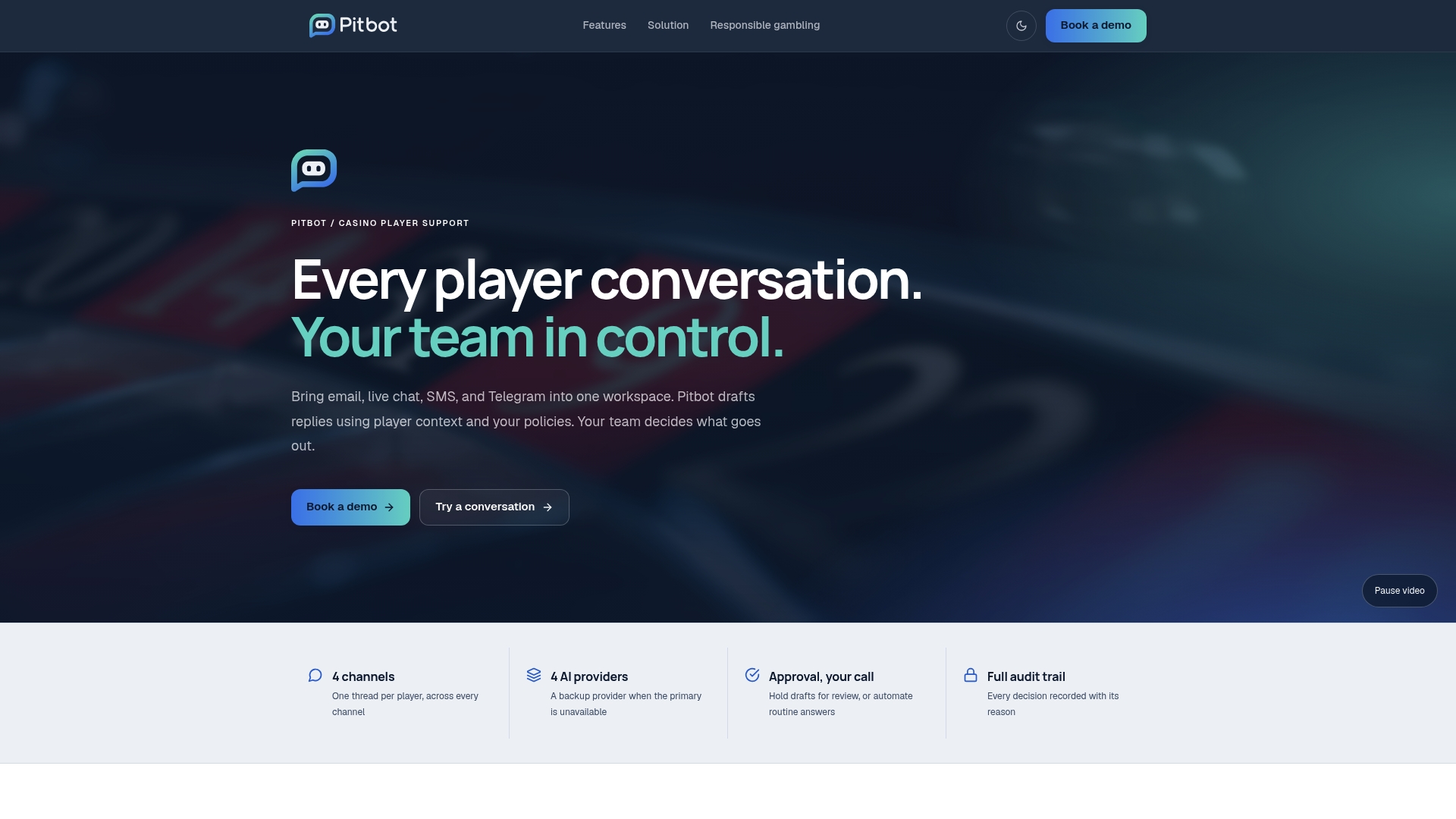
We built our platform around the principle this article describes: fast AI drafting paired with human oversight. With auto send off, AI-drafted replies on email, live chat, SMS and Telegram wait for staff approval before they reach a player, and every approved send is stamped with the staff member who approved it and when.
- Our system supports multi-provider AI drafting to maintain queue continuity.
- Drafts that do not clear the quality review land in the review queue instead of sending, and responsible gambling and regulator flags on email, live chat, SMS and Telegram are a hard stop: the thread is escalated to a person instead of answered, and a sensitive case opens for someone to pick up.
- The platform offers omnichannel coverage across email, live chat, SMS, and Telegram from one workspace.
- It includes built-in audit trails and responsible gambling measures that support your own compliance work.
If you are weighing up how to stand up a compliant review workflow without building the tooling from scratch, our AI customer support platform for online casino and iGaming operators is built for exactly this. You can see the full feature set or book a demo at Pitbot to walk through your own channel mix.
FAQ
What is an AI reply review workflow in iGaming support?
It is the process of routing AI-generated player replies through human review before they are sent, with risk-based rules deciding how much scrutiny each reply gets. High-risk cases such as self-exclusion mentions get full review, while routine queries can be sampled.
Do all AI replies need to be reviewed before sending?
No, reviewing every single reply is often unsustainable and can lead to reviewers rubber-stamping drafts without real scrutiny, according to ICO guidance on AI and fairness. A risk-stratified approach, with full review on high-risk cases and sampling elsewhere, is the more workable standard.
What counts as a high-risk player message?
Messages touching self-exclusion, account blocking or closure, or showing strong indicators of gambling harm are high risk and require full manual review under LCCP guidance. Balance disputes and bonus queries are typically treated as medium risk.
What records do operators need to keep for audits?
Operators should keep timestamped logs of AI involvement, reviewer decisions and override reasons, and records of sampling and escalation activity. These map to obligations under the EU AI Act and the Gambling Commission’s formal customer interaction guidance.
Does this platform review every AI-generated reply before it reaches a player?
It can. With auto send off, AI-drafted replies on email, live chat, SMS and Telegram wait for staff approval before they reach a player; with auto send on, drafts that clear the quality review can go out without approval. Plan pricing is published on the Pitbot pricing page.
Sources
- Regulation (EU) 2024/1689 (EU AI Act)
- LCCP Condition 3.4.3 - Remote customer interaction
- Human review | ICO

