

True omni-channel casino support is a single player record plus a unified conversation layer that follows the player across chat, email and messaging. Get this right and repeat contacts fall, resolution speeds up, and every decision leaves an audit trail a regulator can follow. The rest comes down to sequencing: which components to build, in what order, and how to measure whether it is working.
TL;DR:
- Define canonical Player IDs and map provider aliases before adding channels; otherwise, vendor changes can break history and leave agents with fragmented records.
- Pilot one new channel at a time for about 30 days, tracking first contact resolution, repeat contact rate, and channel switching before expanding.
- Automated harm indicators should trigger human review, and operators should suppress marketing offers during active flags while recording who acted and when.
- Track first contact resolution alongside repeat contacts within 48 to 72 hours, response time, transactional satisfaction, escalations, and VIP service compliance.
Table of Contents
- Why omnichannel matters for casino operators
- Core components: the unified player record and conversation layer
- Implementation sequence: identity-first integrations and rollout hygiene
- Compliance and responsible gambling: embedding identify, act, evaluate
- Operational metrics and KPIs to measure omnichannel success
- How Pitbot implements identity-first omnichannel for regulated operators
- Channels to include: chat, email, messaging apps, SMS, phone and VIP lines
- VIP handling and escalation workflows
- Personalisation techniques and the role of AI in player interaction
- Data privacy and security measures for omnichannel support
- Training and managing human reviewers for compliance and quality
- Analytics and AI-driven insights for managing support trends
- A practitioner’s perspective on the one habit that matters most
- Pitbot: how we help and next steps
- FAQ
- Sources
Why omnichannel matters for casino operators
Players who contact support about a stuck withdrawal rarely stop at one channel. They message live chat, then email, then try the VIP host line when nobody replies fast enough. Each handoff that starts from scratch costs time and patience, and each one is a missed chance to notice a responsible gambling flag.
Operators that unify context across channels report improved first-contact resolution and fewer repeat contacts, according to implementation guidance from iGaming CX. That is the commercial case. The regulatory case is just as direct: licensees must run customer interaction systems that identify indicators of harm and act on them promptly, under LCCP condition 3.4.3. A support stack that cannot see a player’s full history across channels cannot reliably spot those indicators.
Two things tend to happen when context is unified:
- Agents resolve more queries on first contact because they can see the whole conversation history, not just their own channel’s slice.
- Harm indicators get caught earlier because no channel is a blind spot.
Case data shows measurable gains in first-contact resolution and transactional CSAT after channel unification, according to operator case summaries, though the exact figures vary by operator and were not published as a single benchmark.
Core components: the unified player record and conversation layer
The foundation is what architecture guidance calls a unified player account: an operator-owned record that centralises identity, wallet and session data so support investigations stay traceable instead of scattering across providers, as described in session architecture guidance from 0xforge.
A useful canonical player record includes:
- A single internal player ID that never changes, regardless of which provider or channel touches the account.
- Linked provider aliases, so swapping a payments or KYC vendor does not break the player’s history.
- Wallet authority and ledger pointers for a live view of balance and transaction state.
- Session records with device and risk context, plus KYC snapshots and active responsible gambling flags.
- A ticket and transcript history, stored with an immutable audit trail.
Provider details, meanwhile, sit at the edge, behind adapters, rather than baked into the core record. That boundary is what lets an operator change a live chat vendor or add a messaging channel without rewriting how identity or wallet state is modelled, a design choice that 0xforge’s guidance ties directly to reduced vendor lock-in.
On top of that record sits the conversation layer: merged transcripts so a player never repeats themselves, clean bot-to-human handoffs that carry full context, and shared ticket state so a VIP host and a live chat agent see the same open case rather than two separate ones.
Pro Tip: Treat the audit trail as a product requirement, not an afterthought, since regulators will ask for it during a routine review, not just after a complaint.
Implementation sequence: identity-first integrations and rollout hygiene
Most fragmentation problems trace back to adding channels before fixing identity. A practical rollout follows a fixed order, and iGaming CX’s implementation sequencing is a useful template:
- Inventory every existing entry point, including shadow inboxes that VIP teams or affiliates run outside the main helpdesk.
- Define the canonical Player ID model before touching a new channel integration.
- Map provider aliases so every channel adapter resolves back to the same internal identity.
- Connect KYC and payments data to the helpdesk, so agents see verification status and transaction history without switching tools.
- Attach the helpdesk as the system of record for tickets and transcripts.
- Pilot one new channel at a time and measure first-contact resolution, repeat-contact rate and channel-switch rate before expanding further.
- Run each pilot for a fixed window, commonly around 30 days, before wider rollout.
A short migration checklist helps keep this honest: confirm data mapping between old and new systems, build an alias registry before go-live, and design the admin view so a single screen shows identity, wallet state and open tickets together. Skipping identity linking to launch a flashy new channel faster is the single most common cause of the fragmented support experiences operators later have to unwind.
Compliance and responsible gambling: embedding identify, act, evaluate
Support workflows are where responsible gambling policy either works or fails in practice. LCCP condition 3.4.3 requires licensees to identify indicators of harm, act on them in a timely way, and evaluate the effectiveness of that action, a cycle that only works if every channel feeds the same player record.
In practice that means:
- Automated markers (unusual deposit patterns, late-night session length, chat sentiment) should trigger a human review, never a silent auto-response.
- Formal guidance on the customer interaction requirement stresses that automated decisions must be manually reviewable and contestable by the player.
- When an RG flag is active, marketing and bonus offers should be suppressed automatically, not left to a separate team to remember.
- Every decision, automated or manual, needs a timestamped record: who reviewed it, what action followed, and when.
Certification frameworks reinforce the same point from a different angle. eCOGRA’s eGAP requirements call for a documented commitment to player support, including 24/7 access and timely complaint handling, alongside technical controls for player safety. A manual-review backstop for every automated RG action is a baseline expectation in both UK regulatory guidance and independent certification standards, per the Gambling Commission’s guidance.
Operational metrics and KPIs to measure omnichannel success
Numbers only mean something in combination. High first-contact resolution paired with a high repeat-contact rate usually means agents are closing tickets without actually solving the problem.
Track these as a set, not in isolation:
- Primary KPIs: first-contact resolution, transactional CSAT, average response time, and repeat-contact rate within 48 to 72 hours.
- Secondary KPIs: escalation volume by channel, responsible gambling intervention rate, and VIP SLA compliance.
- Channel-switch rate: how often a single player issue touches more than one channel before resolution, a direct signal of fragmentation.
- Automation accuracy: the share of automated or AI-assisted replies that a human reviewer edits or overrides before sending.
A dashboard that surfaces all four groups side by side, rather than celebrating one metric alone, catches the false positives that a single-metric view misses.
How Pitbot implements identity-first omnichannel for regulated operators
Our platform combines AI-generated replies with the option of human approval to provide player interactions that aim to be fast, compliant, and personalised, applying the identity-first model across multiple channels from one workspace.
Context-aware replies draw on the same unified player record described above, so a VIP player who messages on Telegram after an earlier email ticket gets a response that reflects that history rather than starting cold.
- With auto send off, AI-drafted replies on email, live chat, SMS and Telegram wait for staff approval before they reach a player, and each approved send records who authorised it.
- An audit trail is maintained that logs reviewer actions and subsequent steps.
- Coverage includes multiple languages, with VIP players handled in the same dashboard as every other ticket; any thread can be assigned to a named owner with handover history.
Pro Tip: When evaluating any omnichannel platform, ask specifically how it logs the human review step, not just whether AI is involved.
Channels to include: chat, email, messaging apps, SMS, phone and VIP lines
An operator’s channel mix needs to match where players actually want to reach out, not just which tools are easiest to integrate first.
Live chat remains the front line for in-session issues like a stuck deposit, where speed matters more than depth. Email suits complaints, account verification and anything that needs a paper trail. Messaging apps such as WhatsApp and Telegram have become standard for VIP relationships and markets where players prefer a familiar app over a web widget. SMS still covers time-sensitive alerts, particularly where a player cannot access the platform directly. Phone support, often underused, matters for complex disputes and for players who find text-based channels frustrating.
VIP channels deserve separate treatment rather than being folded into general support. A host line or dedicated messaging thread for high-value players carries its own service expectations and usually its own escalation path.
Real-world operator support pages illustrate how this plays out: public pages commonly list live chat alongside multilingual 24/7 support and a separate VIP host arrangement, as seen on Rivo Casino’s support page, which highlights quick response times for in-session issues specifically.
The order matters less than the discipline behind it: every channel added should plug into the same Player ID and the same conversation layer, not sit as its own silo with its own ticket history.

VIP handling and escalation workflows
VIP players generate a disproportionate share of revenue and a disproportionate share of risk, which makes their support workflow worth designing separately rather than bolting on as an afterthought.
A workable VIP workflow starts with a dedicated queue that routes straight to a host or senior agent, bypassing the general ticket pool. That queue needs the same unified player record as every other channel: a host switching from a Telegram thread to a phone call should see the full history without asking the player to repeat themselves.
Escalation triggers should be explicit rather than left to judgement alone: a certain deposit velocity, a session length threshold, or specific chat sentiment can all trigger an automatic flag to a senior reviewer. Because VIP players often carry higher deposit limits, the responsible gambling stakes are higher too, which means the identify, act, evaluate cycle required under LCCP 3.4.3 applies with extra weight here, not less.
Service level agreements for VIP tickets are typically tighter than standard support, and tracking SLA compliance for this segment separately from general metrics avoids a fast overall average masking slow VIP handling.
Personalisation techniques and the role of AI in player interaction
Personalisation in casino support means a reply that reflects a player’s actual history, not a first-name merge field dropped into a template. That requires the same unified record discussed earlier: wallet state, recent session activity, past tickets and any active RG flags, all visible to whoever or whatever is responding.

AI’s role here is to draft responses that pull from that context automatically, so a player asking about a bonus sees an answer that accounts for their specific account status rather than a generic policy summary. Multi-provider AI systems can tailor tone and language to the player’s own channel and language preference, which matters more in markets with diverse player bases.
The limiting factor is not how sophisticated the AI drafting is, but whether a human reviews the output before it reaches the player, particularly on anything touching money, verification or responsible gambling. Personalisation without that review step risks a confident-sounding reply that is factually wrong or, worse, misses a harm indicator the player’s history would have flagged.
Data privacy and security measures for omnichannel support
Centralising player data across channels raises the stakes on how that data is protected, since a single unified record now holds identity, financial and behavioural information in one place rather than scattered across separate systems.
Access controls matter more than most operators initially plan for: not every support agent needs to see full KYC documents or payment details, and role-based access limits exposure without slowing down routine queries. Encryption in transit and at rest is table stakes for any system handling identity documents or wallet data.
The audit trail that supports regulatory compliance also doubles as a security control: a logged, timestamped record of who accessed what, and when, makes it possible to spot unusual access patterns, not just satisfy an inspection. KYC-related processes, in particular, carry their own compliance expectations, and guidance on ID check compliance covering identity verification practices is a useful reference point when designing how verification data flows into a support system.
Retention policy deserves explicit attention too: transcripts and audit logs need to be kept long enough to satisfy regulatory review windows, but not indefinitely, and that retention period should be a deliberate decision rather than a default setting left unchanged.
Training and managing human reviewers for compliance and quality
Human review only works as a compliance control if the reviewers doing it are trained consistently and checked regularly, not left to develop their own standards over time.
Training should cover two distinct skills: spotting responsible gambling indicators that an automated system might miss or flag incorrectly, and recognising when an AI-drafted reply is factually accurate but tonally wrong for a sensitive situation. These are different judgement calls, and conflating them in a single training session tends to produce reviewers who are strong on one and weak on the other.
Quality management works best with regular sampling of reviewed messages against a documented standard, rather than relying solely on complaint volume as a quality signal, since complaints only surface the failures that reach a player. Reviewer decisions themselves should be logged as part of the audit trail, both to support quality coaching and because regulators reviewing a case will want to see who made the call and on what basis.
Rotating reviewers across channels, rather than siloing one reviewer permanently on email and another on chat, also helps catch the kind of channel-specific blind spot that builds up when one person owns a channel for too long.
Analytics and AI-driven insights for managing support trends
Reactive support, where teams only notice a problem once ticket volume spikes, misses the window where early intervention is cheapest and most effective.
Analytics built on the unified player record can surface trends before they become incidents: a rise in chat sentiment flagged as frustrated, a cluster of repeat contacts about the same withdrawal issue, or a channel-switch rate creeping upward for a specific player segment. Each of these is a signal worth a proactive look, not just a metric to review at month end.
AI-driven pattern detection works best as a prioritisation tool rather than a decision-maker: it can rank which tickets or player segments deserve human attention first, but the judgement about what to do with that information still belongs to a trained reviewer, particularly where responsible gambling is involved.
Dashboards that combine the KPIs from earlier sections (first-contact resolution, repeat-contact rate, escalation volume) with trend detection give operations teams a view of where the support system is heading, not just where it has been.
A practitioner’s perspective on the one habit that matters most
Everything in this playbook reduces to one habit: attach every inbound conversation to a Player ID before anything else happens. Operators who add channels first and fix identity later spend years untangling the mess.
Watch for shadow processes too: a VIP side-inbox, a host’s personal WhatsApp, a complaints spreadsheet nobody else sees. Each one is a gap in the record you are trying to build.
— pitbot
Pitbot: how we help and next steps
We built Pitbot around the identity-first model this article describes: a unified player record, the option to hold AI-drafted replies for staff approval, and coverage across email, live chat, SMS and Telegram from a single dashboard.
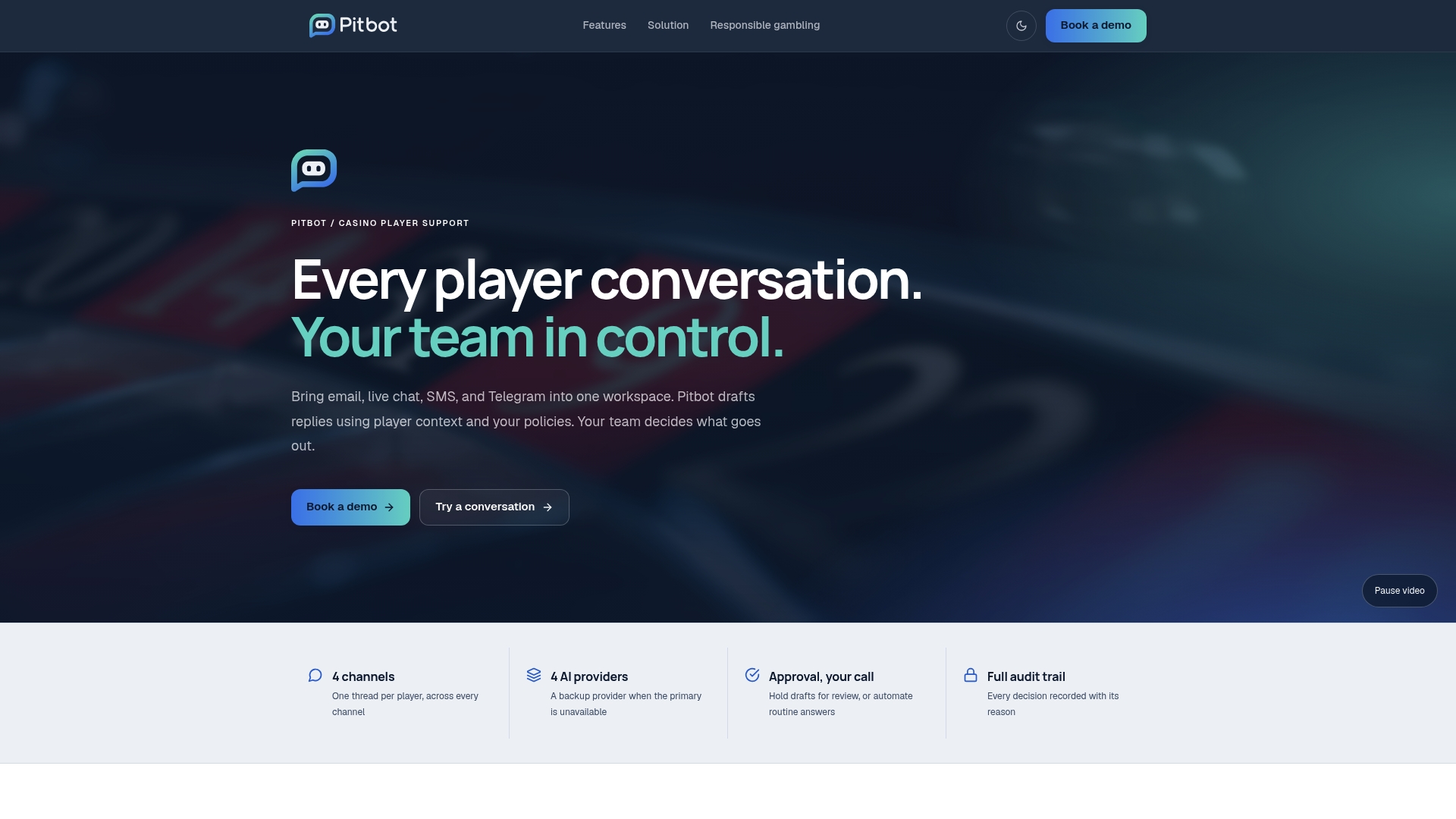
That combination gives operators the audit trail regulators expect and the response speed players expect, without choosing between the two. If you are mapping out an omnichannel rollout, our responsible gambling automation features show how identify, act, evaluate fits into a live support workflow, and our platform overview covers the full channel and review setup. Book a demo to see how it handles your own ticket volume.
FAQ
What does omni-channel support mean?
Omni-channel support means a player’s conversation, identity and history follow them across every channel (chat, email, messaging apps, SMS and phone) as one continuous record, rather than separate conversations in each channel. It contrasts with multichannel support, where channels exist in parallel but do not share context.
What is an omni-channel contact centre?
An omni-channel contact centre is a support operation built around a single player record and shared conversation layer, so any agent on any channel can see the full interaction history immediately. In a casino context, that typically means linking the player account management system, KYC data and responsible gambling flags to the same helpdesk record.
What is an omnichannel call centre?
An omnichannel call centre is a phone-based support operation integrated into the same unified record as chat, email and messaging channels, rather than running as an isolated system. A player calling after an earlier email exchange reaches an agent who can see that history without the player repeating it.
How do operators start building omnichannel support?
The first step is identity, not channels: linking every existing entry point to a canonical Player ID before adding or expanding any new channel. Implementation guidance recommends mapping entry points and defining that identity model before anything else.
How does responsible gambling fit into omnichannel support?
Responsible gambling obligations under LCCP 3.4.3 require operators to identify harm indicators, act on them promptly and evaluate the response, a cycle that depends on every channel feeding the same player record. In Pitbot, responsible gambling and regulator flags on email, live chat, SMS and Telegram are a hard stop: the thread is escalated to a person instead of answered, and a sensitive case opens for someone to pick up. No AI draft is written; the player receives an automatic acknowledgment while a human picks up the case, and marketing outreach to that player is blocked while the case is open.
Sources
- How to run omnichannel player support without losing context — iGaming CX
- LCCP condition 3.4.3 — Remote customer interaction — UK Gambling Commission
- Unified player account session architecture — 0xforge
- eGAP certifiable requirements — eCOGRA

