

Chat transcript auditing produces a searchable, timestamped evidence trail that supports quality control, compliance proof and targeted training. It means systematically reviewing recorded conversations between agents, bots or AI systems and customers against defined standards. Compliance auditors, support managers and quality leads should run audits on a regular cadence, weekly for high-risk channels and monthly for general support, rather than only after a complaint arrives.
TL;DR:
- Choose samples according to risk, covering every complaint or escalation and random routine chats; confirm access permissions and redact unrelated personal data before review.
- Record the exact excerpt, issue type, severity, and required action for each finding, then track serious cases through verified remediation.
- Automated ACQI models reached weighted average F1 scores around 0.79 in published experiments, supporting triage but not final decisions on serious or disputed cases.
- Check that exports preserve message order and timestamps, and that unavailable content carries a reason; missing provenance weakens evidence in regulatory reviews.
- Have people review every flagged or escalated case, while retaining a smaller random sample of unflagged conversations to catch misses and monitor detection quality.
Table of Contents
- Why transcript audits matter for quality and compliance
- How to audit chat transcripts: a step-by-step process
- Measuring quality: ACQIs and other actionable indicators
- Accessing and exporting transcripts for reliable evidence
- How a regulated support platform approaches audit trails
- Where automation should stop and auditors should start
- How Pitbot supports audit-ready conversations for operators
- FAQ
- Sources
Why transcript audits matter for quality and compliance
A well-run audit programme does more than catch mistakes after the fact. It builds a record that regulators, legal teams and customers can trust, and it gives support managers a steady feed of signals about what is actually happening in conversations, not what dashboards assume is happening.
The core benefits auditors should prioritise are:
- Demonstrable compliance record. A dated, unaltered transcript log proves what was said and when, which matters the moment a regulator or ombudsman asks for evidence.
- Consistency and training signal. Patterns across many transcripts reveal where agents or bots consistently struggle, turning anecdote into a training curriculum.
- Safety and escalation capture. Reviewing transcripts for distress signals, threats or regulatory triggers lets teams catch cases that should have been escalated but were not.
- Time saved through searchable records. Timestamped, indexed transcripts let an auditor jump to the exact moment a problem occurred instead of replaying an entire session.
Each of these benefits depends on the underlying data being complete and tamper-evident. A transcript with gaps, missing timestamps or unclear speaker attribution undermines every use case above, whether the goal is a training deck or a regulatory submission.
How to audit chat transcripts: a step-by-step process
A repeatable audit process protects auditors from accusations of bias and gives support managers a defensible method they can explain to regulators or auditors in turn.
- Define scope and sampling strategy. Choose a risk-based sample: all conversations tagged as complaints or escalations, plus a random sample of routine chats, across a fixed date range and all relevant channels.
- Confirm permissions and redaction rules before opening a single transcript. Auditors need role-based access that matches their clearance level, and personal data outside the audit’s purpose should be redacted or masked first.
- Read for context, not just keywords. Scan the full exchange to understand what the customer wanted and whether the response actually addressed it.
- Verify timestamp integrity. Check that message order and timing are intact; a transcript with scrambled or missing timestamps cannot stand as reliable evidence.
- Identify rule breaches. Flag anything that breaches a script requirement, a regulatory disclosure rule or an internal policy.
- Classify severity. Grade each finding (minor, moderate, serious) so remediation effort matches actual risk rather than reviewer mood.
- Record standard finding fields. For every flagged item, log who was involved, when it happened, the exact excerpt, the issue type and the required action.
- Route to escalation and track remediation. Serious findings go to a named owner with a deadline, and the audit log should show when the fix was verified.
Pro Tip: Keep a single findings template across every audit cycle, it turns months of scattered notes into a dataset you can trend over time.
This sequence works whether the conversations were handled by human agents, bots or a blend of both, because the standard being checked is the outcome, not who produced it.
Measuring quality: ACQIs and other actionable indicators
Vague quality scores do not tell an auditor what to fix. A taxonomy of actionable conversational quality indicators, or ACQIs, labels specific moments in a conversation that affect experience, rather than issuing a single pass or fail mark.
Common negative ACQI categories include:
- Doesn’t understand, where the system or agent misreads the customer’s intent.
- Unable to resolve, where the conversation ends without the customer’s issue being solved.
- Bad transfer, where an escalation loses context or sends the customer to the wrong queue.
- Ignored statement, where a relevant customer comment goes unanswered.
Turning these labels into dashboard KPIs means tracking frequency per agent or bot version, severity-weighted scores, and average resolution time once a flag appears. Set alert thresholds conservatively at first and review flagged false positives weekly, since a spike often reflects a new product issue rather than a drop in quality.
Automated models can predict ACQIs with useful accuracy, reaching weighted average F1 scores of around 0.79 in published experiments, which is strong enough for triage but not for final adjudication. Automated detection should narrow the pile of transcripts for human review, never replace the human decision on a serious or disputed case.
Accessing and exporting transcripts for reliable evidence
An audit is only as strong as the export it relies on. Transcripts typically come as JSON, CSV or PDF, and timestamp fidelity across all three matters more than file format, since a reordered message sequence can invalidate an otherwise solid finding.
Points to check in any platform before trusting its exports:
- Audit-log endpoints with defined permission scopes. Platforms such as Rocket.Chat require an explicit auditor role or permission before anyone can search or export messages, which keeps access controlled and logged.
- Session-level compliance APIs. Some providers, including Claude’s compliance sessions API, return full session metadata and messages while flagging gaps with reasons such as “retention_elapsed” or “content_unavailable” when content was not retained.
- In-session transcript logging for live support tools. Platforms like TeamViewer support event logging and API access so transcripts from remote sessions can be pulled into an audit trail rather than left stranded in a separate tool.
- Security controls. Role-based access, encryption in transit and at rest, and a documented redaction process before any transcript leaves the system.
A transcript missing provenance markers for unavailable content is a weaker piece of evidence than one that clearly states why a section is missing.
How a regulated support platform approaches audit trails
We built our own platform around the assumption that every regulator eventually asks for proof, not just a policy document. Our support platform combines multiple AI providers with the option to hold AI-drafted replies for staff approval before they reach a player, across email, live chat, SMS and Telegram.
With auto send off, AI-drafted replies on email, live chat, SMS and Telegram wait for staff approval before they reach a player, which keeps a person accountable for what is sent rather than leaving it to a single model’s judgement. The result is a record of which AI provider and model drafted each reply and which staff member approved it, so an operator can show who decided what on a player conversation.

Where automation should stop and auditors should start
Automation earns its place at scale: triaging thousands of transcripts for ACQI-style flags is a job no human team can match. But context, judgement calls and anything with regulatory weight still need a person. A reasonable starting ratio is full human review of all flagged and escalated cases, alongside a smaller random sample of unflagged ones, with that balance shifting as detection accuracy improves and the auditor’s role moves toward verification and escalation governance.
— pitbot
How Pitbot supports audit-ready conversations for operators
For casino and iGaming operators, audit readiness is critical for maintaining licences. Pitbot keeps each player’s conversation on one thread, can hold AI-drafted replies for staff approval, and records who approved each reply that was signed off, so the evidence a regulator asks about is already in place.
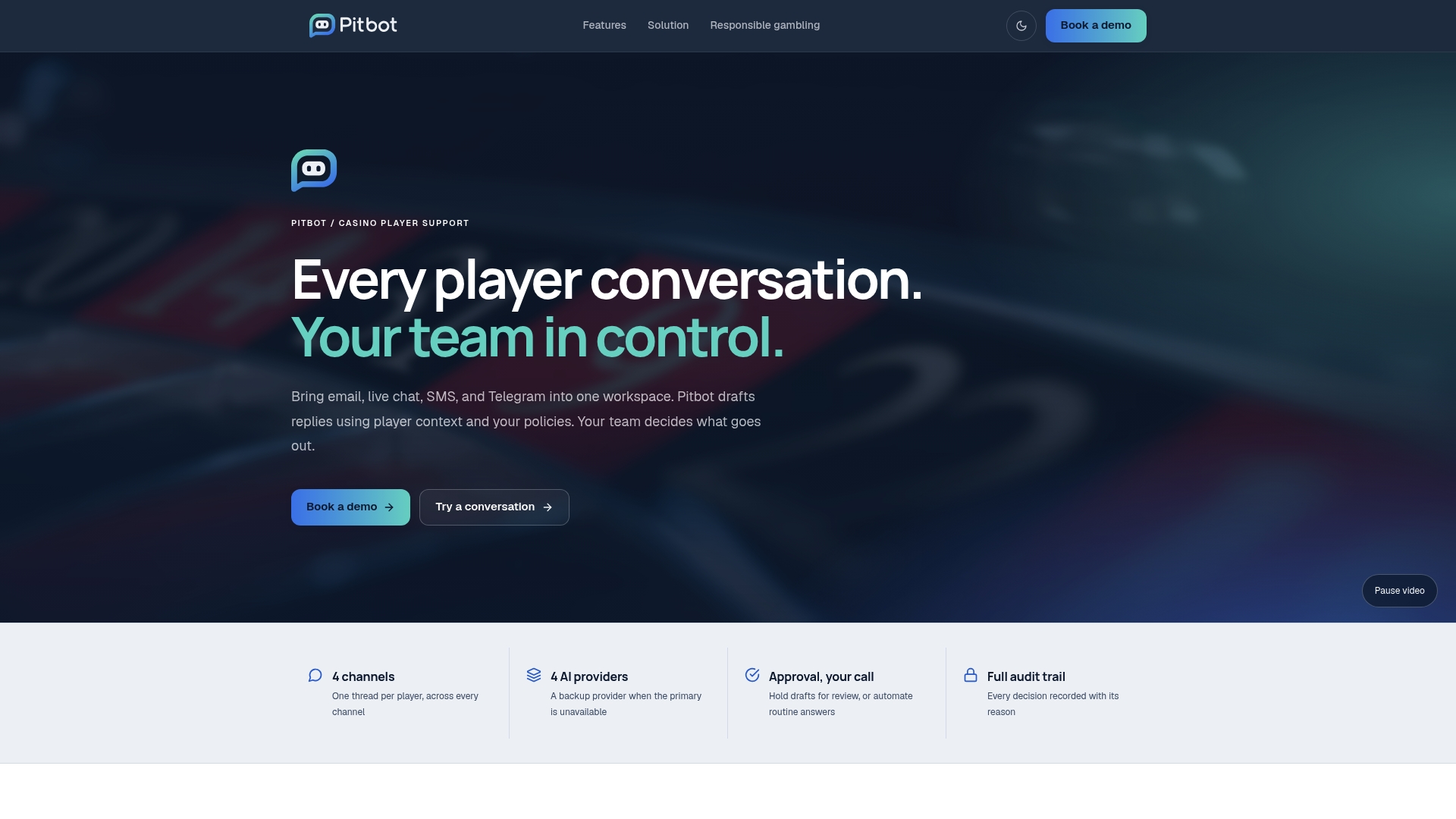
- Multi-channel coverage across email, live chat, SMS and Telegram, with each player’s conversation kept on one thread.
- Staff approval on AI drafts: with auto send off, AI-drafted replies on email, live chat, SMS and Telegram wait for staff approval before they reach a player, closing the gap between automated speed and compliance accountability.
- Timestamped conversation records that show who approved each reply, kept on the player’s thread rather than reconstructed under pressure.
See how this works for your operation on our AI customer support page for online casino and iGaming operators, or book a demo to walk through your own audit requirements.
FAQ
Does auditing affect GPA?
This question usually refers to academic course auditing, which is unrelated to chat transcript auditing. Auditing a university course for no credit typically does not affect GPA, but the exact policy depends on the institution.
Will auditors be replaced by AI?
Automated models can flag likely issues with useful accuracy, reaching weighted F1 scores of around 0.79 for ACQI-style classification, which is strong for triage. Serious, disputed or regulatory cases still need a human adjudicator, so auditors shift toward verification and escalation oversight rather than disappearing.
What is a social media audit?
A social media audit reviews an organisation’s social accounts, posts and engagement to check performance, consistency and compliance with platform or brand rules. It is a distinct discipline from chat transcript auditing, though both rely on systematic review against defined standards.
What are the five C’s of audit findings?
Definitions vary across audit disciplines, but a common version lists criteria, condition, cause, consequence and corrective action as the elements a finding should document. Recording these fields consistently, similar to the standardised finding fields used in transcript audits, makes a finding easier to act on and easier to defend later.
Sources
- Actionable conversational quality indicators for improving task-oriented dialog systems
- Message auditor — Rocket.Chat documentation
- Provide in-session chat transcripts for integrations — TeamViewer
- Retrieve session transcripts — Claude compliance sessions documentation

