An operator-facing casino knowledge base is the structured internal repository of response templates, escalation rules, compliance procedures and interaction records that support teams and AI systems use to answer player queries consistently. Done properly, it delivers three outcomes: fast and consistent replies, audit-ready records, and evidence a regulator like the Gambling Commission can review without a scramble. Standards such as ISO 30401 and platforms such as Pitbot both point in the same direction: treat the knowledge base as a governed system, not a folder of documents.
TL;DR:
- Implement incident logs and response templates with detailed metadata to ensure traceability and compliance with regulatory recordkeeping requirements.
- Regularly export interaction logs and attach reviewer rationales to facilitate audit readiness and routine quality assurance processes.
- Establish clear human oversight protocols for AI replies, including documented authority to override suggestions and comprehensive data protection impact assessments.
- Develop a structured workflow for creating, reviewing, and updating knowledge base entries, with version control, tagging, and scheduled quality checks.
- Use platforms like Pitbot to automate multi-channel compliance workflows, ensure consistent responses, and provide operational analytics for ongoing improvement.
Table of Contents
- Core components every operator knowledge base needs
- Compliance and recordkeeping regulators expect to see
- Human oversight, DPIA and explainability for AI replies
- Building, reviewing and improving the knowledge base
- Knowledge codification: structure, tagging and version control
- Types of casino games and the rules support teams need to know
- Common operational procedures a knowledge base should document
- Customer support protocols for casino environments
- Security and fraud prevention knowledge agents must have
- Why a governed knowledge base earns its keep
- Pitbot: putting these controls into an operator platform
- Sources
- FAQ
Core components every operator knowledge base needs
A casino knowledge base is only as useful as its structure. Support agents and AI systems need entries that are consistent enough to search quickly and detailed enough to defend later.
The entry types worth building first are the ones tied to regulatory risk and player experience:
- Incident logs recording behaviour that triggered an interaction, the action taken and the outcome.
- Response templates for account queries, bonus disputes and payment delays.
- Escalation playbooks defining when a case moves from agent to supervisor to compliance.
- VIP protocols covering high-value player communication and relationship management.
- Responsible gambling scripts for affordability checks, self-exclusion requests and safer-gambling nudges.
Each entry needs metadata that makes it traceable rather than just readable. At minimum that means a customer identifier, the trigger indicator that prompted the interaction, the action taken, the outcome, the staff owner, the reviewer, timestamps for creation and review, and a version number. Without these fields, an entry is a static article rather than an auditable record.
Searchability matters as much as content. Tagging by game type, issue category and jurisdiction, plus a synonym list so “self-exclusion” and “cool-off period” both surface the same article, keeps agents from writing ad hoc replies that drift from approved wording. A lightweight governance table (who drafted the entry, who approved it, and the review date) keeps ownership visible without needing a separate system.

Compliance and recordkeeping regulators expect to see
Regulatory expectations are specific about what a customer interaction record must contain. Under the Gambling Commission’s customer interaction guidance, operators must keep records covering the behaviour that prompted the interaction, the support provided and the outcome, with dip-sampling and spot-checking expected as routine quality assurance. Malta Gaming Authority rules take a similar approach: the Player Protection Directive requires a clear and detailed audit trail of player interactions, retained for at least two years from the date of the last interaction.
Minimum retention for customer interaction records is two years from the last interaction under Malta Gaming Authority rules, a baseline worth matching even where a licence does not explicitly demand it, since regulatory returns and complaint investigations often reach back further than teams expect.
A knowledge base earns its keep here by turning individual interaction logs into aggregate evidence. Practical habits that make audit preparation faster:
- Export interaction logs by date range and player segment ahead of scheduled returns.
- Attach reviewer rationale to every escalated case, not just the final outcome.
- Aggregate incident types monthly to spot patterns before a regulator does.
- Keep a running log of dip-sample results separate from individual case files.
When an inspection or licence review lands, the operator that can hand over a clean export with reviewer notes attached looks materially different from one still assembling records from separate mailboxes.
Human oversight, DPIA and explainability for AI replies
AI-assisted replies raise a specific governance question: who can stop or change what the system suggests, and is that oversight documented well enough to survive scrutiny. The ICO’s guidance on AI and data protection is clear that meaningful human oversight requires reviewers with real authority to overturn automated decisions, and that this activity must be documented, not assumed.
A workable governance sequence looks like this:
- Define which case types require mandatory human review before a reply goes out.
- Give reviewers explicit authority to overturn or edit AI-generated suggestions.
- Log every reviewer decision with a timestamp, a rationale and whether the AI suggestion was overturned.
- Complete a data protection impact assessment covering processing scope, controller and processor roles, and ongoing risks.
- Attach both process-based and outcome-based explanations to sensitive cases, following the explanation types the ICO sets out.
Pro Tip: Record the trigger for every manual intervention, not just the outcome: a reviewer log that only shows results looks like a rubber stamp, not oversight.
Building, reviewing and improving the knowledge base
A knowledge base needs a workflow as much as it needs content. Entries should move through defined stages: drafted against a template, assigned an owner, approved by a named reviewer, staged for testing, then published with a version number that supersedes the previous entry rather than sitting alongside it.
Quality assurance is where most knowledge bases quietly fail. Gambling Commission guidance recommends spot-checking chat records, emails and behaviour-change data to evaluate what works and surface staff training needs. Useful KPIs to track alongside dip-sampling include:
- Average response time by channel and case type.
- Complaint volume trends following template updates.
- Take-up of responsible gambling tools after an intervention.
- Reviewer override rate on AI-generated suggestions.
| Activity | Frequency | What it tells you |
|---|---|---|
| Dip-sampling of interaction records | Ongoing, per Gambling Commission guidance | Whether agents follow approved templates |
| Follow-up contact with sampled players | Periodic | Whether indicators of harm reduced after an interaction |
| Template and workflow review | Scheduled | Whether entries still match current regulatory wording |
Small trials matter more than wholesale rewrites. Testing one revised escalation template against a sample of cases, then measuring response time and complaint rate before rolling it out wider, matches the identify, act, evaluate approach set out in LCCP condition 3.4.3, which requires licensees to evaluate the effectiveness of their approach, for example by trialling and measuring impact, rather than assume a policy works.
Knowledge codification: structure, tagging and version control
Codifying knowledge means converting what staff know into articles that follow a repeatable structure: a title, a trigger scenario, the approved response, escalation conditions and a version history. Consistent structure is what lets a new agent or an AI system locate the right answer in seconds rather than guessing at phrasing.
Tagging should work on at least two axes: subject (payments, bonuses, self-exclusion, VIP) and jurisdiction, since wording that satisfies one regulator may not satisfy another. Version control matters just as much as tagging. Every update needs a version number, a change reason and the name of the approver, so that if a player complaint refers to an old response, the team can show exactly what guidance was live at the time. This is the codification discipline that ISO 30401 treats as core to knowledge management: identification, structured storage, retrieval and evidence of management review, rather than an unmanaged pile of documents that nobody dates.
Types of casino games and the rules support teams need to know
Support staff cannot resolve a dispute without understanding the game mechanics behind it. Table games such as blackjack, roulette and baccarat each carry distinct rules around payouts, house edge variations and dealer procedures that affect how a dispute gets investigated. Slot games raise different questions entirely: return-to-player percentages, bonus round triggers and malfunction clauses tend to generate the bulk of player queries.
Live dealer games sit between the two, adding streaming reliability and dealer conduct to the list of things a support agent might need to explain. Poker and other player-versus-player formats introduce rake structures and table rules that differ from house games. A knowledge base entry for each game type should cover the basic rules, the most common player complaints tied to that game, and the standard resolution path, so an agent handling a roulette payout dispute is not improvising an explanation of the wheel layout on the fly.
Common operational procedures a knowledge base should document
Day-to-day casino operations generate a steady stream of procedural questions that a knowledge base should answer without escalation. Account verification, know-your-customer checks and deposit or withdrawal processing times are among the most frequent. Bonus terms, including wagering requirements and game-weighting rules, generate enough disputes to justify a dedicated, regularly updated entry.
Payment processing procedures deserve particular care, since delays or declined transactions are a leading driver of complaints and often intersect with fraud checks. Account closure, self-exclusion and cooling-off procedures need clear, unambiguous steps, since getting these wrong carries both player welfare and regulatory risk. Each procedural entry should state who is authorised to approve exceptions, since inconsistent handling of edge cases is one of the fastest ways for a knowledge base to lose staff trust.
Customer support protocols for casino environments
Support protocols set the tone and structure for every player interaction, independent of channel. A clear first-response standard, an escalation path for disputes above a certain value, and a defined handover process between AI-generated and human-reviewed replies all belong in the knowledge base rather than in individual agents’ heads.
Tone guidelines matter more in gambling support than in most sectors, since a poorly worded reply to a player showing signs of harm can itself become a regulatory issue. Protocols should specify how to handle multilingual queries, how VIP cases are prioritised and routed, and how a case gets flagged for responsible gambling review rather than closed as a routine query. Consistency here is what separates a knowledge base from a loose set of good intentions: the same trigger should produce the same standard of response regardless of which agent or system handles it.
Security and fraud prevention knowledge agents must have
Fraud attempts against casino operators tend to cluster around a small number of patterns: bonus abuse through multiple accounts, identity fraud during know-your-customer checks, and payment fraud using stolen card details. A knowledge base entry for each pattern should describe the warning signs, the verification steps to take, and who to escalate to when a case looks suspicious.
Account security procedures, including two-factor authentication resets and suspicious login investigations, need equally clear documentation, since support agents are often the first point of contact when a player reports unauthorised account access. Chargeback handling and know-your-customer document verification are two more areas where inconsistent agent handling creates both financial loss and regulatory exposure, so these entries benefit from the same versioned, reviewed structure as compliance content elsewhere in the knowledge base.
Why a governed knowledge base earns its keep
A shared knowledge base does more than speed up replies. It removes the variability that comes from ten agents each remembering the rules slightly differently, and it turns VIP handling from personal relationships into repeatable, reviewable process. Reviewer logs and audit trails are not paperwork for its own sake. They are what lets an operator answer a regulator’s question in minutes rather than weeks, and usage patterns across the knowledge base often point straight at where staff training is falling short.
— Pitbot
Pitbot: putting these controls into an operator platform
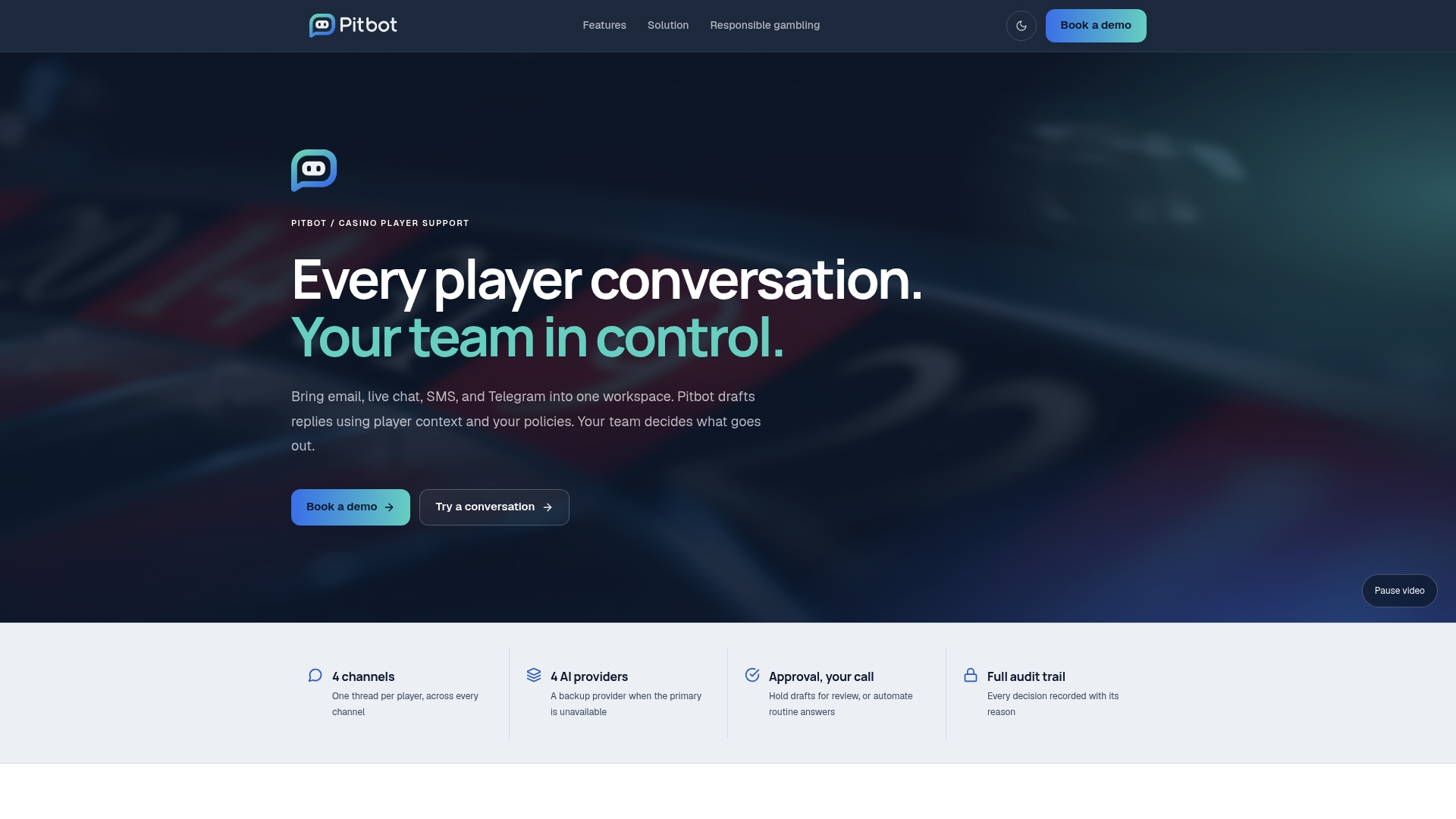
Building this structure by hand across email, live chat, SMS and Telegram is a lot to maintain. Pitbot combines multi-provider AI drafting with configurable human review: you can hold AI-drafted replies for staff approval before they reach a player, decisions are recorded in an append-only audit trail, and each brand keeps its own knowledge base and policies.
In practice, that means:
- AI-drafted replies on email, live chat and Telegram can wait for staff approval, and responsible gambling and regulator flags on those channels are a hard stop: the thread is escalated to a person instead of answered, and a sensitive case opens for someone to pick up.
- One active thread per player shared across email, live chat, SMS and Telegram, with each brand’s knowledge base and policies behind every draft.
- Analytics on first response times, AI handle rate, VIP handling and sentiment, with exportable reports.
If your team is weighing up whether to build this internally or adopt a platform that already does it, book a demo to see how Pitbot handles audit trails and reviewer oversight in practice.
Sources
Before finalising a knowledge base structure, operators should read the primary guidance directly rather than relying on secondary summaries.
- Customer interaction guidance - requirement 8 (Gambling Commission)
- Guidance on AI and data protection — human oversight (ICO)
- Directive 2 of 2018: Player Protection Directive (Malta Gaming Authority)
FAQ
What should an operator-facing casino knowledge base contain?
It should contain incident logs, approved response templates, escalation playbooks, VIP protocols and responsible gambling scripts, each tagged with metadata such as trigger indicator, action taken, outcome, reviewer and timestamp. This structure is what makes entries usable for both staff and AI systems while remaining auditable.
How long must customer interaction records be kept?
Retention requirements vary by regulator, but Malta Gaming Authority rules require interaction records to be kept for at least two years from the date of the last interaction. Operators licensed elsewhere should check their own regulator’s specific retention rule rather than assume this figure applies universally.
What counts as meaningful human oversight of AI replies?
Meaningful oversight means a reviewer has real authority to overturn or edit an AI-generated reply before it reaches a player, not just a formal sign-off step. The ICO expects this activity to be documented so the organisation can demonstrate it was genuine.
How often should a knowledge base be quality-checked?
Gambling Commission guidance recommends ongoing dip-sampling and spot-checking of chat and email records rather than a fixed annual review. Pairing this with periodic follow-up contact with sampled players helps confirm whether interactions actually reduced indicators of harm.
Can Pitbot hold AI-generated replies for human review?
Yes. Staff approval is configurable per brand: with auto send off, AI-drafted replies on email, live chat and Telegram wait for staff approval before they reach a player. Responsible gambling and regulator flags on email, live chat and Telegram are a hard stop: the thread is escalated to a person instead of answered, and a sensitive case opens for someone to pick up. Decisions are recorded in an append-only audit trail.