

Outreach suppression in gambling means stopping promotional contact from reaching a player the moment risk indicators say it should not. The operational rule that matters most: suppression checks must run live at the point of dispatch, not from a stale export, and any unresolved conflict should block the message by default. Trials link this approach to meaningful drops in bets placed, spend and short-term harm, and UK regulatory guidance treats it as a licence condition, not a nice-to-have.
TL;DR:
- Suppression checks should be performed in real-time at message dispatch to prevent promotional contact after risk indicators trigger an intervention.
- Tiered risk indicators like spend spikes, loss chasing, and payment failures determine whether a player needs routine monitoring, a check-in, or suppression of all outreach.
- Automated suppression must be integrated across all communication channels with live, event-driven checks to avoid delays or outdated lists.
- Outreach methods like personalized feedback and timely communication significantly reduce gambling activity and harm among at-risk players.
- Clear accountability, regular audits, and documented decision logs are essential to maintaining compliant and effective suppression and outreach systems.
Table of Contents
- Core pillars of an outreach suppression strategy
- Which behavioural signals should trigger suppression or outreach?
- Designing suppression as a live, event-driven control
- Which outreach methods actually reduce harm?
- Turning SR Code 3.4.3 into a day-to-day checklist
- Measuring whether suppression and outreach actually work
- Where automation and human review fit into suppression
- Getting the balance right between protection and usability
- How Pitbot supports suppression and safer outreach
- FAQ
- Sources
Core pillars of an outreach suppression strategy
Suppression only works when it sits inside a wider responsible gambling framework rather than standing alone as a marketing filter. Four pillars hold that framework together.
Prevention starts with product and communication design: tools, limits and warnings surfaced at moments when a player is actually making a decision, not buried in a settings menu. Monitoring then turns raw account activity into something a suppression engine can act on, pulling together deposit patterns, session length and account flags into a single risk signal. Outreach and human support give the system somewhere to send players once promotional contact has been blocked: a welfare message, a support line, or a case worker rather than silence. Measurement and governance close the loop, giving compliance teams and regulators evidence that the whole system does what it claims.
Each pillar depends on the others. Monitoring without outreach just identifies harm without acting on it. Outreach without suppression risks sending a sympathetic message alongside a bonus offer, which undermines both.
- Prevention: build limit-setting and warnings into the product itself, not just the terms and conditions.
- Monitoring: feed deposit, session and payment-failure data into a live risk score.
- Outreach: pair every suppression event with a route to support, not just an absence of marketing.
- Measurement: track outcomes against a control group wherever ethically possible, and keep the audit trail regulators will ask for.
The Gambling Commission’s customer interaction guidance frames this as an identify, act and evaluate cycle, with action tailored to the strength of the indicators rather than a single trigger point.
Which behavioural signals should trigger suppression or outreach?
Not every signal carries equal weight, and treating them all the same produces either too many false alarms or too many missed cases. A tiered approach works better than a single threshold.
- Spend spikes. A sudden jump in deposits or wagering relative to a player’s own baseline is one of the most reliable early indicators.
- Deposit cadence. Increasingly frequent top-ups, especially several in a single session, often precede chasing behaviour.
- Loss chasing. Rapid re-deposits immediately after a loss, particularly larger ones, is a classic red flag.
- Session length. Long, late-night or unusually frequent sessions suggest the player is losing control of their time.
- Payment failures. Repeated declined payments followed by retries from different cards or methods point to financial strain.
- Account behaviour changes. Switching off limits, ignoring reality-check prompts, or contacting support about losses are direct, customer-led signals.
The Gambling Commission guidance lists exactly this mix: spend, patterns of spend, time spent, behavioural indicators and customer-led contact, and expects operators to combine them rather than rely on one metric.
Distinguishing a genuine VIP from a player in trouble is the hardest part of this exercise. High lifetime value with stable, predictable deposit patterns and no escalation after losses looks very different from erratic spend spikes paired with repeated payment failures, even when the pounds involved are similar.
A practical tiering model: low risk is stable spend with no flags, which needs only routine monitoring. Medium risk is one or two signals, such as a deposit spike without chasing, which warrants a personalised check-in rather than suppression. High risk is multiple concurrent signals, loss chasing plus payment failures plus late-night sessions, which should trigger suppression of all promotional contact and a welfare outreach attempt.
Pro Tip: Weight customer-led signals, such as a player asking about losses or disabling a limit, more heavily than inferred ones. They are harder to misread.
Designing suppression as a live, event-driven control
The biggest operational mistake in suppression is treating it as a batch job. A nightly export of self-excluded or opted-out players, pushed into the email platform once a day, leaves a gap of hours during which SMS, push notifications, onsite banners and bonus engines keep firing. Live, event-driven checks at the point of dispatch close that gap, because every channel queries the same suppression status at the moment it is about to send.
A precedence hierarchy resolves conflicts between systems that might otherwise disagree. Self-exclusion outranks marketing opt-in, marketing opt-out outranks a VIP tag, and any unresolved conflict defaults to blocking the message rather than sending it. This is the fail-closed principle: when the system cannot confirm a message is safe to send, it does not send it.
- Email and SMS: check suppression status at send-time, not at list-build time.
- Push and onsite banners: route through the same suppression API as email, since these channels are often forgotten.
- Bonus engines: suppress automatic bonus grants and related messages, not just the notification about them.
- Paid and third-party lists: contractually require suppression file syncing before any list upload.
- Transactional and service messages: these remain allowed, since account security, withdrawal confirmations and regulatory notices are not promotional contact.
| Channel | Suppression check timing | Typical failure mode without it |
|---|---|---|
| Live, at dispatch | Stale list sends offer hours after opt-out | |
| SMS | Live, at dispatch | Separate platform misses the suppression flag |
| Push notification | Live, at dispatch | Often excluded from suppression scope entirely |
| Bonus engine | Live, at trigger event | Automated bonus still granted and announced |
| Paid/third-party lists | Pre-upload sync | Supplier uses an outdated export |
Which outreach methods actually reduce harm?
Suppression stops harm from arriving through the front door; outreach is what operators send instead. The evidence base here is stronger than for most responsible gambling tools, and it points in a specific direction.
A randomised field experiment of 227 regular Australian bettors found that opting out of direct marketing led to 23% fewer bets, 39% less money spent and 67% fewer short-term gambling harms over 14 days compared with a control group who kept receiving marketing. Separately, a study of 2,576 Dutch online gamblers found that personalised feedback interventions sent by email or telephone significantly reduced deposits, wagers, deposit frequency and time spent gambling over the following 30 days. Email-based personalised feedback appears to scale almost as well as telephone outreach, while telephone calls remain better suited to individual case management for the highest-risk accounts, where a human conversation can pick up on things a template cannot.
- Light-touch nudges (email or SMS) suit medium-risk players and should focus on factual feedback, such as time spent or net loss, rather than guilt or alarm.
- Telephone case management suits high-risk players where a single message is unlikely to be enough and a two-way conversation can assess genuine need.
- Timing matters: outreach sent soon after a risk event lands better than a delayed, generic campaign.
Pro Tip: Suppress commercial offers immediately on a risk trigger, but keep a welfare contact route open. Blocking all contact, including support messages, can leave an at-risk player with nowhere to turn.
Turning SR Code 3.4.3 into a day-to-day checklist
Regulatory obligations only protect players if they translate into specific, dated actions. The Gambling Commission expects remote operators to act on indicators of harm, which includes keeping marketing away from customers it should not reach, such as those who have self-excluded, and making sure third-party suppliers do the same.
- Remove from marketing lists immediately on a self-exclusion or opt-out event, not at the next scheduled sync.
- Propagate the suppression flag to every internal system within the same day, including bonus engines and onsite personalisation.
- Write suppression clauses into vendor contracts, with a defined SLA for how quickly a third-party supplier must apply an updated suppression file.
- Audit third-party compliance periodically, rather than assuming a contract clause guarantees behaviour.
- Log every suppression decision in an append-only record, including the reason for the block and the system that acted on it.
- Require manual review before any automated decision that materially affects a player, such as an account restriction, takes effect without a human check.
Measuring whether suppression and outreach actually work
Suppression without measurement is a policy on paper. Three categories of KPI matter: direct behaviour (bets placed, net deposit), short-term harm proxies, and downstream outcomes such as subsequent self-exclusion rates.
- Behavioural KPIs: bets placed and net deposit, tracked for the suppressed group against a comparable baseline period.
- Harm proxies: short-term gambling harm scales, adapted where needed, applied before and after an intervention.
- Trial design: randomised field experiments or matched controls give the strongest evidence, as demonstrated by the Australian opt-out trial, which compared an opt-out group against a control group over a fixed 14-day window.
- Ethical safeguards: vulnerable players should never be placed in a control group that withholds known protective action purely for measurement purposes.
- Reporting loop: results should go to both internal stakeholders and, where relevant, regulators, with the same figures used in both to avoid a credibility gap.
Where automation and human review fit into suppression
A suppression and outreach system generates constant decisions: who gets blocked, who gets a welfare message, who gets escalated to a case worker. Multi-provider AI can draft context-aware responses across email, live chat, SMS and Telegram, and you can hold AI-drafted replies for staff approval before they reach a player, which matters most where the message concerns a sensitive account state. Recording who approved what and when matters as much for a regulator’s file request as for the player’s experience. Escalation, multilingual replies and assigning a thread to a named owner can run alongside suppression logic rather than against it, so a high-value player with a genuine risk flag still reaches a case worker instead of a bonus email. Read more in our responsible gambling automation overview.

Getting the balance right between protection and usability
Suppression works best with a named policy owner, a named technical owner and clear reviewers, not a system nobody is accountable for. Over-blocking frustrates safe players; under-blocking causes harm and regulatory exposure, which costs more. Measure outcomes, keep regulator-ready logs, and let evidence settle the argument rather than instinct.
— pitbot
How Pitbot supports suppression and safer outreach
Our platform is built so that promotional and support messages can be checked before they reach a player, with a traceable record. A campaign cannot be sent until an admin approves it, and with auto send off, AI-drafted replies on email, live chat, SMS and Telegram wait for staff approval before they reach a player.
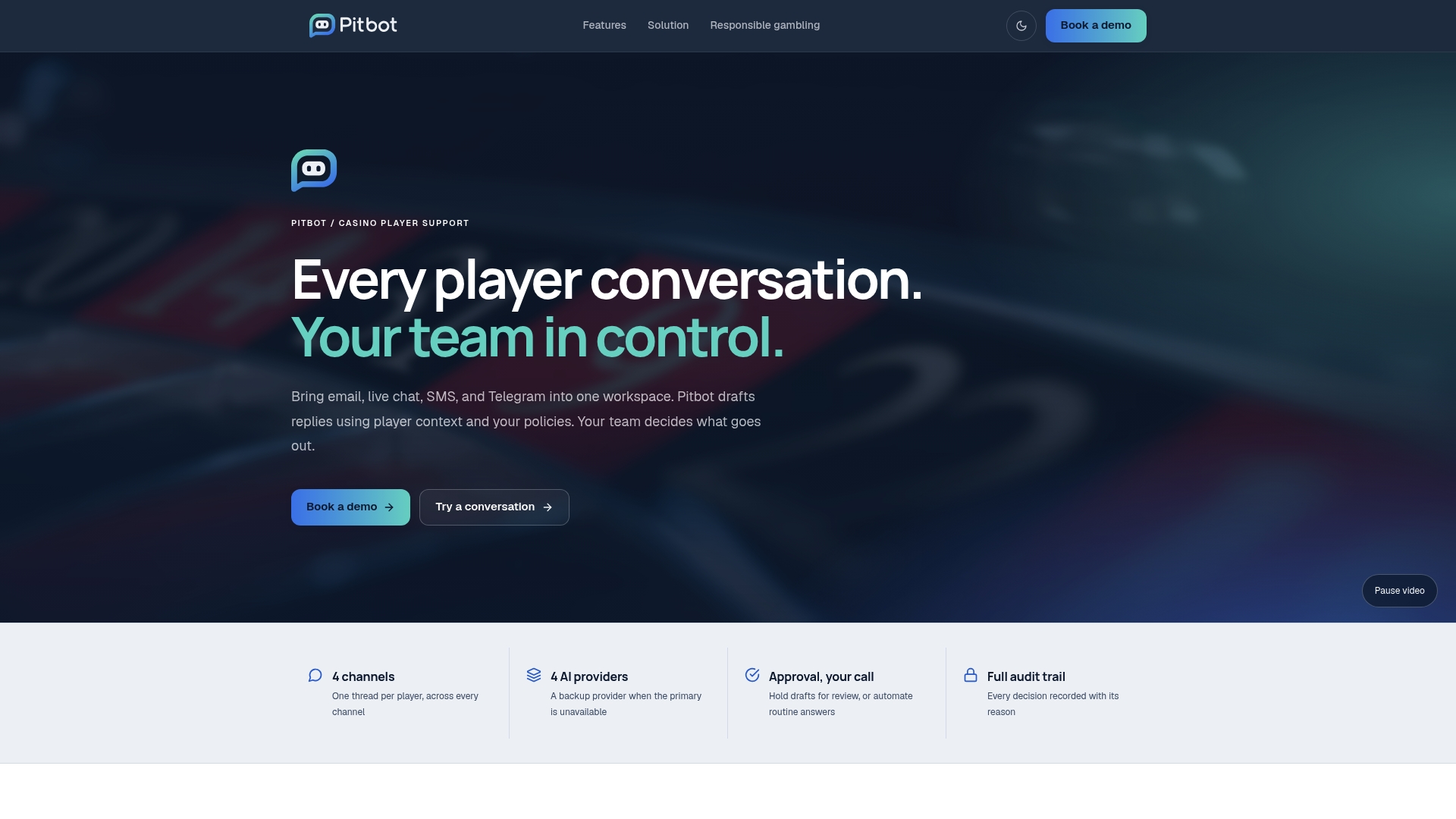
- Campaigns and automations check suppression rules and the player’s consent on that channel at send time, and self-excluded players, players in cooling-off and players with an open sensitive case are blocked from marketing.
- Responsible gambling and regulator flags on email, live chat, SMS and Telegram are a hard stop: the thread is escalated to a person instead of answered, and a sensitive case opens for someone to pick up.
- Thread assignments let you hand a conversation to a named member of your team, with handover history, so a case stays with the person working it.
- A suppression log and an append-only audit trail support compliance needs for audit and regulatory purposes.
If you are reviewing how suppression fits your own player support setup, book a demo or read more on our responsible gambling product page.
FAQ
Can you claim for irresponsible gambling?
In some jurisdictions, players who believe an operator failed in its duty of care, for example by continuing to market to a self-excluded account, can raise a complaint with the operator and escalate to the relevant regulator or ombudsman. Outcomes depend on local law and the specific facts, so players should check the rules that apply in their own market.
What are the seven warning signs of problem gambling?
Commonly cited signs include chasing losses, gambling with money needed for essentials, lying about gambling, borrowing to fund play, neglecting responsibilities, irritability when trying to stop, and needing to gamble with increasing amounts to feel the same excitement. Definitions vary slightly between organisations, but these themes recur across most screening tools.
What is SR Code 3.4.3 in gambling regulation?
SR Code 3.4.3 is part of the UK Gambling Commission’s social responsibility code and covers customer interaction for remote operators: identifying customers at risk of harm and taking action, which can include stopping marketing to them. Separate Gambling Commission rules require operators to keep marketing away from self-excluded customers, including through third-party suppliers. Check the current text of the code with your compliance team.
What strategies help prevent gambling harm?
Effective strategies combine product-level controls such as deposit limits and reality checks with active monitoring of spend and session patterns, paired with personalised outreach when risk indicators appear. Evidence from personalised feedback interventions shows that timely, tailored contact from the operator itself can reduce deposits and time spent gambling in the following weeks.
Sources
- Direct gambling marketing, direct harm: a randomised experiment (2026)
- The impact of personalised feedback interventions by a gambling operator on subsequent gambling expenditure (2022)

