

Sentiment-based escalation uses sentiment signals to spot dissatisfied customers early and route them down a monitored path to a human. If you run high-value accounts, a regulated operation or a busy omni-channel queue, enable it now. Start with alerts that a person reviews during an initial period, then loosen thresholds only when the evidence supports it.
TL;DR:
- Run live scoring on one or two highest risk channels, use batch analysis elsewhere, and monitor queue latency from launch so alerts arrive in time.
- Use a dedicated single task model with filtered customer text, then validate negative class recall and precision against your own CSAT and ticket outcomes.
- Send flagged cases to a named owner with a concise summary, timeline, sentiment trajectory, confidence, and reasoning; require human review before regulated customer messages.
- Before EU deployment, document lawful basis, assess impact, inform customers, preserve human oversight, restrict retention, and consult counsel because emotional inference faces tight rules.
- Pilot one high value queue against a comparable control for a full contact cycle; extend the run if too few cases emerge for comparison.
Table of Contents
- How does sentiment-based escalation work in real time and in batch?
- How do you choose and validate a sentiment model?
- What does a good escalation workflow and handoff look like?
- What governance and compliance safeguards do you need?
- How do you measure success and run a pilot?
- What do production deployments tell us?
- Which types of sentiment analysis should you use?
- What do typical escalation scenarios look like in an online casino?
- How do you integrate sentiment escalation with your CRM and support systems?
- How should you train staff to handle escalated cases?
- Our perspective: human review comes first
- How Pitbot helps you put this into practice
- FAQ
- Sources
How does sentiment-based escalation work in real time and in batch?
The core idea is simple: read what the customer wrote or said, score the mood, and decide whether a person should step in. What differs is when that decision happens.
Real-time analysis covers live chat and call transcripts. It catches a customer who is turning angry mid-conversation, while there is still time to change the outcome. Batch analysis covers reports and historical tickets. It cannot save a conversation already finished, but it shows which topics, queues and agents generate frustration. Most teams run both: live alerts for rescue, nightly trend analysis for fixing causes.
The pipeline has the same shape either way:
- Ingest: pull messages from chat, email, tickets and call transcripts into one stream.
- Prefilter: strip out agent text, templates and signatures so the model reads only the customer.
- Model inference: score each interaction for sentiment.
- Structured output: return a label, a confidence score and a short reasoning field.
- Alerting and triage: route flagged cases to the right queue by priority.
The trade-off is latency against coverage. A real-time pipeline needs fast inference and monitoring, so you may score fewer channels at first. Batch jobs can cover everything cheaply but arrive too late to rescue a single conversation. Starting real-time on your one or two highest-risk channels, and running batch over the rest, is a sensible compromise. The ordering also matters operationally: because the alert only helps if someone sees it in time, instrument queue latency from the first day, not after launch.
How do you choose and validate a sentiment model?
Choose for the failure you most want to avoid: missing a dissatisfied customer. Practitioner evidence points towards dedicated single-task agents rather than one model doing many jobs at once, because multi-task setups tend to drift towards a neutral verdict.
A 2026 deployment study found that dedicated single-task LLM agents with input filtering and explicit prompt engineering improved detection of dissatisfied customers, and that costlier models did not always catch more bad cases. Price is not a proxy for the performance you need.
Require structured output on every call: a sentiment label, a confidence score and a one or two sentence reasoning. That reasoning lets a human triage in seconds and lets you audit why an alert fired.
Validate against production ground truth, meaning your own CSAT scores and ticket outcomes, not a public benchmark. Track recall and precision on the negative class specifically. Overall accuracy flatters a model that labels everything neutral, since most interactions are neutral anyway. The question to ask is how many of the customers who ended up unhappy did the model flag beforehand, and how many of its flags were false alarms.
Pro Tip: Keep a sample of every week’s flagged and unflagged tickets, label them by hand, and re-run your recall figure monthly. Drift shows up here long before it shows up in CSAT.

What does a good escalation workflow and handoff look like?
An alert is only useful if the person who receives it can act promptly. A common failure is a handoff that forces the customer to repeat themselves, which can turn mild irritation into anger.
Practitioner studies describe context-rich handoffs: verified identity, the core problem in a sentence or two, a chronological timeline and the sentiment trajectory, rather than a raw transcript. Add the model’s confidence and reasoning so the receiving agent knows how much weight to give the flag. In regulated markets, keep a human gate on any outbound message to the customer.
A repeatable process:
- Detect: the model flags an interaction with label, confidence and reasoning.
- Route by priority: combine sentiment with account value and open-escalation status to choose the queue.
- Notify: alert the named owner or on-duty escalation lead, not a shared inbox.
- Brief: attach the summary, timeline and sentiment trajectory to the case.
- Act first: the receiver acknowledges the problem in their own words and states the next step before asking anything new.
- Review and close: log the outcome so the model and thresholds can be checked against it.
Pro Tip: Write the handoff summary template once, with fixed fields, and make it the only way a case can be escalated. Consistency matters more than eloquence.
What governance and compliance safeguards do you need?
Inferring emotional states is one of the more sensitive things you can do with AI in the European Union. The EU’s AI regulatory framework and GDPR together require transparency, protection against discriminatory bias, human oversight and impact assessments, and the consequences of getting it wrong are real. A Hungarian supervisory authority case reported by the European Data Protection Board involved automated analysis of service calls that inferred emotional states without adequate transparency or objection rights, ending in an investigation and an administrative fine of approximately EUR 650,000.
The Commission’s guidelines on prohibited AI practices add that manipulative or exploitative techniques are banned, which matters if escalation ever feeds persuasive outbound messaging. Legal status depends on your market and use case, so take advice from counsel before launch. Practical safeguards:
- Document your lawful basis and run an impact assessment before going live.
- Tell customers that sentiment analysis happens and give a way to object where required.
- Keep a person in the loop for decisions and outbound messages.
- Store only what you need of the inference outputs, and log every decision for audit.
- Set confidence thresholds, require human review below them, and audit routinely.
How do you measure success and run a pilot?
Track two families of metrics. Operational: time to escalation, SLA compliance, and precision and recall for the negative and frustrated labels. Business: churn on flagged accounts, revenue recovered per saved account, and CSAT or NPS movement.
Run a pilot on one queue or segment, ideally your highest-value one. Split comparable traffic into a group with sentiment alerts and a control without, run it long enough to see a full contact cycle for your customers, and make sure each arm has enough escalation-worthy cases to compare. If volumes are small, extend the run rather than reading early noise as a result. Use the model’s reasoning field to sort false positives into patterns, such as sarcasm or quoted complaints, and adjust thresholds accordingly.
A 2026 evaluation found that dedicated agents with input filtering outperformed multi-task models at spotting dissatisfied customers, so your pilot should measure bad-case recall first and savings second. Without recall, any financial figure is guesswork.
Present the investment case in three lines: cases caught earlier, accounts retained, and handling effort saved by better handoffs.
What do production deployments tell us?
One lesson stands out from practitioner deployments. Detection quality comes less from model size than from design: a single-task agent, a filtered input and a prompt that states exactly what counts as dissatisfaction. The 2026 study reports that this combination improved detection against multi-task models, and that the costliest model did not automatically win.
Structured reasoning is the second lever. A one-line explanation beside each flag lets a human confirm or dismiss an alert quickly, which keeps review cheap and false alerts from clogging the queue. Without it, you either trust the model blindly or re-read every transcript.
The third point is that neutral bias is an engineering problem, not a fact of life. Context filtering and careful prompting are what move a model from labelling almost everything neutral to catching the cases you care about. If your first results look flat, change the input and the instruction before changing the vendor.
Which types of sentiment analysis should you use?
Several approaches matter in support, and they answer different questions.
Polarity analysis labels a message positive, neutral or negative. It is the simplest and the right starting point for an escalation trigger, though it says nothing about why the customer is unhappy.
Aspect-based analysis attaches sentiment to specific topics within one message, such as “happy with the agent, furious about the delay”. It tells you whether to route to billing, technical or account teams, and it is what turns a flag into a useful routing decision.
Emotion detection goes beyond positive and negative to categories such as anger, anxiety or disappointment. It can help an agent adjust their opening tone, but it is also the form most exposed to regulatory scrutiny, so apply the safeguards above before using it on voice or other sensitive channels.
Intent detection identifies what the customer wants to do: cancel, dispute, request a refund, ask for a manager. Intent often predicts escalation risk better than mood alone, since a calm message that says “I will close my account” matters more than an irritated one asking about opening hours.
In practice, combine polarity for the trigger, aspect for routing and intent for urgency, and treat emotion labels as optional context rather than the decision itself.

What do typical escalation scenarios look like in an online casino?
Casino support has its own pressure points, and each calls for a slightly different response.
- Delayed or disputed withdrawals: the classic trigger. A player waiting on a payout whose messages shift from polite to repeated and terse should reach a senior agent before they reach social media or a regulator.
- Verification friction: a player asked repeatedly for documents they believe they have already sent. Repeat-contact signals plus negative sentiment justify priority routing.
- Bonus and promotion disputes: disagreements over terms often carry strong language. Human review matters here because the reply has compliance weight.
- VIP complaints: high account value raises priority even when the wording is mild. A calm message from a valued player about a broken service promise still deserves quick human attention.
- Account restrictions and closures: emotionally charged, and sometimes linked to responsible gambling concerns. Escalation should go to trained staff, and outbound marketing to that player should pause.
- Signs of distress: messages suggesting a player is struggling with their gambling should never be handled by automation alone. Route to a human trained for these conversations and follow your responsible gambling procedures.
The common thread is that sentiment is a trigger, not a verdict. The final call on tone, remedy and compliance always sits with a person.
How do you integrate sentiment escalation with your CRM and support systems?
Treat sentiment output as another field in the systems your team already uses, not a separate tool people must remember to check.
Start with the data flow. Messages from each channel reach the sentiment service, and the result (label, confidence, reasoning, timestamp) is written back to the ticket and the player or customer record. From there, your existing routing rules can use it: a negative label on a VIP account can set priority, change the queue and notify a named owner without any new interface.
Keep three principles in mind. First, write results back as structured fields so they can be filtered, reported and audited; free-text notes are hard to analyse. Second, preserve the link between the alert and the case outcome, because that connection is what lets you recompute recall and tune thresholds. Third, respect access control: sentiment inferences are sensitive, so limit who can see them and how long they are retained, consistent with the governance steps above.
Plan for failure modes too. If the sentiment service is slow or down, tickets should fall back to normal routing rather than stall, and a monitoring dashboard should show queue latency and alert volumes so you notice drift. Start with the one system your agents live in all day and integrate deeper only once the first loop works.
How should you train staff to handle escalated cases?
Training turns a good alert into a good outcome. Escalated customers arrive already frustrated, so the agent’s opening response matters.
Teach the receiving agent to read the briefing before replying: the summary, the timeline, the sentiment trajectory and the model’s confidence. Then acknowledge the problem in their own words and state a concrete next step before asking anything new. Techniques such as affect labelling (“it sounds like this has been really frustrating”) and calibrated questions tend to lower emotional intensity better than standard scripts, though this is practitioner experience rather than a figure we can cite.
Build practice around real cases:
- Run short role-plays using anonymised flagged tickets, including false positives, so agents learn when to trust the alert and when to question it.
- Calibrate together: have agents label a sample of tickets and compare with the model’s labels.
- Train specifically for sensitive situations, including distress signals and regulated conversations, with clear escalation paths to specialists.
- Close the loop: feed agent feedback on bad flags into threshold and prompt reviews.
Finally, protect the people doing this work. Escalated queues are emotionally demanding, so rotate ownership, review workload and give agents authority to resolve issues instead of passing them on.
Our perspective: human review comes first
In regulated environments, an auditable human decision matters more than a faster automated one. The temptation is to chase automation rates, but a sentiment alert that triggers an unreviewed message in a gambling context creates risk you cannot easily reverse. Start with a high-value pilot, measure recall and business outcomes from the outset, and invest in handoff quality before anything else. A clean briefing and a prepared human beat a clever model every time.
— pitbot
How Pitbot helps you put this into practice
We built Pitbot as an AI plus human review platform for regulated operator support, so many of the patterns in this guide are built in rather than add-ons.
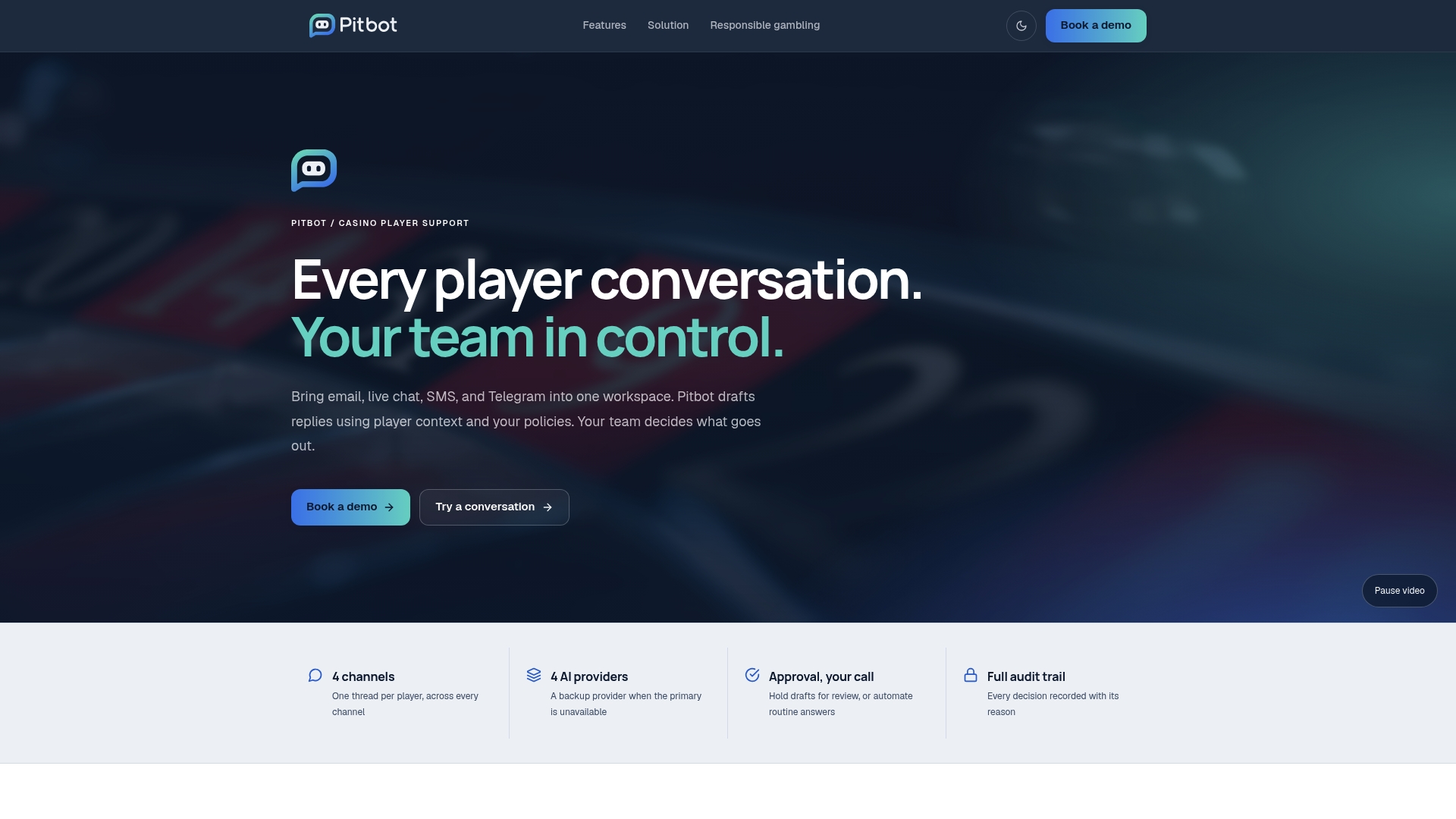
A demo shows you:
- Omni-channel coverage across email, live chat, SMS and Telegram
- Audit trails of AI actions and of who approved each reply
- Escalation for sensitive cases. Responsible gambling and regulator flags on email, live chat, SMS and Telegram are a hard stop: the thread is escalated to a person instead of answered, and a sensitive case opens for someone to pick up.
- Thread assignments that hand a conversation to a named owner, with handover history
- Approval before sending: with auto send off, AI-drafted replies on email, live chat, SMS and Telegram wait for staff approval before they reach a player
To see it with your own scenarios, request a demo of our AI customer support for online casino operators or see plans and prices on the pricing page.
This article is general information, not a substitute for advice from a qualified lawyer. Consult a qualified legal professional about your own circumstances before acting on anything here.
FAQ
What are the applications of sentiment analysis in support?
In customer support, sentiment analysis flags unhappy customers early, routes cases by urgency and reveals which topics or queues generate frustration. It also feeds quality reviews and trend reporting. Large language models can perform it alongside tasks such as automating responses and escalating complex cases to human agents.
Can I use ChatGPT for sentiment analysis?
A general-purpose chat model can classify sentiment, but production escalation needs more: structured output, filtered input, validation against your own outcomes and a compliance review. Evidence from a 2026 deployment study favours dedicated single-task agents with input filtering over looser setups.
What is a good accuracy for sentiment analysis?
There is no universal benchmark worth trusting. Overall accuracy can look high while the model misses the unhappy customers you care about, so measure recall and precision on the negative class against your own CSAT and ticket outcomes instead.
Is sentiment analysis of customer calls legal?
It depends on your market, your lawful basis and your safeguards. In the EU, inferring emotional states is tightly constrained, so document your basis, assess impact, be transparent and keep human oversight, as set out in the EU’s AI regulatory framework. Take legal advice before deploying.
Sources
Start where the customer’s own words already live. The strongest sources are:
- Digital-strategy
- Data protection issues arising in connection with the use of Artificial Intelligence | European Data Protection Board
- Commission Guidelines on prohibited artificial intelligence practices established by Regulation (EU) 2024/1689 (AI Act)
- From TextBlob to LLM Agents: Sentiment Model Selection for B2B Technical Support with CSAT Ground Truth
Prefiltering deserves more attention than it usually gets. If you feed the model agent replies and canned phrases alongside customer messages, polite scripted language drags scores towards neutral and hides real frustration. Limiting input to customer-facing comments sharpens the signal considerably.
Then enrich the text signal with non-text indicators. Repeat contacts on the same issue, account value, an escalation already open and time since first contact all say something the words do not. Map these to priority so that a mildly annoyed VIP with several unresolved tickets outranks an angry one-off enquirer. The point is not to build a perfect predictor on day one. It is to capture a handful of cheap, reliable signals, combine them, and refine from real outcomes.

