
The best VIP support model is a policy-based escalation lane layered with context-aware automation and human-in-the-loop review, not a hidden channel or a single hero agent. This structure protects revenue from your highest-value accounts, cuts resolution time, and creates an audit trail that shows exactly why each case got priority treatment.
TL;DR:
- VIP support should be managed through a policy-based escalation lane combined with automation and human review, not informal channels or single agents.
- Eligibility depends on measurable criteria like lifetime value, recent revenue, operational risk, renewal likelihood, and strategic importance, with an exception process managed by supervisors.
- The optimal delivery model varies from dedicated account managers for few clients, to policy-driven escalation lanes, or technical account managers for large enterprise accounts.
- Escalation triggers should be tiered based on urgency, with dynamic SLAs shortening response times for higher-risk issues and requiring justified case escalation.
- Automation handles detection and routing, but humans must review AI drafts and approve responses involving money, disputes, or regulatory issues to ensure compliance.
Table of Contents
- What counts as vip support management, and who actually qualifies?
- Which VIP delivery model fits your team?
- How do you design escalation triggers and dynamic SLAs?
- Where should automation end and human review begin?
- How do you handle privacy and verification for high-value customers?
- Which KPIs actually tell you if VIP support is working?
- How do you staff and train for VIP support without burning out your team?
- How do human-in-the-loop AI platforms operationalise this in practice?
- What good VIP support governance actually looks like
- A practical next step for operators building this now
- Sources
- FAQ
What counts as vip support management, and who actually qualifies?
VIP support means giving a defined segment of customers faster response times, named points of contact, and more discretion than the standard queue. It is not simply “being nicer” to whoever complains loudest. The distinction matters because informal VIP treatment, granted on gut feeling, is where most support operations lose control of cost and fairness.
Eligibility should be measurable, not political. Managers who rely on subjective judgement (“this account feels important”) end up with VIP lists that balloon every quarter, because nobody wants to say no to a sales team’s favourite client.
A defensible eligibility framework typically weighs:
- Lifetime value (LTV): cumulative revenue or deposit activity above a set threshold.
- Recent revenue velocity: spend or usage in the last 30 to 90 days, since LTV alone misses accounts trending down.
- Operational risk: accounts whose downtime or dissatisfaction could trigger regulatory, legal, or reputational exposure.
- Contract or renewal value: enterprise clients within a defined window of a renewal decision.
- Strategic weight: partnerships, press visibility, or reference-customer status, flagged separately from pure revenue.
Build in an exception process, reviewed by a manager rather than a single agent, so genuine edge cases get considered without every account manager inventing their own criteria. KYZEN’s guidance on VIP management stresses that retaining high-value customers depends on consistent relationship management, not sporadic favours triggered by complaints.
Which VIP delivery model fits your team?
Three broad models dominate premium support design, and the right one depends on account count, budget, and how relationship-driven your product actually is.
- Dedicated agent or named account manager. One person owns the relationship end to end, understands account history without a briefing, and handles disputes with discretion. This works best for a small number of very high-value accounts, typically fewer than a few hundred, where the relationship itself is the product. It is expensive to scale and creates a single point of failure if that agent leaves or goes on leave.
- Policy-driven VIP escalation lane. Every VIP ticket routes through defined rules rather than a specific person, with tiered response targets and automated flagging. This scales far better than named agents and treats similar accounts consistently, which matters when finance or compliance asks why one client got faster service than another. Supportbench’s escalation lane framework is built around exactly this trade-off between speed and fairness.
- Technical account manager (TAM) or customer-aware model. Used by large cloud vendors, this gives support staff pre-established visibility into a customer’s architecture or history before a ticket is even raised. Google Cloud’s Premium Support pairs a named TAM with enterprise-grade response SLOs, while AWS’s Enterprise and Business Support plans combine designated TAMs with AI-assisted troubleshooting and response times under 30 minutes for mission-critical issues.
Smaller operations tend to start with a dedicated agent for their top ten accounts, then graduate to an escalation lane once VIP volume outgrows what one or two people can hold in their heads.
How do you design escalation triggers and dynamic SLAs?
A tiered escalation structure works better than a flat “VIP equals fast” rule, because not every VIP issue carries the same urgency. A useful starting framework runs from Level 0 to Level 4:
- Level 0, routine VIP contact: standard VIP response target, no escalation needed.
- Level 1, elevated concern: negative sentiment detected or repeat contact on the same issue within 24 hours.
- Level 2, revenue at risk: account nearing renewal, or a dispute involving payment or withdrawal.
- Level 3, operational impact: service outage or technical failure affecting the account’s ability to use the product.
- Level 4, reputational or regulatory risk: complaint likely to escalate publicly, or a compliance-relevant issue.
Dynamic SLAs shorten response targets automatically when triggers fire. A Level 2 ticket close to a contract renewal date might drop from a four-hour target to 30 minutes. Conversely, SLAs can relax slightly for low-risk VIP contacts during peak load, provided that relaxation is documented rather than silent.
Every escalated ticket needs a mandatory “VIP justification” field explaining why the case jumped the queue. This single requirement does more to prevent abuse than any amount of manager oversight, because it forces a written reason that can be audited later. Supportbench notes that codifying this kind of justification reduces informal bypass channels and keeps the audit trail intact.

Report SLA performance for VIP and standard queues side by side, not separately. If VIP resolution times improve while standard queue times quietly degrade, you have not built a better support system, you have just moved the pain somewhere less visible.
Pro Tip: *Review your escalation trigger list every quarter against actual ticket data.
Where should automation end and human review begin?
Automation should handle detection, routing, and drafting. Humans should own approval, tone, and anything touching money, disputes, or regulatory sensitivity. Getting that split wrong in either direction is where most VIP programmes fail.
CRM and ticketing integration is the foundation. When a VIP contacts support, the system should auto-flag their status and surface account history, recent transactions, and open cases before an agent even opens the ticket. This single piece of context-aware tooling is what Google Cloud calls “customer-aware support”, and it is one of the clearest levers available for cutting resolution friction on complex accounts.
AI earns its place in several specific tasks:
- Prioritisation and routing: automatically ranking incoming tickets by VIP status, sentiment, and urgency.
- Sentiment detection: flagging frustration or risk language before an agent reads the full thread.
- Summarisation: condensing a long ticket history into a short brief a human can absorb in under a minute.
- Suggested replies: drafting a first-pass response for a human to edit, not to send unreviewed.
That last point is where guardrails matter most. In regulated industries, letting an AI system send unreviewed replies to high-value customers is a compliance liability, not just a quality risk. A human-in-the-loop review step, where every AI-generated draft is checked before it reaches the customer, keeps response speed high without losing the ability to explain any decision to a regulator later. A best-practice pattern is producing a short incident summary and sentiment score alongside the draft reply, so the human reviewer can act within 30 to 90 seconds rather than reconstructing context from scratch.
How do you handle privacy and verification for high-value customers?
VIP customers rightly expect less friction, not more. Repeatedly asking a long-standing high-value client to prove their identity for routine requests damages the relationship you are trying to protect. The fix is not skipping verification, it is redesigning how it happens.
Discreet verification workflows solve this. A named point of contact who already recognises the account, paired with a lightweight secondary check for anything involving money movement or account changes, cuts friction while keeping a real audit trail behind the scenes.
- Minimise repeated verification requests for known, low-risk contact types.
- Respect stated communication preferences (channel, time zone, language) as recorded data, not guesswork each time.
- Keep records lean: store what compliance requires, not everything technically possible.
- Log every verification decision, even the low-friction ones, so the audit trail survives scrutiny.
Reconciling this with anti-money-laundering and know-your-customer obligations is genuinely harder for regulated operators, because jurisdictional rules vary and often override convenience. KYZEN’s approach to VIP management treats discretion and proactive outreach as core to retention, but that discretion still has to sit inside whatever reporting obligations your specific market imposes. There is no universal rule here beyond checking your own jurisdiction’s requirements before designing shortcuts.
Which KPIs actually tell you if VIP support is working?
Five metrics matter more than the rest: time-to-first-response, time-to-resolution, VIP CSAT, VIP churn risk indicators, and SLA adherence across both VIP and standard queues simultaneously.
Beyond those headline numbers, track the operational health of the programme itself:
- Reserved capacity usage: what percentage of the VIP buffer is actually being consumed week to week.
- Escalation frequency: how often tickets jump levels, and whether that rate is rising.
- Handover rate: how often a named agent’s absence forces a case to a stranger.
- Agent familiarity score: whether the assigned agent already knew the account, or started from zero.
Supportbench’s guidance on reserved capacity recommends keeping 15 to 25% of team capacity ring-fenced for VIP work, a figure worth tracking against actual usage rather than assuming it once and forgetting it.
Report weekly on operational metrics (response times, queue depth, escalation counts) and monthly on strategic ones (CSAT trends, churn risk, capacity trade-offs). When presenting to leadership, frame it plainly: protecting VIP response times costs a specific slice of capacity, and that slice is not available to the standard queue. Hiding that trade-off is how VIP programmes quietly starve everyone else.
How do you staff and train for VIP support without burning out your team?
Resourcing VIP support properly means reserving capacity before you need it, not scrambling once escalations spike. Supportbench’s recommendation of a reserved portion of team capacity is a sensible starting point, adjusted upward if your VIP segment concentrates a large share of revenue in a small number of accounts.
- Set the buffer, then review it quarterly. Track actual VIP ticket volume against reserved capacity and adjust up or down rather than leaving the number static for a year.
- Build shift and handover coverage. A named agent who is the only person who understands an account is a liability the moment they take leave. Pair every VIP account with a documented backup who can pick up context in minutes, not hours.
- Train for judgement, not just process. Discretion, escalation triggers, and sentiment handling are skills that need deliberate practice, ideally through shadowing experienced agents on live VIP cases before handling them solo.
- Use AI to remove the repetitive load. Summarising ticket history, drafting first-pass replies, and flagging sentiment frees human agents to spend their time on judgement calls and relationship building rather than data entry.
Pro Tip: Rotate your VIP shadowing programme every six months. Agents who only ever handle VIP tickets can develop tunnel vision about what “urgent” really means, and rotating fresh people through keeps escalation judgement calibrated against the standard queue.
How do human-in-the-loop AI platforms operationalise this in practice?
Platforms built specifically for regulated, high-stakes support environments show how the pieces above fit together in a live system, rather than as separate policies. An AI-powered support platform for online casino operators exemplifies this operating model.
The platform combines several capabilities that map directly onto the sections above:
- Omni-channel coverage across email, live chat, SMS, and Telegram, so context follows the customer regardless of channel.
- Multi-provider AI generation paired with a staff review queue: with auto send off, AI-drafted replies on email, live chat and Telegram wait for staff approval before they reach a player.
- VIP level on the player profile, so high-value players are visible and filterable, plus thread assignment that keeps their conversations with a named owner.
- Compliance-ready audit trails recording every decision, which matters directly for regulated markets where you need to show a regulator why a given response was sent.
This is an exemplar of the architecture, not the only way to build one. Teams with different tooling can reach similar outcomes by combining CRM flagging, AI drafting, and a human approval gate themselves. The value lies in the pattern: automation for speed, humans for judgement, and a record of both.
What good VIP support governance actually looks like
The biggest mistake teams make is not underinvesting in VIP support, it is running it informally alongside the real system rather than inside it. A hidden Slack channel for “important clients” or an unwritten rule that certain account managers get to skip the queue creates exactly the fairness and audit problems service-desk practitioners have warned about for years. Transparency, even about who gets priority and why, is what keeps a VIP programme defensible when someone eventually asks.
A 30-day checklist for managers starting this work: define measurable eligibility criteria in week one, draft escalation levels and SLA triggers in week two, integrate CRM flagging and set up the human review gate in week three, then run reporting for two weeks before presenting capacity trade-offs to leadership; to further enhance customer retention and marketing impact, consider ways to get featured on Raffle Genius as a strategic promotion.
— pitbot
A practical next step for operators building this now
There are platforms that give online casino operators a working version of the model this article describes, without needing to build escalation logic, CRM integrations, and audit tooling from scratch. Where a manual VIP lane relies on staff remembering to flag high-value players, Pitbot keeps a VIP level on the player profile and lets a named owner take the thread, and with auto send off, AI-drafted replies on email, live chat and Telegram wait for staff approval before they reach a player.
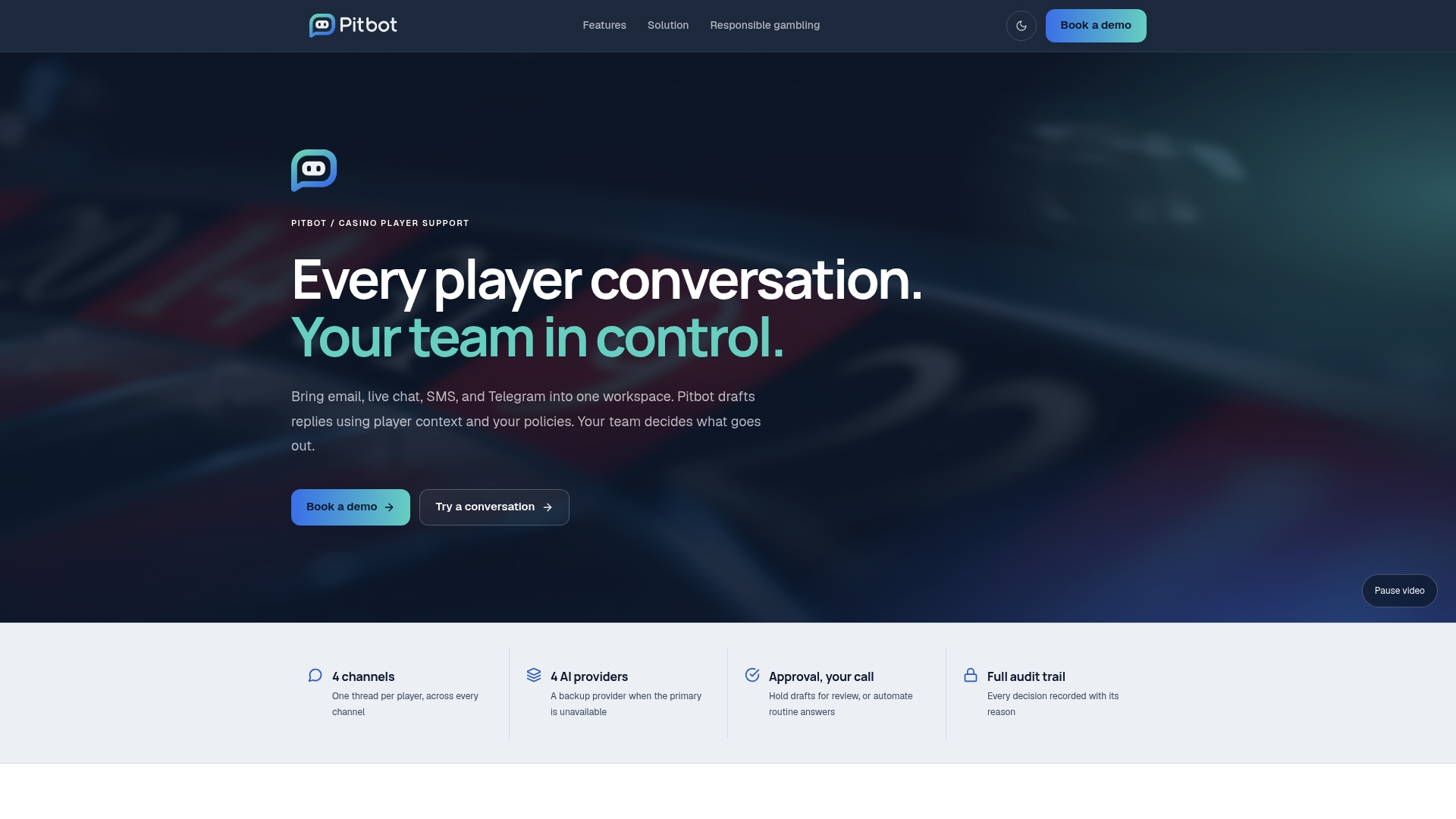
The platform pulls together omni-channel support across email, live chat, SMS, and Telegram, so a VIP’s context travels with them regardless of how they get in touch. Holding AI-drafted replies for staff approval before sending keeps compliance-sensitive replies auditable in a way that pure automation cannot match. For operators managing regulatory obligations alongside player retention, that combination of speed and traceability solves the exact trade-off this article has walked through. The full feature set covers responsible gambling detection and multilingual support alongside VIP handling.
If your VIP queue is currently held together by a spreadsheet and an account manager’s memory, it is worth seeing how this looks running live. Book a demo to walk through how it would map onto your current escalation process.
Sources
- Premium Support | Google Cloud
- AWS premium support
- VIP Escalation Lane: Fair Support Design | Supportbench
- We Did Away with VIP Support and Got More Efficient | HDI
FAQ
What is VIP customer support?
VIP customer support gives a defined segment of high-value customers faster response times, named points of contact, and more discretion than the standard support queue, based on measurable criteria like lifetime value or operational risk rather than informal favouritism.
How do I contact VIP support as a customer?
Most operators assign VIP customers a dedicated agent or account manager directly, often via a private channel or direct line disclosed once eligibility is confirmed, rather than the general support queue.
What does VIP stand for in customer support?
VIP stands for “very important person”, referring to customers whose revenue, contract value, or strategic importance qualifies them for prioritised handling under a formal escalation policy.
How can a customer qualify for VIP support?
Eligibility is usually set against measurable thresholds such as lifetime value, recent revenue velocity, contract or renewal value, and operational risk, reviewed periodically rather than granted on an ad-hoc basis. Platforms like Pitbot record the resulting VIP level on the player profile so it is visible wherever the player gets in touch.