

A support brand voice is your operator’s personality in every player reply. Build it by writing a compact support style guide with three voice traits and tone sliders for common iGaming scenarios, then let agents and AI follow it. In regulated markets, AI-generated replies need human oversight you can prove: a person reviews what matters, and decisions leave an audit trail.
TL;DR:
- Support voice remains consistent across all replies, but situational tone adjusts based on context, such as outages or VIP interactions.
- Building a support style guide requires clear voice traits, specific tone sliders for different scenarios, and micro-templates for efficiency.
- Training both agents and AI on the same style guide reduces inconsistency, with KPI tracking like first response time and suggestion acceptance rate indicating success.
- Human review of AI-generated responses ensures compliance, maintains voice consistency, and supports rapid multi-channel support workflows.
- Regular quarterly reviews and regional checks are essential to keep tone appropriate and safeguard against drift or outdated phrasing.
Table of Contents
- What is brand voice for support, and how does it differ from tone?
- Building a support style guide: sliders, banned words, and templates
- How do you train agents and AI on the same voice?
- Which metrics actually show your voice is working?
- Why AI plus human review is the only version of this that works
- Get your support voice running with human-reviewed AI
- Sources
- FAQ
What is brand voice for support, and how does it differ from tone?
Voice is stable. It’s the personality your operator brings to every reply, whether a player is topping up a wallet or complaining about a delayed withdrawal. Tone shifts with the situation. Support voice is the company’s personality in support interactions, and it stays fixed while tone changes by context such as an outage, a VIP escalation, or a first-time deposit query.
For iGaming, most operators settle on three or four voice traits that balance warmth against regulatory caution. A workable set looks like this:
- Direct: players want a clear answer on withdrawal times, not padding.
- Reassuring, never over-promising: confidence without guarantees you can’t back, especially around payouts or bonus terms.
- Respectful of autonomy: players are adults making their own decisions; the voice should never sound parental.
- Calm under pressure: disputes and self-exclusion requests need a steady register, not scripted cheerfulness.
Word choice carries regulatory weight here in a way it doesn’t for most industries. “Guaranteed win” or “can’t lose” language isn’t just off-brand; it can breach advertising rules in several licensed markets. Building that constraint into your voice traits from day one, rather than bolting it on later, saves a lot of retraining.
Building a support style guide: sliders, banned words, and templates
A style guide only earns its name if the team actually uses it day to day. Structure it around four elements:
- Tone-by-situation sliders. Represent tone as adjustable sliders, friendly against formal, concise against detailed, empathetic against direct, and set a default position for each common scenario. An outage message sits closer to formal and concise; a VIP retention chat sits closer to friendly and detailed.
- Banned words and preferred phrases. Document banned words and preferred phrases directly in the guide, alongside blame filters (“you failed to verify” becomes “we still need one document to verify your account”) and clarity-first rules that ban jargon like “KYC pending” without explanation.
- Format rules. First line confirms the player’s issue in plain language. Follow with the fix or next step. Keep paragraphs short and use bullets only for genuine multi-step processes, not for a single sentence dressed up as a list.
- Micro-templates for recurring scenarios, written once, refined often, and reused by agents and AI alike.
Sample slider settings for five frequent situations:
| Scenario | Default tone | Format |
|---|---|---|
| Platform outage | Formal, concise | Status line first, ETA if known |
| Refund/withdrawal delay | Empathetic, direct | Confirm timeline, no jargon |
| VIP handling | Friendly, detailed | Personalised, named host reference |
| Security/account lock | Formal, reassuring | Clear steps, no blame language |
| Player frustration/abuse | Calm, boundaried | De-escalate, no matching aggression |
Pro Tip: Run a “first-line check” on twenty random tickets each week. If the opening sentence doesn’t confirm the player’s actual issue in plain words, the template needs rewriting, not the agent.
How do you train agents and AI on the same voice?
Agents and AI suggestions need to be trained against the same style guide, or you end up with two brand voices fighting each other in the same chat window. Training AI on trusted company data and documented brand guidelines cuts the robotic feel that makes AI-drafted replies stand out from human ones for the wrong reasons.
A practical training plan includes:
- Role-play sessions where agents rewrite a robotic AI draft into on-voice language, scored against the style guide’s sliders.
- Macros with dynamic placeholders (player name, product, deadline) built from the same micro-templates used in the style guide, so agents and AI draw from one source.
- An acceptance KPI: what percentage of AI-suggested replies agents approve without heavy editing. Treat tone as a dial and track suggestion acceptance as an operational KPI, not a vanity metric.
- Human-in-the-loop review on every AI-generated message before it reaches a player, with the reviewer’s decision logged.
A low acceptance rate isn’t an agent problem first. It usually means the AI’s training data or prompt hasn’t absorbed the style guide’s slider positions yet.
Privacy matters here too. Any AI system touching player data needs clear rules on what it can retain, for how long, and who can access logs, particularly where self-exclusion or affordability flags are involved.
Which metrics actually show your voice is working?
Four numbers tell you whether the voice is landing, and none of them require guesswork.
- First response time, because a warm voice delivered slowly still frustrates players.
- Repeat contact rate, which drops when tone and clarity are aligned; players who get a clear first answer don’t come back three times for the same issue.
- CSAT, the most direct read on whether tone matched the moment.
- AI suggestion acceptance rate, your earliest warning sign that voice training has drifted from the style guide. Together, first response time, repeat contact rate, and acceptance rate give a fuller picture than CSAT alone.
Audit every AI-assisted message with metadata: who reviewed it, what was changed, and why. That log matters twice over, once for coaching, and once for regulators who will ask for it. Logging escalation metadata into every message record supports post-incident reviews that licensed markets increasingly expect.
Escalation changes tone deliberately. A specialist picking up a self-exclusion request or a dispute over a large withdrawal should shift from the standard empathetic-direct default to something more formal and measured, slower, more careful with phrasing, no attempts at brand personality flourishes. Build that shift into the escalation protocol itself, not left to individual judgement.
Review the whole guide quarterly, and check regional variants for tone that reads warm in one market and presumptuous in another. Consistent tone across channels reduces friction and raises CSAT while shortening ticket threads, but only if localisation checks catch phrasing that doesn’t translate.
Why AI plus human review is the only version of this that works
Support is often the only human interaction a player has with an operator, and that’s precisely why voice discipline matters more here than in marketing copy nobody reads twice. Most guides on this topic stop at “write a style guide.” That’s necessary but incomplete. The harder problem is keeping AI-generated replies on-voice at speed, in a regulated market, without creating a compliance gap.
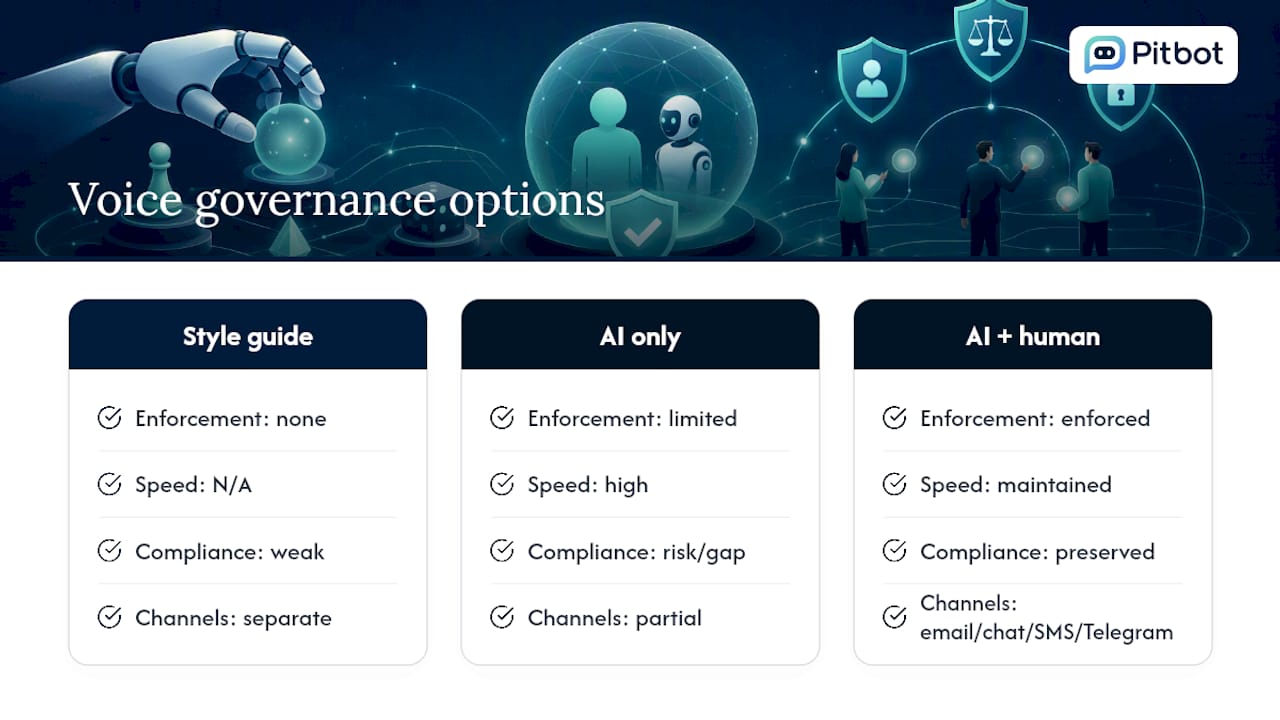
Pitbot is built around that specific gap. It combines multi-provider AI with configurable human review: with auto send off, AI-drafted replies on email, live chat and Telegram wait for staff approval before they reach a player, so speed and compliance aren’t traded against each other. It integrates email, live chat, SMS, and Telegram into one workflow with audit trails and responsible-gambling automation built in, rather than bolted on as an afterthought.
The uncomfortable truth is that a style guide without enforcement is just a document nobody reads after week one. Human-in-the-loop review is what turns the guide into a habit.
— Pitbot
Get your support voice running with human-reviewed AI
You now have the framework: three voice traits, tone sliders by scenario, a style guide agents and AI both train against, and KPIs that show whether it’s working. Building all of that manually across email, live chat, SMS, and Telegram is where most support teams stall.
Pitbot is the alternative to building this stack piece by piece. You can hold AI-drafted replies for staff approval before they reach a player, keeping speed and compliance in the same workflow rather than fighting each other. It runs across live chat, email, SMS, and Telegram from a single dashboard, with audit-ready logging, responsible-gambling detection and escalation built in, and per-brand support personas that carry your tone and signature. If your style guide is ready and you want it enforced consistently across channels, book a demo and see how the review workflow fits your existing team.
Sources
Four sources back the framework above and are worth bookmarking for your own team’s reference. Salesforce covers voice-versus-tone fundamentals and style guide structure. Typewise breaks down tone sliders with copy-paste examples. Hootsuite explains brand messaging frameworks that support voice should sit inside. Sprinklr details channel-specific tone adaptation.
- Customer service voice: what it is and how to develop it | Salesforce
- Tone of voice for support teams: the complete guide + copy-paste examples | Typewise
- Brand messaging | Hootsuite
- Customer service tone | Sprinklr
FAQ
What is the difference between brand voice and tone in support?
Voice is your operator’s fixed personality across every reply; tone is how that personality flexes for a given situation, such as an outage versus a VIP query. A style guide should document both separately, with fixed traits and situational tone sliders.
Can AI write player support replies in regulated iGaming markets?
Yes, with oversight: regulators expect you to control what goes out and to evidence it. With Pitbot’s multi-provider AI with human review you can hold AI-drafted replies for staff approval before they reach a player, and decisions are logged in an append-only audit trail.
Which KPIs show whether a support voice is working?
Track first response time, repeat contact rate, CSAT, and AI suggestion acceptance rate together. A rising acceptance rate usually signals the AI’s training has caught up with the style guide.
How often should a support style guide be reviewed?
Quarterly reviews catch drift in tone, banned words that have become outdated, and regional phrasing that no longer fits a growing player base. Pair each review with a localisation check across markets, since tone that reads warm in one region can land differently in another.
What does Pitbot cost?
Pitbot publishes its plans on the pricing page: Starter, Growth, Scale and Enterprise, in EUR, with unlimited operator seats, and you can start free.

