

A regulated market is one where a licensing authority sets the rules for who may offer gambling, how they must treat players and what they must be able to prove afterwards. For an online casino operator, a regulated markets checklist is the working list of controls you confirm before launch and keep re-checking: licence conditions, player protection, communications, records and third-party oversight. This one is built around the part operators most often leave until last, which is what happens in the conversation with the player.
It draws on published guidance from the UK Gambling Commission, the Alcohol and Gaming Commission of Ontario (AGCO), the Malta Gaming Authority (MGA) and Nevada. Rules differ by country, so treat each item as a prompt to check your own licence conditions, not as legal advice.
TL;DR
- Regulated means a licensing body defines your obligations, from age checks to spending controls, and expects evidence that you meet them.
- Start with the licence route and target markets, then build policies, named officers, staff training and a written control framework around them.
- Player communications are a compliance surface: marketing must stop when harm is indicated, and self-exclusion must take effect immediately.
- Keep records of every interaction, including the ones that did not happen and why, for the retention period each regulator sets.
- Re-run the checklist whenever a rule, a market or a supplier changes. Outsourcing a function never outsources responsibility.
Table of Contents
- What a regulated market actually asks of you
- Step 1: fix the licence route and the markets
- Step 2: cover the licence conditions
- Step 3: make player communications a checklist item
- Step 4: oversee suppliers, automation and staff
- Step 5: keep records that tell the whole story
- Step 6: keep the checklist alive
- A one-page version to copy
- Our perspective
- Where Pitbot fits
- FAQ
- Sources
What a regulated market actually asks of you
Regulation lets a jurisdiction protect its residents by requiring online gambling businesses to operate to rules such as preventing underage gambling, giving players tools to control spending and delivering responsible gaming information. That early academic overview still describes the core bargain well: the operator gets a lawful route to market, and the player gets safeguards.
The flip side is the unlicensed market. The New York State Gaming Commission points out that regulated gambling lets patrons cool off or self-exclude, reach help promptly and benefit from independent integrity monitoring, which unlawful operators do not offer. Definitions of illegality also depend on where the player sits: under the 2014 Council of Europe Macolin Convention, betting is illegal when its type or operator is not allowed under the law of the consumer’s jurisdiction. In practice, that means a licence in one country does not make you compliant in another, and your checklist must be built per market.
Step 1: fix the licence route and the markets
Everything else hangs on two decisions: which licences you hold or will apply for, and which countries you accept players from. Write them down before you write a single policy.
For each market, record:
- the licensing authority and the licence type you operate under;
- the technical standards and codes of practice that attach to it;
- the age, identity verification and responsible gambling rules that apply to players there;
- the advertising and bonus rules for that market;
- the languages and channels you will use to talk to players.
The last two items are where support teams get pulled in. A market that allows live chat and email but restricts promotional SMS needs different tooling from one that does not.
Step 2: cover the licence conditions
In Great Britain, the Gambling Commission’s Licence Conditions and Codes of Practice (LCCP) are the baseline. The online LCCP covers qualified persons, technical standards, customer funds, fair and open provisions, anti-money laundering, customer identity verification, responsible gambling, marketing, complaints and staff. A useful way to use it is to turn each heading into a row in a control register with an owner, a frequency and a place where the evidence lives.
| Area | Question to answer | Evidence to keep |
|---|---|---|
| Qualified persons and staff | Who holds each named role, and are they trained? | Appointment records, training logs |
| Technical standards | Do your systems meet the required standards? | Test and audit reports |
| Customer funds | How are balances protected? | Policy, reconciliation records |
| AML and identity | When do you verify, and what triggers review? | Risk assessment, case files |
| Responsible gambling | How do you identify and act on harm? | Interaction records, outcomes |
| Marketing | What stops a message going to the wrong player? | Suppression rules, approval logs |
| Complaints | How are they logged and resolved? | Complaint register, response times |
Other jurisdictions ask for the same thing in a different shape. In Ontario, operators must submit an independently audited document setting out the processes and controls that meet the Standards, commonly called a Control Activity Matrix. If you plan to serve more than one market, building your register once in that matrix style makes it much easier to map a second licence onto it.
Step 3: make player communications a checklist item
Most compliance programmes cover onboarding, payments and game integrity well. Messages to players, whether a support reply, a VIP nudge or a bonus email, tend to sit with several teams and get checked least. Regulators do not make that distinction.
Spot harm and act on it
The Gambling Commission’s customer interaction guidance requires remote licensees’ systems and processes to embed three elements: identify, act and evaluate, and to consider the factors that make a customer more vulnerable. The same guidance says licensees must prevent marketing and the take-up of new bonus offers when strong indicators of harm have been identified.
In Ontario, the AGCO’s 2026 guidance expects operators to use both automated and manual tools to monitor player behaviour continuously, or at a rate that reflects how quickly behaviour changes, so that support is timely and effective.
Checklist questions:
- Can a support agent, human or automated, see a player’s risk flags before replying?
- Does a harm flag automatically remove that player from promotional sends?
- Is there a defined escalation route from a sentiment or distress signal to a trained member of staff?
- Are VIP communications held to the same suppression rules as everyone else?
Handle self-exclusion without friction
Malta is explicit: self-exclusion must be implemented immediately upon receipt of a request, whether new or an extension, with no attempt to induce the player to keep playing. Returning is also controlled. The MGA’s audit manual says access after removal may be granted only after at least 24 hours for a definite exclusion or 7 days for an indefinite one.
The support angle is easy to miss. A player who writes “I need to stop” in a live chat is making a request in the channel they happen to be in. Your checklist should confirm that every channel routes such messages to the same workflow, and that no automated reply tries to retain the player. Our guides on regulator-ready self-exclusion workflows and on proving self-exclusion with audit logs go through the checkpoints in more detail.
Keep marketing and messaging honest
Ontario’s Registrar’s Standards state that marketing and communications must not target underage or self-excluded persons and must not be misleading or imply that gambling can solve personal problems or be a financial investment. That applies to a friendly support agent as much as to a banner. Reply templates, VIP scripts and persona tone guides all belong in scope.
Step 4: oversee suppliers, automation and staff
If you use outsourced agents, a chatbot vendor or an AI provider, you have not moved the obligation. The AGCO’s approach is that operators remain responsible for compliance even when functions are contracted to third parties, and must have controls and oversight to ensure those parties meet the standards.
For each supplier that touches player communications, the checklist should confirm:
- what data the supplier sees and where it is processed;
- who approves what the supplier’s system says to a player, and before or after sending;
- how you would switch off or override it quickly if a rule changed;
- what logs you can export on request, in a form a regulator can read;
- how often you review the supplier’s performance against your own standards.
Point 2 deserves the most attention with AI. A model can write a fluent, friendly answer that quietly breaks a marketing rule or ignores a risk flag. Review by a trained person before sending is the simplest control that addresses this, and it is the one regulators find easiest to understand.
Step 5: keep records that tell the whole story
Records are where a good programme proves itself. The AGCO’s 2026 guidance and the Gambling Commission’s 2022 guidance both point to complete and accurate records of customer activity, including risk profiling, interventions or the reasons for non-intervention, and follow-up actions. The Gambling Commission’s requirement 8 guidance says to record all customer actions and interactions, including where an interaction did not take place or was delayed and the reasons why.
Retention periods differ, so write each one into the register:
| Jurisdiction | What the source says |
|---|---|
| Nevada | Records such as player identities, registration details, account changes and contact logs are kept for at least five years |
| Malta | Self-exclusion records are kept for the exclusion period plus six months |
| Great Britain | Follow the current customer interaction guidance and your licence conditions for the period that applies to you |
A good test for any record set: pick one player and one month, and see whether you can show what was flagged, who saw it, what was sent or withheld, and who approved it. If that takes a day of digging through inboxes, the audit trail is not ready. Our player communication audit article shows how to map those findings to UKGC and MGA expectations.
Step 6: keep the checklist alive
A checklist signed off at launch goes stale. The AGCO expects operators to regularly assess and validate their control environments against the Standards, address gaps and report substantial changes to the regulator.
Regulators also tell you where they will look. In 2025 the Malta Gaming Authority found inconsistencies in how licensees implemented and enforced self-exclusion across brands and flagged player protection detection systems for targeted attention. Its supervisory review set out to test whether self-exclusion prevents access across brands. If you run several brands or white labels, that is a direct prompt to test the same thing yourself.
A review rhythm that works for most teams:
- Monthly: sample interactions, check suppression and escalation outcomes, log exceptions.
- Quarterly: review supplier performance and any complaints that touched communications.
- On any change: a new market, channel, AI provider, bonus type or regulatory update triggers a review of the affected rows.
- Annually: a full walk-through against each licence’s current conditions, with a named owner signing each row.
You can see a longer-term version of this in our 90-day regulator-first plan for support compliance monitoring.
A one-page version to copy
- Licence route and target markets recorded, per market.
- Licence conditions mapped to a control register with owners.
- Business risk assessment written and dated.
- Named officers appointed and trained.
- Harm indicators defined and linked to marketing suppression.
- Self-exclusion works immediately in every channel and brand.
- Communications templates reviewed for misleading or inducing language.
- Every outgoing message has an approval path you can evidence.
- Supplier oversight documented, with exportable logs.
- Retention periods set per jurisdiction.
- Review calendar in place, with triggers for change.
- Staff rehearsed on a mock regulator request for one player’s history.
Our perspective
We build player support for casinos, so we see the same gap again and again: the compliance programme is strong on paper, and the support inbox sits outside it. Agents, scripts and now AI tools write to players hundreds of times a day, often faster than anyone can check.

Our view is that speed and oversight are not a trade-off if you design for both. That is why Pitbot is built so that AI drafts come from multiple providers but a member of staff reviews every reply before it reaches a player. The review is not a formality: it is the point at which a person confirms the message respects risk flags, marketing suppression and the tone the market expects. Each decision then lands in an audit trail, so when a regulator asks about one player, you answer from the record rather than from memory.
We would also tell any operator to test the awkward cases first: a VIP who mentions losing control mid-conversation, a self-exclusion request sent by SMS or Telegram, a complaint written in a second language. If your process handles those cleanly, the routine cases follow.
— pitbot
Where Pitbot fits
Pitbot is an AI-powered support platform for online casino operators. It brings email, live chat, SMS and Telegram into one dashboard, detects player sentiment and escalates sensitive cases, manages VIP queues, supports multilingual replies, and keeps compliance-ready audit trails. It also detects responsible gambling signals and suppresses outreach to affected players, which maps directly to the communication items above.
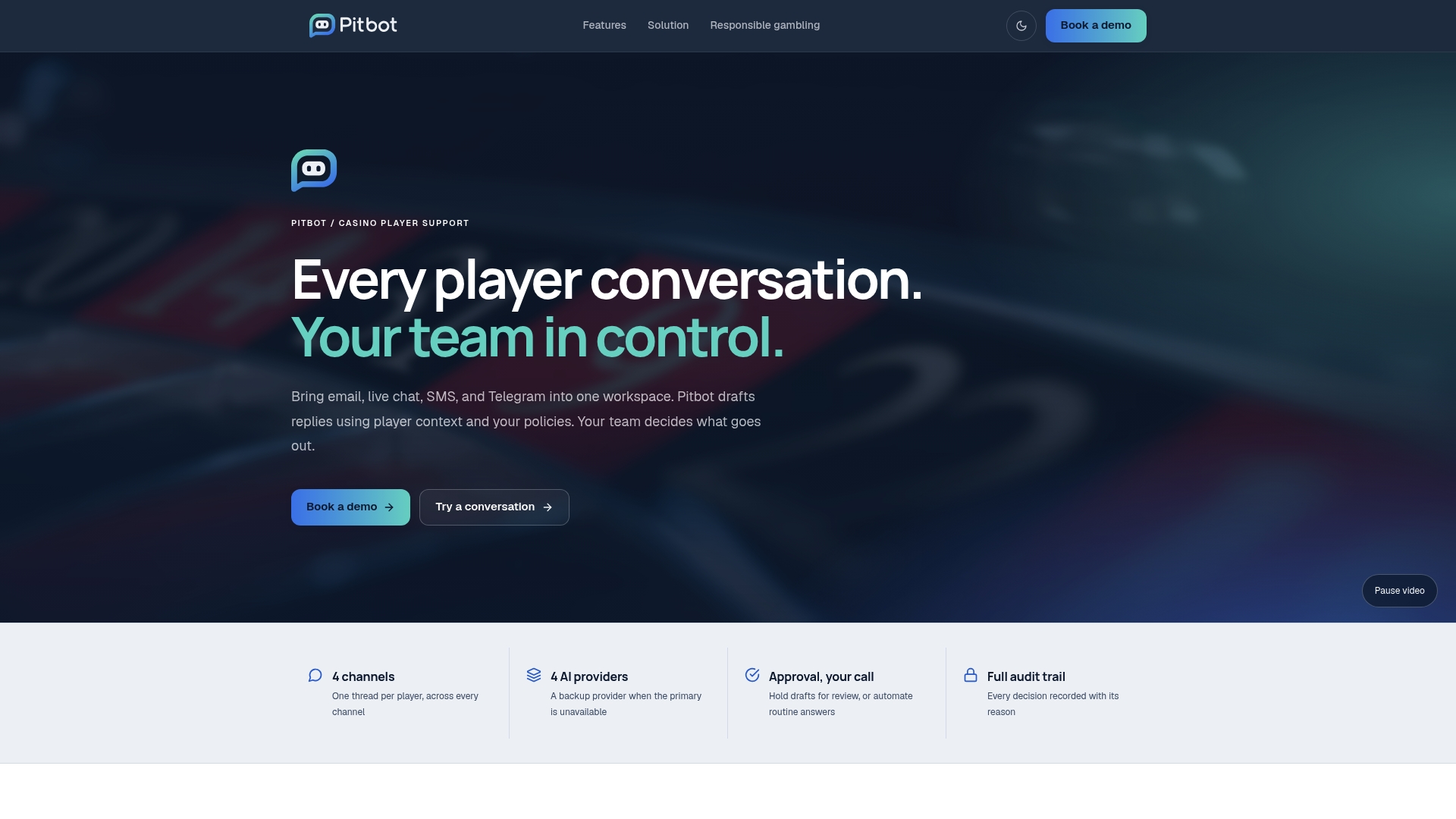
If you want to see how that works against your own checklist, look at AI customer support for online casino and iGaming operators, or read about our responsible gambling automation. Pricing is not published, so the next step is a demo.
FAQ
What does it mean for a market to be regulated?
A licensing authority sets rules for who can operate and how, and checks that operators follow them. In online gambling those rules typically include age restrictions, tools to control spending and responsible gaming information. Operators must be able to show evidence of compliance on request.
How do I prepare a compliance checklist for a new licence?
Start with the licence route and markets, then turn the licence conditions into a register of controls with named owners and evidence. Add policies, staff training and a rehearsal of a regulator request. Finally, set a review calendar so the list is updated when rules or suppliers change.
Does using AI for player support change my obligations?
No. Operators remain responsible for compliance even when functions are contracted to third parties. Document who approves AI-generated messages, how risk flags and suppression apply, and what logs you can produce.
How long should I keep player communication records?
It depends on the jurisdiction. Nevada requires at least five years for certain records including contact logs, while Malta ties self-exclusion records to the exclusion period plus six months. Check your own licence conditions for the period that applies.
Sources
- Final report: An overview of internet gambling (Wiebe et al.)
- Defining illegal betting, World Lotteries
- Avoid the Risky Bets of Unlawful Online Gambling, New York State Gaming Commission
- Licence Conditions and Codes of Practice, Gambling Commission
- iGaming Standards FAQs, AGCO
- Customer interaction guidance introduction, Gambling Commission
- Customer interaction guidance, requirement 8, Gambling Commission
- Guidance for iGaming Operators on Identifying and Supporting Players at Risk of Harm, AGCO
- Player Protection, Malta Gaming Authority
- Compliance Audit Manual, Malta Gaming Authority
- Registrar’s Standards for Gaming, AGCO
- AGCO Compliance Approach, Section 1
- Operation of Interactive Gaming, Nevada Gaming Control Board
- Regulatory Oversight: Supervisory Engagement Efforts 2025, Malta Gaming Authority

