
A player communication audit must produce a regulator-ready audit trail proving who acted, when, why, and what outcome followed for every sampled interaction. That means reviewing email, live chat, SMS, and Telegram messages against frameworks such as LCCP Social Responsibility Code Provision 3.4.3 and MGA Directive 2, then documenting the identify, act, and evaluate chain that operators are expected to show inspectors on demand.
TL;DR:
- A comprehensive player communication audit must include all channels and message types, such as live chat, email, SMS, and messaging apps, to capture regulator-critical interactions.
- Each interaction must be recorded with complete metadata, including timestamps, agent IDs, player identifiers, message content, automated triggers, and outcomes, ensuring audit trail integrity.
- Sampling should be risk-based and event-driven, focusing on high-risk accounts and triggers like self-exclusion or deposit breaches, rather than relying solely on random samples.
- The audit report must document clear evidence of harm indicator identification, appropriate action taken, and outcome evaluation, aligning with UKGC and MGA requirements.
- Implementing an audit-ready platform that links each interaction to automated and human review steps ensures traceability and facilitates continuous compliance improvement.
Table of Contents
- What should a player communication audit checklist cover?
- How do you map audit findings to UKGC and other regulator expectations?
- Sampling, evidence collection, and chain of custody for digital records
- How do you score audit findings and flag red cases?
- Turning audit findings into remediation and governance
- What good player communication quality actually looks like
- Which tools support a communication audit workflow?
- What commonly goes wrong during a player communication audit?
- How should audit findings feed continuous improvement?
- How does an AI and human-review platform keep communications audit-ready?
- Ready to see what an audit-ready platform looks like in practice?
- Sources
What should a player communication audit checklist cover?
Start by fixing the scope before touching a single transcript. An audit that only samples live chat while ignoring triggered system emails or Telegram support threads will miss exactly the interactions regulators tend to ask about first.
Channels and message types to include:
- Live chat transcripts, including bot-handled sessions and escalations to human agents
- Email correspondence, particularly responsible gambling outreach and account restriction notices
- SMS messages, especially deposit-limit alerts and reactivation prompts
- Telegram or other messaging-app support threads, where operators offer them
- CRM notes attached to player accounts, including internal flags and case summaries
- Automated triggered messages, such as system-generated warnings after unusual deposit patterns
Each sampled interaction needs a consistent record structure. Missing even one field can turn a defensible interaction into an indefensible gap during inspection.
Minimum fields to capture per interaction:
- Timestamp of the message and any response
- Agent identifier (human or system/bot ID)
- Player electronic identifier (account reference, not raw personal data in the audit log)
- Full message content, not a paraphrase or summary
- Policy reference that triggered or governed the interaction
- Details of any automated trigger involved
- Recorded outcome, meaning what changed after the interaction
Sampling strategy matters as much as field capture. A pure random sample looks statistically tidy but often misses the cases regulators care most about. Risk-based sampling, weighted towards accounts with recent self-exclusion requests, large or rapid deposits, or multiple support contacts in a short window, surfaces more genuine problems per hour of review than blind randomisation. Event-driven extraction, pulling every communication tied to a specific trigger like a self-exclusion request or a deposit-limit breach, should run alongside a smaller random control sample to catch issues the risk model didn’t anticipate.
Marketing suppression checks deserve their own pass. Cross-reference every promotional email, SMS, or push notification sent during the audit period against the self-exclusion and opt-out list, active at the time the message was sent, not the current list. Suppression errors often show up only when you check historical list states rather than today’s.
How do you map audit findings to UKGC and other regulator expectations?
Regulators generally aren’t asking whether an interaction happened. They want proof it followed a structured response. The UKGC’s LCCP Social Responsibility Code Provision 3.4.3 requires remote operators to run customer interaction systems built around three steps: identify a harm indicator, act on it, and evaluate whether the action worked.
Each step needs distinct evidence in the audit report:
- Identify: logs showing what behavioural or account signal (session length, deposit velocity, chat sentiment) triggered review
- Act: the actual message, call, or account restriction applied, with timestamp and responsible agent
- Evaluate: a follow-up record showing subsequent player behaviour and whether the intervention changed it
Formal UKGC guidance published in August 2023, which applies from 31 October 2023, goes further, stating that interactions must have recorded outcomes, not just a note that contact was attempted. Regulators want behaviour before the interaction, the method used, and behaviour afterwards, all in one traceable record.
MGA-licensed operators face a parallel but distinct requirement: Directive 2 requires B2C licensees to retain a record of player interactions as a clear and detailed audit trail, producible to the Authority on request and kept for at least two calendar years from the last interaction, whichever channel the interaction happened on.
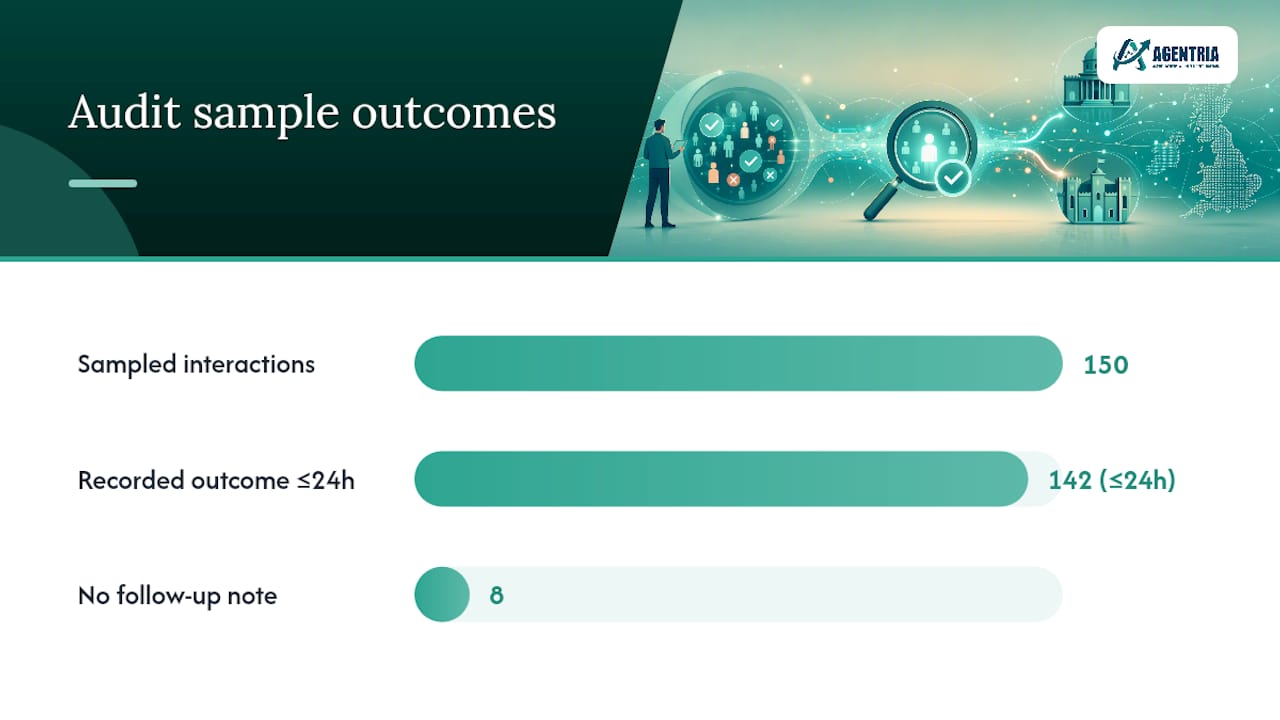
When writing the audit report itself, keep statements neutral and jurisdiction-specific. Rather than a blanket claim like “the operator complies with regulatory standards,” write what you actually checked and what you found: “Of 150 sampled interactions tied to deposit-limit triggers, 142 showed a recorded outcome within 24 hours; 8 lacked a follow-up note.” Specificity like that survives inspection scrutiny far better than generalised assurance language.
Sampling, evidence collection, and chain of custody for digital records
Getting the sample right means nothing if the export itself can’t be trusted. Regulators and, increasingly, courts want to know that a chat log presented in an audit is the same one the player actually saw, unedited and complete.
Technical export practice should follow a few non-negotiable rules:
- Export from immutable logs where the platform prevents post-hoc editing
- Generate hash checksums for each export batch so any later alteration is detectable
- Retain session identifiers linking chat, email, and SMS threads to the same account event
- Keep full metadata (IP address ranges, device type, channel routing) alongside the message content
Context matters as much as the message itself. A single chat line pulled in isolation rarely tells the full story. Include the messages immediately before and after the sampled exchange, plus any account events, KYC flags, or transaction triggers active at that moment. Pennsylvania’s interactive gaming rules, for instance, require electronic player files with session identifiers precisely so a terminated session can be reconstructed later.
Document chain of custody explicitly: who exported the data, on what date, using what tool, and what verification step confirmed the export matched the source system. Store the finished package as an encrypted archive with retention metadata attached and a searchable index, not a folder of loose files someone has to open one by one during an inspection.
Pro Tip: Build the checksum and session ID capture into your export script from day one. Retrofitting chain-of-custody proof onto six months of historical logs after a regulator asks for them is a miserable, error-prone job.
How do you score audit findings and flag red cases?
Raw pass/fail judgements don’t give compliance teams enough to prioritise fixes. A simple scoring rubric across five dimensions turns a pile of transcripts into a ranked action list.
- Completeness: are all required fields present for the interaction?
- Timeliness: did the response happen within the policy-defined window?
- Policy linkage: does the record show which policy or trigger governed the action?
- Escalation correctness: did the case route to the right team or authority level?
- Outcome recorded: is there a documented result, not just a documented attempt?
Score each dimension on a simple scale (say, 0 to 2) per sampled interaction, then set thresholds.
Certain findings should skip the scoring exercise entirely and go straight to urgent action:
- Marketing sent to an account with an active self-exclusion flag
- Missing agent ID on any escalated or high-value interaction
- No recorded outcome on a harm-indicator interaction
- A gap of more than 48 hours between identified risk and first contact
Each red flag needs an immediate recommended action attached in the report itself, not left for a follow-up meeting to decide.
Turning audit findings into remediation and governance
An audit that ends with a findings document and no owner is a wasted audit. Every finding needs to become a tracked ticket with a named owner, a deadline, and a defined verification check confirming the fix actually worked, not just that someone marked it closed.
Governance artefacts give the remediation programme weight beyond a single spreadsheet:
- Revised policy documents showing exactly what changed and why
- Training logs proving staff received updated guidance on the specific gap found
- Change logs for any automated rule adjusted (suppression lists, trigger thresholds)
- Minutes from the compliance board meeting where findings were reviewed and signed off
Measuring improvement needs concrete KPIs, tracked audit to audit rather than described qualitatively. Track the repeat offence rate (the same red flag recurring in the next sample), time to contact after a harm indicator fires, and the percentage of complete records across the whole sample, not just the flagged ones. Industry codes such as the IGRG Code (backed by the BGC) expect these controls to be demonstrable, not merely described in policy. A quarterly follow-up audit cadence, tightened to monthly for any channel that failed its last review, keeps the loop closed.
What good player communication quality actually looks like
Compliance and quality aren’t separate goals here. A message that’s compliant but confusing still fails the player, and a message that’s warm but vague on policy still fails the audit. Good player communication does both at once: it’s accurate, timely, and traceable back to a specific policy or trigger.
Clarity is the first standard worth enforcing. A responsible-gambling message that buries the actual restriction in vague language (“we’re reviewing your account”) gives auditors nothing to verify and gives the player nothing actionable. Compare that with a message stating the specific limit applied, the reason, and the review date; it satisfies both the player’s need to know and the auditor’s need for a paper trail.
Consistency across channels matters more than most operators expect. A player who gets one message via email and a contradictory one via live chat an hour later creates a genuine compliance headache, because the audit trail now shows conflicting policy application. Standardising message templates for high-risk scenarios, deposit limits, self-exclusion confirmations, and cool-off periods, while still allowing agents to personalise the surrounding conversation, keeps that risk down.
Safer gambling visibility is its own standard. Guidance from bodies including the BGC expects safer gambling information to be prominent and functional, meaning links to self-exclusion tools and deposit-limit controls actually work when tested, not just exist on a page somewhere. An audit should test those links, not assume they function.
Which tools support a communication audit workflow?
Most operators start with what they already have: export functions built into the CRM, live chat platform, and email system, pulled manually into spreadsheets for review. That works for a small pilot but breaks down fast once volume climbs past a few hundred interactions a month, because manual tagging introduces inconsistency between reviewers.
Purpose-built audit tooling generally falls into three categories. Log aggregation tools pull messages from multiple channels (email, chat, SMS, Telegram) into one searchable repository, solving the scattered-export problem. Compliance case management systems track findings through to remediation, giving each red flag a ticket, an owner, and a closure date rather than a line in a report nobody revisits. Sentiment and pattern-detection layers flag likely harm indicators automatically, narrowing the pool a human reviewer needs to check by hand.
The common thread across all three categories is that none of them should operate without a human checkpoint. A tool that automatically categorises an interaction as “resolved, no action needed” without a person confirming that judgement is exactly the kind of gap regulators flag during inspection. Platforms built for regulated player support, Pitbot’s feature set among them, generally keep a staff review step in the loop specifically so the automated tagging doesn’t become the final word on a compliance-sensitive case.
What commonly goes wrong during a player communication audit?
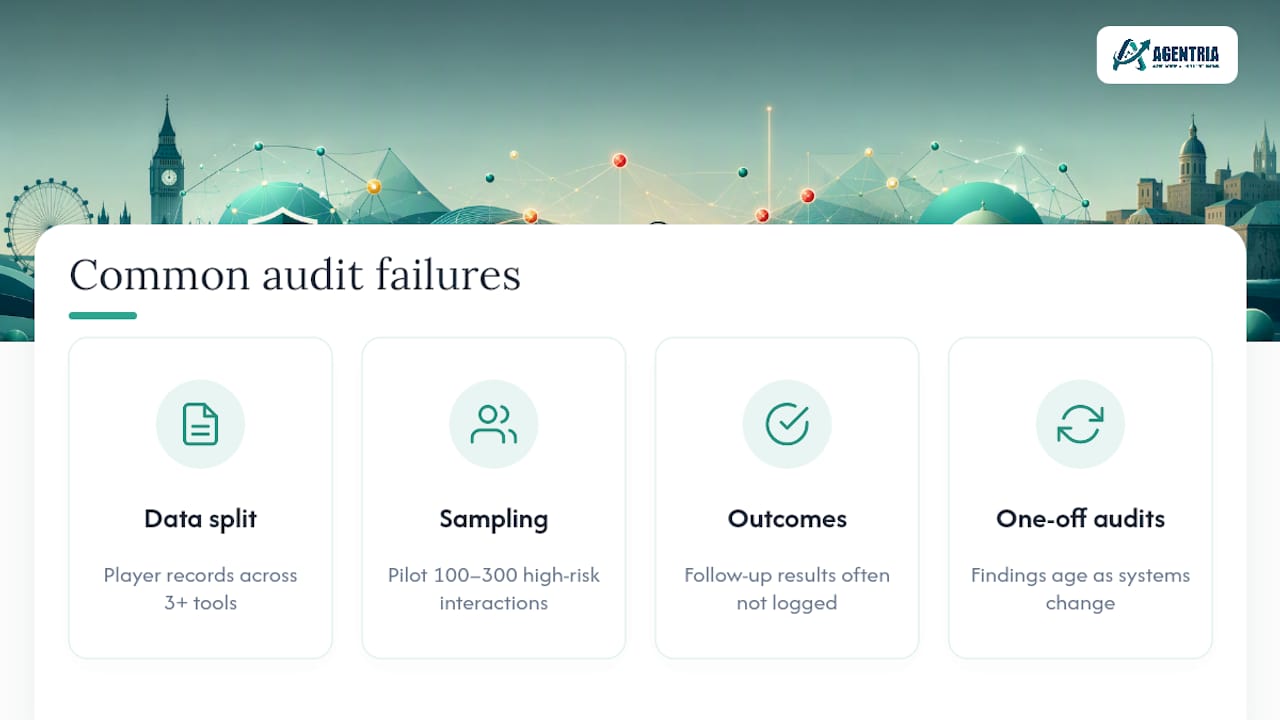
The most frequent failure isn’t a missing policy. It’s inconsistent data across channels that makes reconstruction genuinely difficult. A player’s chat history might sit in one system, their SMS alerts in a separate marketing platform, and their email correspondence in a third tool with no shared identifier linking them. Reconstructing a single player’s full interaction timeline can take hours per case when systems don’t share a common reference.
Sample size decisions cause the second most common problem. Auditors under time pressure often sample too few interactions from the highest-risk cohort, self-excluded players, VIPs with unusual deposit patterns, to draw a defensible conclusion, while over-sampling low-risk, routine support tickets that were never going to reveal much. A short pilot combining automated export with manual review of 100 to 300 high-risk interactions tends to surface systemic gaps far faster than a larger but poorly targeted sample.
Outcome recording is the third recurring gap. Teams are generally good at logging that an interaction happened and even good at logging what was said. They’re worse at logging what happened next, whether the player’s behaviour actually changed. Without that follow-up record, the audit can show an operator was active but can’t show the intervention worked, which is precisely the gap UKGC guidance targets.
A subtler pitfall is treating the audit as a one-off compliance exercise rather than a recurring discipline. Findings age quickly when suppression lists, staff, and automated triggers keep changing.
How should audit findings feed continuous improvement?
Findings that sit in a static report get stale fast. The interactions flagged this quarter tell you almost nothing about next quarter’s risk unless the process for capturing and acting on them becomes routine rather than occasional.
Building a feedback loop starts with a shared findings register that both the compliance team and the support operations team can see, so a red flag identified in an audit becomes visible to the people who can actually change the underlying process, not just the people who wrote the report. When a training gap surfaces, it should trigger a specific update to onboarding materials, not a generic reminder email.
Automated rule changes deserve the same discipline as policy changes: log every adjustment to a suppression list, a sentiment threshold, or an escalation trigger, with the audit finding that prompted it referenced directly. That log becomes valuable evidence in the next audit cycle, showing regulators a working improvement loop rather than a static compliance document that never changes.
Cadence matters more than most compliance calendars reflect. A channel or team that failed its last review should face a shorter follow-up interval, monthly rather than quarterly, until two consecutive clean audits restore the standard schedule. That responsiveness is itself evidence regulators look favourably on: not a perfect audit, but a demonstrably improving one.
How does an AI and human-review platform keep communications audit-ready?
Building auditability into a support platform from the ground up beats retrofitting it after a regulator asks a hard question. With auto send off, AI-drafted replies on email, live chat and Telegram wait for staff approval before they reach a player, which means the “who, when, why” chain regulators ask about is captured as the interaction happens.
That matters most for the interactions that generate the closest regulatory scrutiny: responsible gambling triggers, VIP escalations, and account restriction notices. Because Pitbot’s responsible gambling tooling records the sensitive case it opened, the escalation decision a reviewer made on it, and the messages that followed against the same player, the Player Journey Timeline shows those touchpoints in one chronological view. An auditor sampling that case can follow the identify and act steps in order, rather than reconciling three separate exports by hand.
Human-in-the-loop review does something else worth noting: it catches the marketing-suppression errors that automated systems alone tend to miss, because a person is checking context before a message goes out, not just after a complaint arrives.
Ready to see what an audit-ready platform looks like in practice?
Some platforms provide operators with a compliance-ready trail generated automatically as every interaction happens, instead of reconstructed under deadline pressure after a regulator asks for it. This approach keeps each interaction, who acted on it, and what followed in one timeline per player, with human review integrated into the workflow.
A practical starting point is a focused pilot: two to four weeks, scoped to your highest-risk cohorts and channels, the same approach that tends to surface systemic gaps fastest in any audit. A provider can supply the audit trail exports, staff review layer, and a compliance-ready report covering that window, so you see exactly what an inspector would see. If you want to run that pilot, book a demo or explore the full platform capabilities to see how the channels, review workflow, and reporting fit your current setup.
Sources
- LCCP Social Responsibility Code Provision 3.4.3 - Remote customer interaction
- Directive 2 of 2018 (Player Protection Directive)
- 58 Pa. Code Chapter 812a. Interactive Gaming Player Accounts
- BGC Code for the Display of Safer Gambling Information (Gambling Websites & Apps)