
For regulated casino operators, ensemble LLMs for support means combining several AI models with retrieval over your policy documents, live tool calls into your back office, and staff approval of AI-drafted replies before they reach a player. The recommended posture is not full automation: it’s an ensemble with deterministic gates on money‑impacting flows, escalation for KYC and AML triggers, and a documented audit trail behind every reply. It is the posture a platform like Pitbot is built around: AI drafts, staff approval, audit trail.
TL;DR:
- Routing models classify incoming queries to ensure high-risk flows always route to human reviewers, especially for AML, KYC, or responsible gambling issues.
- Retrieval‑augmented generation and tool calling ground answers in policy documents and live systems, reducing hallucination risk and increasing accuracy.
- Operators must document decision chains, set redaction policies, and clearly define vendor responsibilities to meet regulatory accountability requirements.
- Starting with high-volume, low-risk support intents helps limit compliance challenges during initial AI implementation.
- Key success metrics include first contact resolution, escalation accuracy, error rates, and audit completeness, reviewed regularly to ensure safety and compliance.
Table of Contents
- How does an LLM ensemble actually work for player support?
- What compliance controls do regulators actually expect?
- Where do you start? A practical rollout checklist
- Which metrics tell you the ensemble is actually working?
- Why human oversight isn’t a compromise, it’s the point
- Ready to run a compliant ensemble in your support desk?
- Sources
How does an LLM ensemble actually work for player support?
An ensemble isn’t one clever chatbot. It’s an orchestration layer that decides, ticket by ticket, which model handles what, and whether a human needs to see the answer before it goes out.
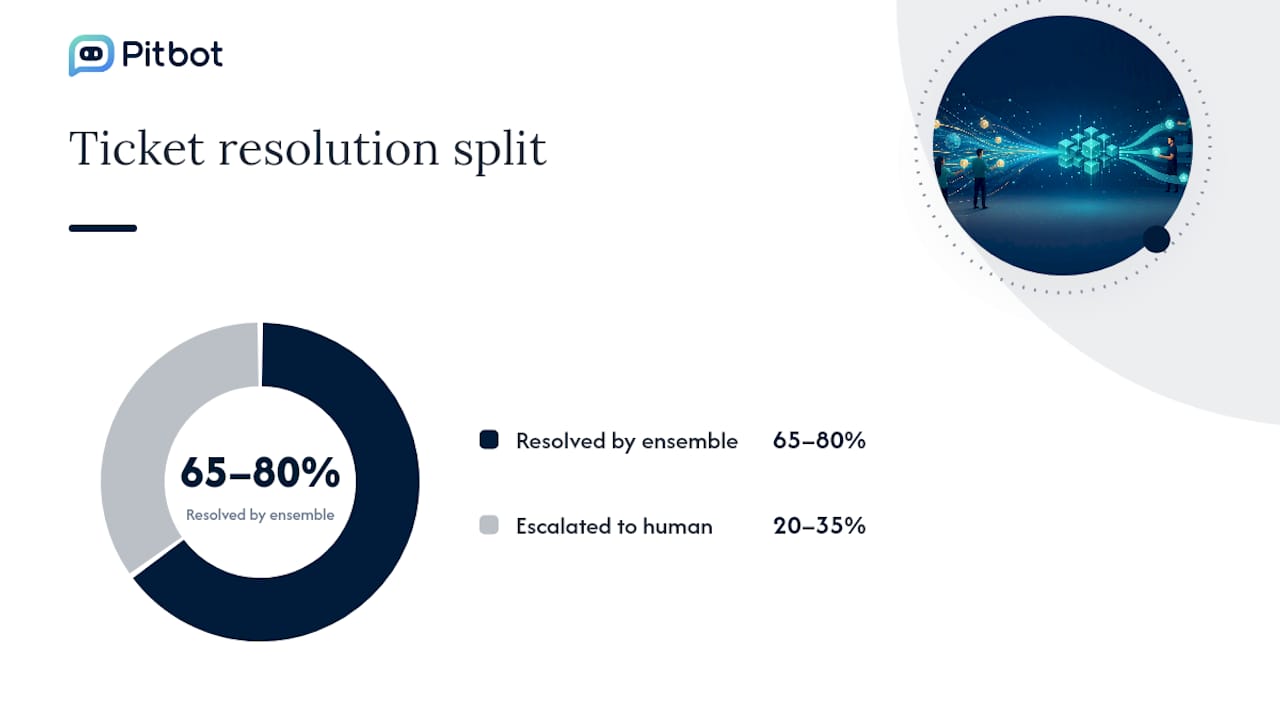
A routing model classifies the incoming message: withdrawal query, bonus dispute, self‑exclusion request, general account question. That classification determines which specialist model picks it up. One model might summarise a long thread, another matches the query against policy clauses, a third drafts the conversational reply. Running several models in parallel, rather than relying on a single general‑purpose one, reduces the odds that a single model’s blind spot becomes the player’s problem.
Two mechanisms make this workable at scale rather than just clever in a demo:
- Retrieval‑augmented generation (RAG) grounds every policy‑sensitive answer in the actual terms and conditions, not the model’s memory of what casino terms typically say.
- Tool calling lets the model query live systems, PAM for account status, KYC verification state, payment processor logs, instead of guessing.
NowG’s engineering guidance on Tier 1 support recommends splitting these retrieval indices into a policy corpus and an operational corpus, so a model answering “what’s your wagering requirement” pulls from terms and conditions, while one answering “where’s my withdrawal” pulls from transaction state. Confidence gates sit on top of both: when a model’s certainty drops below a set threshold, or when the query touches a hard‑gated topic, the system routes to a human reviewer instead of auto‑sending. InteractiveAI reports production deployments resolving 65 to 80% of tickets this way, with the remainder escalated by design, not by failure.
What compliance controls do regulators actually expect?
Regulators don’t expect operators to avoid AI. They expect operators to prove a human remains accountable for every decision the AI influences. That distinction shapes almost every design choice in a compliant ensemble.
LicenceGaming’s regulatory analysis is blunt about the gap that gets operators into trouble: auto‑closing a ticket without a documented human sign‑off, even when the AI’s answer was correct, leaves no defensible trail if a player disputes it later. The fix is procedural, not technical alone.
- Classify every flow as hard‑gated or soft‑gated. Bank detail changes, withdrawal approvals above a threshold, and any AML or responsible‑gambling flag should always route to a human, no exceptions.
- Log the full decision chain. Reviewer identity, timestamp, the clause IDs the model cited, its confidence score, and any tool calls made, all retained together.
- Set PII retention and redaction rules before launch, not after an audit request arrives.
- Run calibration reviews on a fixed schedule to check whether confidence thresholds are still catching the right cases.
- Write the vendor contract clearly. LicenceGaming and Gambling Insider both flag that operators, not vendors, carry ultimate accountability for compliance outcomes, so responsibility splits need to be explicit on paper.
Pro Tip: Anchor every AI‑generated policy answer to a clause ID, jurisdiction, and effective date. When a dispute lands months later, you’re pulling a specific record, not reconstructing what the model “probably” meant.
Where do you start? A practical rollout checklist
Trying to automate every support flow on day one is how compliance‑first programmes turn into compliance headaches. Start narrow.
- Pick 5 to 10 pilot intents with high volume and low legal risk, wagering progress, bonus rules, KYC status checks, rather than anything touching payouts or self‑exclusion.
- Turn policy into data. Give every clause in your T&Cs, responsible‑gambling rules, and KYC procedures a clause ID, jurisdiction tag, and version number.
- Split your RAG indices into policy corpus and operational corpus, tagged so retrieval never blurs the two.
- Map tool calls per intent. A withdrawal query needs
get_withdrawal_status; a bonus question needsget_bonus_assignment. Whitelist exactly which actions each model can trigger. - Build the guardrails first, not last. Confidence gates, a deterministic policy engine for anything money‑impacting, and explicit escalation rules that don’t depend on a model “deciding” to be cautious.
- Sample disputes for regression testing. Feed real disputed tickets back into your evaluation set before expanding autonomy to new intents.
InteractiveAI’s Betsson France deployment resolved about 75% of customer issues end‑to‑end once the ensemble was tightly wired into PAM, KYC, and ticketing systems. This figure reflects integration depth as much as model quality. That’s the pattern worth copying: the ensemble isn’t smarter because it has more models, it’s safer because it’s wired into the systems that hold the truth.
Which metrics tell you the ensemble is actually working?
Efficiency metrics alone will mislead you here. A support programme that resolves tickets fast but escalates the wrong ones is a regulatory problem wearing a good dashboard.
Track these together, never in isolation:
- First contact resolution (FCR), your retention signal.
- Escalation precision, whether flagged tickets genuinely needed a human.
- Hallucination or error rate, your regulatory risk signal.
- Time‑to‑human for gated flows.
- Audit completeness, the percentage of AI‑touched tickets with a full decision log.
- Dispute regression rate, how often resolved tickets get reopened.
| Metric | What it protects | Review cadence |
|---|---|---|
| FCR | Player retention | Daily dashboard |
| Escalation precision | Trust in gating logic | Weekly calibration |
| Hallucination rate | Regulatory exposure | Daily dashboard |
| Audit completeness | Licence defensibility | Monthly audit package |
| Dispute regression | Long‑term policy accuracy | Monthly audit package |
Daily dashboards should surface safety signals, not just volume. Weekly sessions recalibrate thresholds. Monthly packages go straight to your compliance team, formatted for an auditor who has never seen your dashboard before.
Why human oversight isn’t a compromise, it’s the point
Some operators treat human review as a temporary scaffold they’ll remove once the models prove themselves. That’s the wrong mental model. AI should absorb the routine volume humans shouldn’t have to touch, freeing staff for the judgement calls, VIP relationships, and disputed cases that actually need a person. The ensemble doesn’t replace that judgement. It surfaces the right cases to the right reviewer, faster than a single model or a single human queue ever could.
Some platforms are built around that premise: with auto send off, AI‑drafted replies on email, live chat and Telegram wait for staff approval before a player sees them, with the provider and model used and who approved the reply logged alongside it. That’s not caution for its own sake. It’s what makes the system usable in a licensed market at all.
— pitbot
Ready to run a compliant ensemble in your support desk?
Multi‑provider AI drafting, staff approval of AI‑drafted replies, and a full audit trail are what some platforms already run for casino operators today. Instead of stitching together a review queue and an audit log yourself, you get it wired into one dashboard covering email, live chat, SMS and Telegram support, with thread assignment and responsible‑gambling detection features.
If you’re piloting your first AI‑assisted flows, start by reviewing the platform’s feature set against the checklist above, particularly the responsible‑gambling automation piece, since that’s usually where operators hit hard gates fastest. When you’re ready to see the human review workflow and audit trail in action on your own ticket types, book a demo.
Sources
- InteractiveAI | AI player support for iGaming
- AI compliance iGaming 2026: What regulators expect - Licence Gaming
- Compliance focus: A comprehensive pros and cons list for AI’s use in online gaming
- Nowg