
Use WhatsApp where reach, verified commerce and default end-to-end encryption matter most to customers. Choose Telegram where bot automation, large community groups and flexible file handling drive your support workload. Most operators serving high volumes end up running both, routing tickets by intent rather than picking one and abandoning the other. The trade-offs below explain exactly why.
TL;DR:
- WhatsApp’s extensive user base makes it the preferred choice for reaching customers in most regions, especially for transactional and verified commerce support.
- End-to-end encryption is active by default on WhatsApp, whereas Telegram’s encryption applies only in Secret Chats, affecting privacy and compliance strategies.
- Telegram offers larger support groups, richer message formatting, and easier bot deployment, making it better suited for community or broadcast support efforts.
- WhatsApp’s Business API involves messaging fees, template approval delays, and higher risk of suspension, while Telegram’s Bot API allows quick setup with fewer onboarding hurdles.
- Combining both platforms in a unified, compliant support workflow ensures broader reach, operational flexibility, and audit readiness for regulated operators.
Table of Contents
- WhatsApp vs Telegram support: comparing the features that matter
- WhatsApp vs Telegram support: what runs behind the scenes
- How secure is customer data on each platform?
- Which bots and integrations actually work for support?
- How do you choose the right platform for your support team?
- How compliant support platforms handle both channels
- Our take: stop treating this as an either/or decision
- A support platform built for regulated operators on every channel
- Sources
- FAQ
WhatsApp vs Telegram support: comparing the features that matter
Support leads rarely care about a messaging app’s chat wallpaper options. They care about whether a platform can carry an SLA, survive an audit, and scale past a few hundred daily conversations without falling over. On that front, WhatsApp and Telegram solve genuinely different problems.
Reach is not close. WhatsApp reports more than 3 billion monthly active users, which makes it the default expectation for customers in most regions outside a handful of markets where Telegram or other apps dominate. If your support strategy depends on meeting customers where they already are, WhatsApp usually wins that argument before you’ve compared a single feature.
Encryption is where the two platforms diverge sharply, and it’s the point most comparison articles get lazy about. WhatsApp applies end-to-end encryption by default across every regular chat, using the Signal protocol. Telegram’s standard chats sit on its own MTProto system and are encrypted client-to-server, not end-to-end. True end-to-end protection on Telegram only exists in Secret Chats, a separate mode users have to switch on manually. For a support team, that distinction changes how you design a conversation, not just how you market your security posture.
Where Telegram pulls ahead is scale and format. It supports groups of up to 200,000 members and channels with no subscriber cap, alongside native scheduling, richer message formatting, and generous file transfer limits. That makes it a natural fit for community-style support, product announcements, or VIP broadcast channels where you’re talking to thousands at once rather than one customer at a time.
A few other differences shape day-to-day support work:
- WhatsApp’s Business API ecosystem includes verified profiles and structured commerce features built for transactional messaging.
- Telegram’s cloud-first architecture gives smoother multi-device sync and persistent message storage, while WhatsApp’s experience remains more phone-anchored even with linked devices improving.
- Neither platform gives you deep native analytics out of the box. Both expect you to bolt on a helpdesk, CRM, or dedicated reporting layer if you want real dashboards.
- Moderation tools on Telegram (admin roles, slow mode, pinned messages) are built for large groups; WhatsApp’s are built around one-to-one and small group threads.
Neither app is objectively “better.” One is built for reach and trust signals, the other for scale and tooling.
WhatsApp vs Telegram support: what runs behind the scenes
The features are only half the story. What decides whether a support desk actually functions is the operational plumbing behind each app, and here the two platforms ask for very different kinds of effort.
WhatsApp support at any real volume runs through the Business API, which works on a conversation-based pricing model. You pay per messaging session, and outbound messages outside a live conversation window require pre-approved templates. That approval process adds friction: every new automated message type has to go through Meta’s review before it can reach a customer. In exchange, you get the green verification tick, tighter brand trust, and built-in commerce features tied directly to WhatsApp’s Business API for developers.
Telegram’s Bot API, by contrast, has almost no onboarding friction. You can spin up a bot in minutes, send rich formatted messages, schedule broadcasts, and hand over large files without a review queue slowing you down.
That speed comes with its own risks:
- Template overhead on WhatsApp can delay a new support workflow by days while Meta reviews the message format.
- Account suspension risk is real on WhatsApp if enough users report or block a business number, which matters for high-volume outbound support.
- Message failures and retries need explicit handling logic on both platforms since neither guarantees delivery confirmation the way a dedicated helpdesk ticketing system does.
- Telegram’s lower friction is also its weak point: fewer built-in guardrails mean more of the compliance burden sits on your own team.
If you’re setting up from scratch, WhatsApp needs a business verification process and template library before day one. Telegram needs a bot token, a clear command structure, and a plan for who moderates it once volume grows.
How secure is customer data on each platform?
Encryption headlines don’t tell the whole compliance story. What matters for a regulated support desk is what gets stored, where, and for how long.
WhatsApp’s default end-to-end encryption means Meta itself cannot read message content in transit for standard chats. Telegram’s cloud chats sit unencrypted end-to-end on Telegram’s servers by design, which is what enables the multi-device sync support teams often like. That server-side storage is convenient for operations and a genuine liability for anything involving sensitive personal data, unless the conversation is deliberately moved into a Secret Chat. Security researchers note that treating ordinary Telegram chats as private is a common and avoidable mistake among businesses that assume the whole app works like Signal.
For any support team handling identity documents, payment details, or account verification, the practical rules are the same regardless of which app you choose:
- Never transmit unmasked personal or financial data directly in chat, even on an encrypted channel.
- Use authenticated links that route customers to a secure portal rather than pasting sensitive details into a message thread.
- Keep an audit log of every automated and human reply, with retention settings that match your regulatory obligations.
- Treat any third-party connector, bot, or integration as a potential weak point and review its access scope regularly.
Human review before a message goes out remains the single most reliable safeguard on either platform. Automation can draft a reply in seconds, but a person catching a mistake before it reaches a customer is what actually protects a compliance record.
Which bots and integrations actually work for support?
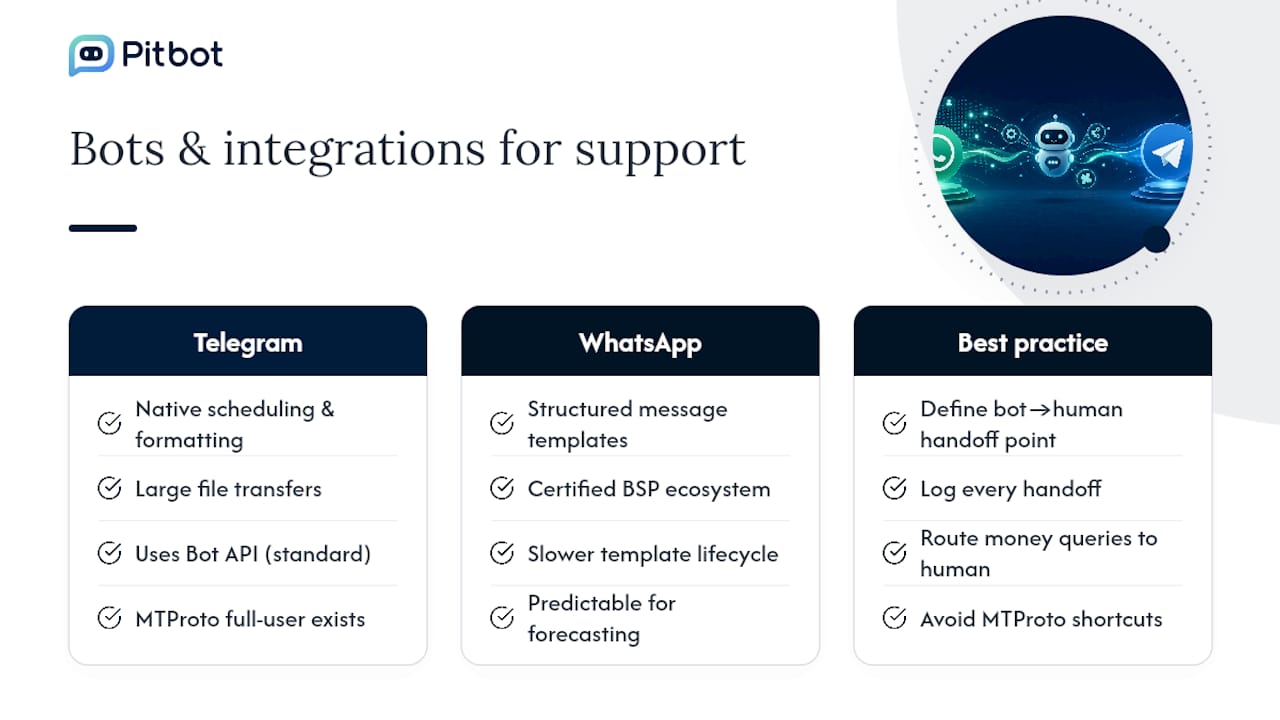
Telegram’s bot ecosystem is built for this kind of work in a way WhatsApp’s isn’t. Native scheduling, structured formatting, and large file transfers make it straightforward to run announcements, escalation queues, and even ticketing logic entirely inside the app.
There’s a caveat worth knowing before anyone on your team gets clever. Some integrations use MTProto to connect as a full user account rather than through the standard Bot API, unlocking capabilities bots don’t normally have. That sits outside Telegram’s typical usage patterns and can introduce policy and operational risk that’s hard to justify for a regulated business chasing a shortcut.
WhatsApp’s ecosystem runs through certified Business Solution Providers, with structured message types and a predictable, if slower, template lifecycle. It’s less flexible but more predictable, which matters when you’re forecasting support costs.
Whichever platform carries the automation, the same rule applies: define exactly when a bot hands off to a human, and log that handover every time.
Pro Tip: Route any message that mentions a balance, withdrawal, or account restriction straight to a human reviewer. Automated replies on money-related queries are where support automation loses trust fastest.
How do you choose the right platform for your support team?
Work through these steps in order rather than picking a platform on gut feel.
- Map your audience. Check where your customers already message you, whether that’s support tickets mentioning WhatsApp, or community activity already happening in Telegram groups.
- Map your compliance requirements. Decide whether you need default end-to-end encryption for every message, or whether audited, retained storage actually serves you better.
- Assess your operational capacity. Large Telegram groups need active moderation; WhatsApp’s transactional model needs template management and API budget.
- Pilot both with real KPIs. Track SLA adherence, CSAT, and escalation rate over a fixed window before committing.
The platform that wins is whichever one meets your bigger constraint: reach and SLA discipline, or tooling and community depth. Many teams find the honest answer is both, split by use case rather than forced into one.
How compliant support platforms handle both channels
Running WhatsApp and Telegram support well without losing an audit trail is an operational problem, not just a messaging one. Pitbot builds around exactly this gap for regulated operators, where Telegram replies drafted by AI wait for staff approval when auto send is off, and every reply on either channel is logged.
An audit-ready support desk doesn’t ask “which app is safer” in the abstract. It asks whether every reply, on every channel, can be traced back to a decision a human signed off on. That’s the standard regulated operators actually get measured against.
Integrating Telegram and WhatsApp inside one workspace, with thread assignment, multilingual handling, and suppression logic for responsible messaging, turns two very different apps into one measurable support operation rather than two separate risk surfaces.
Our take: stop treating this as an either/or decision
The smarter move is usually a hybrid one: WhatsApp for transactional reach and verified commerce, Telegram for community depth and automation. Both bring genuine strengths and genuine gaps, so the winning setup is one dashboard, disciplined human escalation, and a documented process behind whichever app answers the message. Pilot small, measure SLA and CSAT, then scale what actually works for your customers.
— pitbot
A support platform built for regulated operators on every channel
Some support platforms offer operators a single workspace where WhatsApp and Telegram messages can be managed together, rather than requiring separate tools for each app. AI-drafted replies can be configured to pass through human review before reaching players, with audit trails, thread assignment, and multilingual handling features available in some platforms.
That matters most for operators who’ve felt the gap between what a messaging app promises and what a regulator actually expects during an audit. Pitbot’s AI customer support for online casino and iGaming operators connects Telegram and WhatsApp through the same logged workflow, with Telegram replies held for staff approval when auto send is off. Responsible gambling detection and outreach suppression may be integrated alongside support workflows to handle sensitive cases before manual escalation. If you’re weighing which channel to scale next, book a demo and see how the audit trail looks on a live queue.
Sources
- WhatsApp vs Telegram 2026: Interactive Comparison | Creators, Business, Personal
- WhatsApp vs Telegram — which messaging app is safer for your business? | Bitdefender
- Telegram and WhatsApp: a comparison of two leading messaging platforms | TechBloat
- Telegram versus SMS: Which drives more revenue? - OtterText
FAQ
Why should I use Telegram instead of WhatsApp for support?
Telegram suits support operations that need large group broadcasts, bot automation, or generous file transfers without a template approval queue. It’s the stronger pick when your priority is tooling depth and community scale rather than default reach, as comparisons of both platforms confirm.
Is Telegram a red flag for customer support?
Not inherently, but its normal chats aren’t end-to-end encrypted unless Secret Chats are switched on, which surprises many businesses. That’s a design choice to understand and plan around, not a reason to avoid the platform outright.
Which is safer, WhatsApp or Telegram, for handling customer data?
WhatsApp applies end-to-end encryption by default to every standard chat, while Telegram only offers that protection in Secret Chats. For sensitive customer data, WhatsApp’s default posture requires less deliberate configuration to stay protected.
Is Telegram mostly used by Russian speakers?
Telegram has strong adoption across several regions including parts of Eastern Europe and the Middle East, but it has a genuinely global user base rather than being dominated by one language group. Regional strength varies by market, which is exactly why support teams should check where their own customers already are before choosing a channel.
Can Telegram replace SMS for regulated categories?
Yes, in markets or categories where SMS carriers restrict certain content, Telegram can serve as an alternative broadcast channel for announcements and updates. It requires building your own subscriber acquisition flow, since Telegram doesn’t inherit a customer’s phone number the way SMS does.
Does Pitbot support both WhatsApp and Telegram?
Pitbot integrates Telegram alongside email, live chat, and SMS within one compliance-ready dashboard, and with auto send off, AI-drafted replies on email, live chat and Telegram wait for staff approval before they reach a player. Pricing is on request: book a demo.