
The correct approach to VIP queue management is a ranked daily worklist that combines player value, churn risk and responsible gambling suppression, backed by automation and a compliance-ready audit trail. Build a scoring model, wire in hard suppression rules, then automate the routine cases so hosts spend their time on the players who genuinely need a human. Start this week by drafting one automation rule and a single ranked list for your highest tier.
TL;DR:
- Building a VIP queue requires integrating player data, automatic tiering triggers, strict responsible gambling suppression, and centralized routing; skipping any component risks compliance violations or missed opportunities.
- Prioritizing players based on a scoring model that combines lifetime value, recency, and engagement signals ensures hosts focus on the most valuable and safest VIPs, supported by automated rules for routine cases.
- Parallelizing compliance, risk, and liquidity checks accelerates decision-making and reduces withdrawal delays, with detailed logs and explicit rules defining AI versus human decision thresholds for regulatory safety.
- Monitoring key KPIs such as time-to-first-contact, withdrawal speed, and retention rates guides continuous improvement, with a focus on speed of payouts as a critical factor in VIP satisfaction and loyalty.
- Using tools like Pitbot, integrating multi-channel responses, automated responsible gambling, and audit trails simplifies operations and prevents breakdowns caused by manual processes or siloed teams.
Table of Contents
- What are the core components of a VIP queue?
- How do you build a ranked daily worklist and SLAs?
- What architecture keeps VIP queues fast and compliant?
- Which KPIs actually measure VIP queue health?
- How does Pitbot’s approach support this playbook?
- Where do VIP queues actually break down?
- See how Pitbot fits into your VIP queue in practice
- Selected reading to support implementation
- Sources
- FAQ
What are the core components of a VIP queue?
A working VIP queue needs four building blocks in place before you touch automation or SLAs. Skip one and the whole system leaks, either through missed opportunities or compliance exposure.
- Data: player events, KYC and source-of-funds state, open tickets, payment status and recent activity, pulled into one view rather than five separate systems.
- Tiering: rolling triggers for tier entry, typically net deposits, wagering volume and predicted lifetime value, with host assignment rules that follow automatically once a player crosses a threshold.
- Suppression: rigid filters that block outreach the moment a player is flagged for responsible gambling concerns or self-exclusion, applied across every channel without exception.
- Channels and routing: chat, email, SMS and Telegram where your licence permits it, with routing logic centralised so a host isn’t hunting across four inboxes.
Many VIP teams still stitch this together manually. Surveys of operators find teams lose 12 to 17 hours a week to manual work piecing spreadsheets, CRMs and BI dashboards together because no purpose-built VIP tooling exists. That single-pane-of-glass problem is the first thing to fix, and host ratios and compliance separation matter just as much as the tier design itself.
How do you build a ranked daily worklist and SLAs?
Once the data and suppression rules exist, the actual worklist is a straightforward scoring exercise. Here’s a sequence that teams can implement in a few weeks without a full platform rebuild.
- Compute an opportunity score. Combine lifetime value, recency of activity, engagement signals and RG flags into a single number. Cockpit implementations commonly score eligible VIP players from 0 to 100 this way, then pair the score with a recommended next action.
- Rank the daily queue by score, not by inbox order. The player worth the most to your business, and safest to contact, sits at the top.
- Set silence bands with harm checks first. A common ladder runs at-risk contact around day 7, pre-churn around day 14, and churned around day 30, but reactivation cadences must be gated by an RG check before any message goes out. Skipping that check is how operators end up with regulatory incidents.
- Define SLA targets. First response to a VIP message within a set window (many teams target under 15 minutes during operating hours), and a firm escalation path for withdrawal queries so a VIP request never sits behind standard-tier tickets.
- Cap bonus and offer value against tier NGR. A guardrail expressed as a percentage of net gaming revenue per tier stops individual hosts from over-discounting to hit short-term targets.
Pro Tip: Run the harm check as a hard gate before the contact script fires, not as a manual step a host remembers to do. If it’s optional, someone will eventually skip it under pressure.
What architecture keeps VIP queues fast and compliant?
Most delay in VIP operations isn’t caused by decision complexity. It’s caused by doing checks one after another when they could run at the same time.
Parallelise the checks that actually gate a decision, risk, compliance and liquidity, and converge their results into one composite outcome. Technical teams describe this pattern of parallel scoring and short-circuit fails as the fix for sequential queuing that stalls VIP withdrawals. The composite score maps cleanly to three outcomes: approve automatically, hold for review, or decline.
Payment routing needs the same discipline. Multi-rail routing with health checks on each rail, plus idempotency keys on every transaction, prevents duplicate payouts when a rail times out and retries.
The bigger question is where AI stops and a human starts:
- Define explicit rules for which cases an AI system can auto-approve versus which require staff sign-off.
- Every AI-generated reply should be review-ready before it reaches a player, not reviewed after the fact.
- Log every decision: what happened, why, and who authorised it, whether that authorisation was a person or an automated rule.
- Keep that decision log queryable, because a regulator or an internal audit will eventually ask for it.
Most slow withdrawals trace back to manual review queues rather than genuine risk complexity. Automating the majority of cases that are obviously safe is where the biggest experience gains sit, leaving staff time for the cases that actually need judgement.
Which KPIs actually measure VIP queue health?
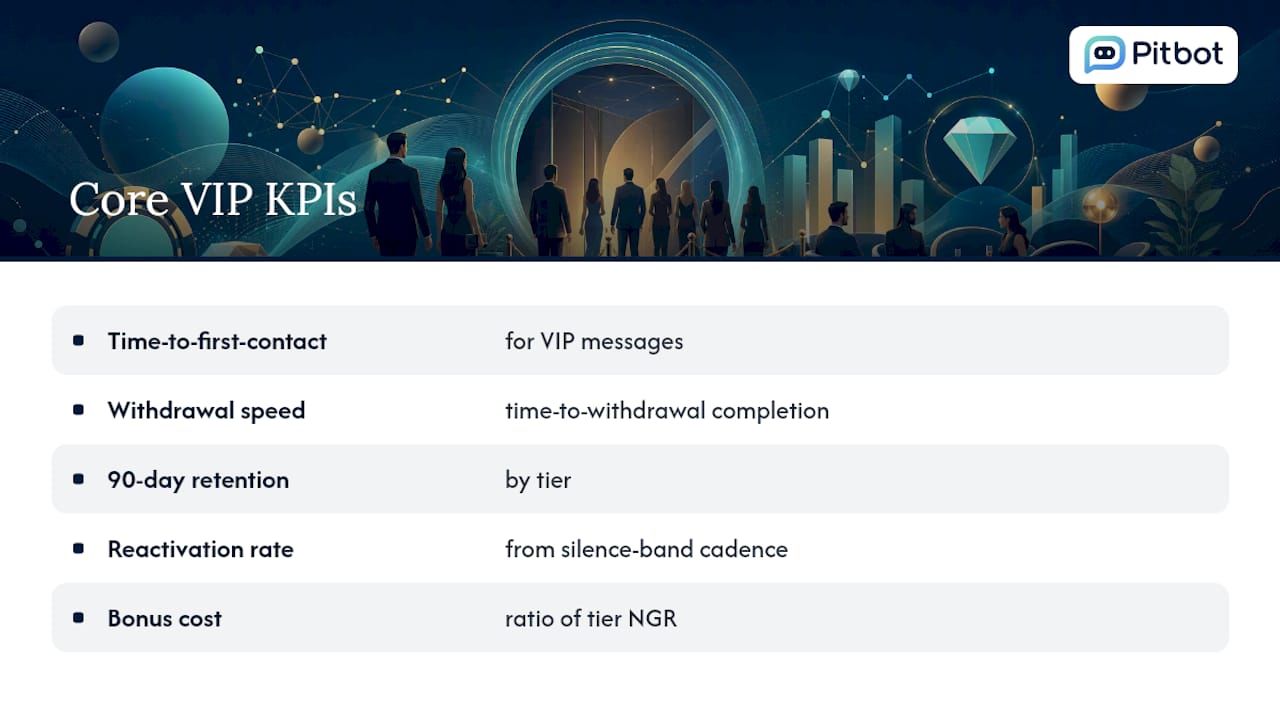
Track a small set of numbers consistently rather than a dashboard nobody reads. The core metrics: time-to-first-contact for VIP messages, time-to-withdrawal completion, 90-day retention by tier, reactivation rate from your silence-band cadence, SLA compliance percentage, and bonus cost as a ratio of tier NGR.
Why payout speed matters more than most bonus strategies: operators increasingly compete on withdrawal speed rather than promotional size, since payout speed retains VIPs as reliably as bonus value, sometimes more so.
Benchmark against your own history before reaching for industry averages. Run internal A/B or holdout tests on offer efficacy, some players respond better to faster service than to a bigger bonus, and you won’t know which until you test it on your own base.
Set a reporting cadence and stick to it: a daily operational dashboard for hosts showing today’s ranked list and SLA status, a weekly ops review looking at trend lines across the KPIs above, and a quarterly compliance audit checking that suppression rules actually held across every channel.
How does Pitbot’s approach support this playbook?
The playbook above only works if the tooling underneath it keeps every VIP conversation, and every decision about it, in one place.
Channel coverage matters because VIPs don’t stick to one inbox. Pitbot integrates email, live chat, SMS and Telegram into context-aware responses, which puts every VIP conversation in one dashboard instead of a fragmented queue.
The human-in-the-loop element is the part worth dwelling on. Human review of AI-generated replies helps balance speed and regulatory compliance, with the review step producing an audit trail that logs what was said, why, and who signed off on it.
Where do VIP queues actually break down?
Most failures aren’t technical. They’re habits that quietly build up until a regulator or a lost VIP forces a review.
The usual suspects: hosts running the queue from memory and spreadsheets rather than a ranked system, sequential manual review that stalls withdrawals for no real reason, contact attempts that slip past a suppression flag, and promotional messages mixed in with an unresolved service complaint.
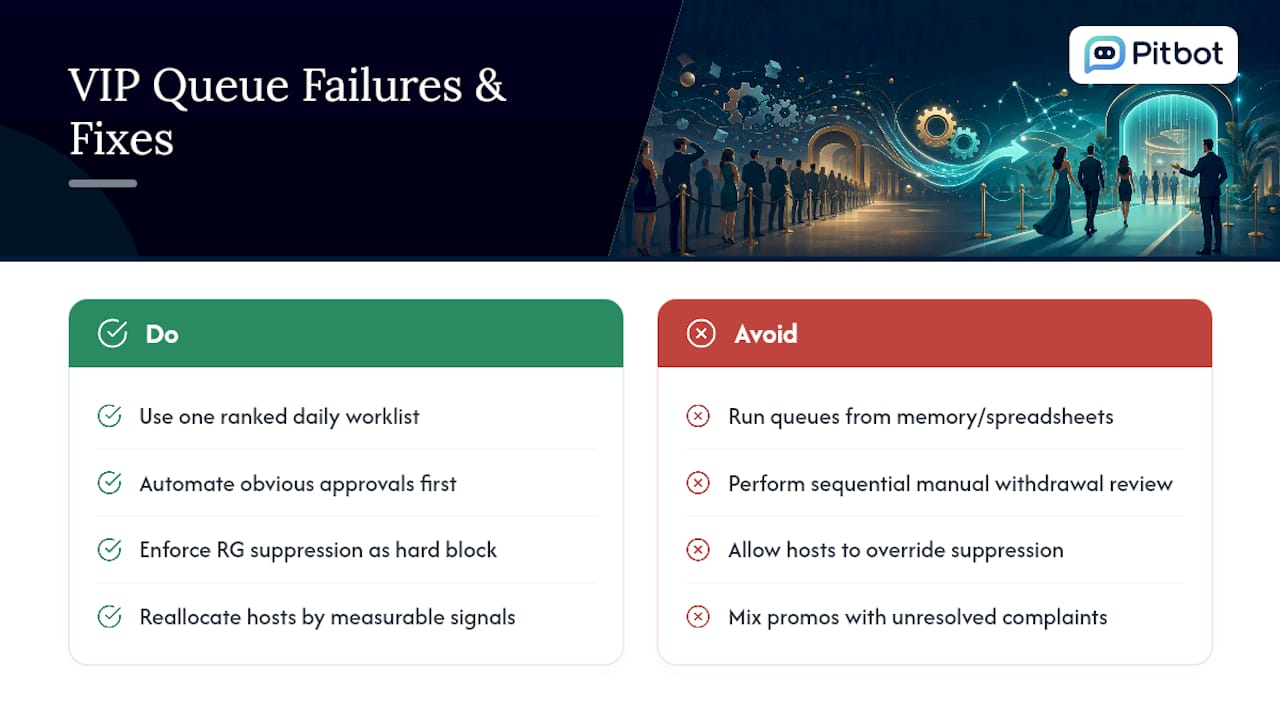
The fastest fixes cost little to implement. Stand up one ranked daily worklist, even a simple one. Automate the obvious approvals first, since that’s where most of the time saving hides. Make RG suppression a hard block, not a warning a host can override. Reallocate host books by measurable signals like response time and retention, not tenure.
None of this works if teams operate in silos. Payments, compliance and marketing need to share the same suppression list and the same escalation rules, or one team’s automation becomes another team’s compliance incident.
— Pitbot
See how Pitbot fits into your VIP queue in practice
Pitbot maps onto most of the checklist above: AI-drafted replies you can hold for staff approval, omni-channel coverage across chat, email, SMS and Telegram, responsible gambling suppression that blocks outreach automatically, and an audit trail that logs every decision without extra manual work from your team.
Rather than rebuilding your VIP operation from scratch, a sensible pilot scope is one VIP tier, a withdrawal routing test, and a daily ranked worklist for a single host team with clearly defined KPIs before and after. That’s small enough to run in weeks, and specific enough to show whether time-to-first-contact and SLA compliance actually move.
If you’re weighing this against continuing to stitch spreadsheets and CRM exports together, the honest comparison is time. Pitbot’s platform for online casino support keeps the conversations, approvals and audit trail in one place, so the worklist you build from your own scoring model sits next to the record of what was said rather than in a separate spreadsheet. Book a demo and bring one real VIP tier’s data to the call, so the pilot scope above is something your team can actually see running rather than describing in the abstract.
Selected reading to support implementation
- VIP teams: iGaming spreadsheets over AI tools, survey finds, on the time cost of manual VIP tooling.
- The state of VIP operations, covering ranked worklists and silence bands in practice.
- VIP player management for iGaming operators in 2026, on tiering, host ratios and compliance guardrails.
- Why most iGaming platforms have slow withdrawals, on parallel scoring and payment routing architecture.
Sources
- VIP teams: iGaming spreadsheets over AI tools, survey finds
- Why most iGaming platforms have slow withdrawals (and how we architected around it)
- VIP player management for iGaming operators in 2026 | iGamingHub
FAQ
What is VIP queue management in iGaming?
It’s the process of prioritising, routing and handling high-value players’ support and service requests across chat, email, SMS and Telegram so they get faster, personalised, compliance-checked responses. A ranked worklist that scores players by value, recency and RG status sits at the centre of a well-run version.
How do you prioritise VIP support requests?
Score each eligible player on lifetime value, recency of activity and permitted engagement signals, then rank the day’s list by that score rather than by inbox arrival order. Suppression rules for responsible gambling or self-exclusion override the score entirely and block contact regardless of value.
What SLA should VIP withdrawal requests get?
VIP withdrawal queries need a firmer escalation path than standard tickets, typically first response within minutes rather than hours, with automated approval for the majority of low-risk cases. Automating the obviously safe cases removes most of the delay that frustrates high-value players.
Does Pitbot handle responsible gambling suppression automatically?
Yes. Pitbot applies responsible gambling suppression across every connected channel, blocking outreach to flagged players automatically rather than relying on a host to remember the check.
What does Pitbot cost?
Pitbot’s pricing is available on request through the site rather than published as a fixed rate. The best way to get an exact figure for your operation is to book a demo and discuss your channel and seat requirements directly.