
Start with RFM to rank customers by recency, frequency and monetary value, then layer behavioural signals on top, and move to always-on AI-driven scoring once your data is unified. The sections below cover exact thresholds, build order and how to activate the segment once it’s built.
TL;DR:
- The recommended thresholds for VIP segmentation include top 5% spenders, at least four transactions within 90 days, and recent high-value activity.
- Effective segmentation combines RFM analysis with behavioral and AI-driven clustering, requiring a unified, accurate customer data foundation.
- Focusing on five to ten well-defined segments optimizes campaign targeting and prevents resource dilution, with static segments reviewed quarterly.
- VIP communication should blend standard marketing with exclusive offers, early access, and personalized support channels, tailored by urgency and customer behavior.
- AI-enabled, human-in-the-loop support platforms help deliver fast, compliant, and personalized VIP responses across multiple channels without sacrificing oversight.
Table of Contents
- Concrete criteria to define a VIP: thresholds and examples
- Which methods actually work, and in what order?
- Why your VIP list is only as good as your data foundation
- How many VIP segments should you actually run?
- What should you actually send VIPs, and through which channel?
- Keeping VIP communication fast and compliant at scale
- How loyalty programmes and personalised offers fit the picture
- Five mistakes that quietly wreck VIP segmentation
- Bringing always-on VIP support into reach for operators
- Sources
Concrete criteria to define a VIP: thresholds and examples
Most teams overcomplicate this. A VIP definition needs three things: a value threshold, a frequency rule, and a time window that keeps the list current.
The RFM framework gives you the fastest route to something usable, and quintile scoring is the standard method: rank every customer 1 to 5 on recency, frequency and monetary value, then concatenate the three scores. Anyone landing a 4 or 5 on all three axes is your working VIP tier.
Practical thresholds worth testing:
- Value-based: top 5–20% of customers by trailing 12-month spend (Pareto’s 80/20 pattern often appears in retail and iGaming spend data).
- Frequency-based: four or more purchases, deposits, or sessions within a rolling 90-day window.
- Blended OR rule: high spend in a single transaction (a whale deposit) OR consistent frequency over time, since one-off big spenders and steady regulars need different treatment.
- Blended AND rule: high spend AND recent activity, used when you want a tighter, more reliable VIP pool for concierge-level resourcing.
Always attach a time bound. A customer who spent big eight months ago and vanished is not a VIP, it’s a churn risk wearing a VIP badge.
Which methods actually work, and in what order?
RFM should be your first build, not because it’s simplistic, but because it needs nothing more than an orders table and gives you a working tier in an afternoon. Digital Applied’s framework recommends quintile or three-tier scoring (low, medium, high) as the entry point for teams without a data science function.
Once RFM is running, add these layers in sequence:
- RFM base — recency, frequency, monetary value, scored on a 1 to 5 or three-tier scale.
- Behavioural overlay — engagement rate, visit recency, product or game preferences, support contact volume, and complaint history.
- Predictive or AI-driven scoring — clustering or decision trees to surface segments humans wouldn’t spot manually, then agentic tools that update tiers automatically as behaviour shifts.
Databricks frames this correctly: effective segmentation blends rule-based, RFM, clustering and machine learning methods, it doesn’t pick one and discard the rest. Clustering earns its place when you have enough volume that manual rules miss meaningful groups, decision trees earn theirs when you need to explain to a compliance team why someone landed in a VIP tier.
Pro Tip: Don’t jump to machine learning to look sophisticated. Add clustering only once RFM plus a behavioural overlay stops surfacing groups you would actually treat differently.
Why your VIP list is only as good as your data foundation
VIP accuracy collapses without clean identity resolution. Databricks is blunt about this: fragmented data is the single most common cause of segmentation failure, and a governed Customer 360 is the fix, not an optional extra.
The sources that typically need unifying:
- Order and transaction history (or deposit and wager logs for gambling operators)
- CRM records and account status
- Support and complaint logs
- Web and app behavioural events
- Loyalty programme activity and tier history
Once unified, segments need to be activation-ready, meaning marketing tools, CRM, and support platforms can all consume the same definition without a manual export each time. Shopify’s research notes that AI-driven segmentation only delivers real-time personalisation when built on these unified profiles, otherwise you’re automating on top of bad data.
Govern the pipeline with a short checklist: who owns each segment definition, how often identity matching runs, what triggers a refresh, and who audits changes. Skip the checklist and you’ll rediscover the same duplicate customer records every quarter.
How many VIP segments should you actually run?
Fewer than you think. Our recommendation for a VIP programme is 5 to 10 segments, starting with two or three when building from scratch. Decision Analyst’s research is clear that there is no magic number, and that the right count should be an outcome of a well-differentiated solution rather than a target set in advance, but it also recommends a readable base of at least 100 customers in every segment. Past a handful of VIP segments, testing gets underpowered and every segment fights for the same limited campaign budget.
Rules worth enforcing:
- Every segment needs a minimum viable size, if it’s too small to test against a control group, merge it or drop it.
- Each segment must be distinct enough that treating it differently from its neighbours actually changes outcomes.
- Tie every segment to a measurable KPI: lifetime value, average order value, response rate, or churn rate.
- Review static segments quarterly, but let AI-driven tiers update continuously so someone doesn’t stay “VIP” for months after going quiet.
What should you actually send VIPs, and through which channel?
VIPs still need your mainstream campaigns. Mailchimp’s guidance on VIP segments is about what to add on top, not what to take away: an early access pass to new inventory, exclusive personalised experiences such as private events or priority support channels, and surprise extras. Keep VIPs on product news and general offers, and layer something extra alongside.
Layer VIP-specific treatments on top:
- Early access to new products, game launches, or limited promotions, sent 24 to 48 hours before general release.
- Exclusive experiences such as invitation-only events or dedicated account management.
- Premium fulfilment, faster payouts, priority shipping, or expedited withdrawal processing.
- Concierge support through a named contact or dedicated channel rather than a general queue.
Map channel to urgency: email for early access and newsletters, SMS or Telegram for time-sensitive offers, live chat or phone for concierge-level support, and in-product messages for contextual nudges. A reactivation flow for a lapsing VIP should escalate faster than a standard win-back, a personal message within days, not a generic email after weeks of silence. For GB-licensed operators, a lapsed high spender returning is itself a safer-gambling signal, so a win-back should pass through the same affordability and customer-interaction checks as any other high-value contact rather than lead with an incentive.
Keeping VIP communication fast and compliant at scale
Manual VIP desks break the moment volume grows past a handful of high-touch accounts. This is where human-in-the-loop AI earns its place: it lets support teams answer VIP queries at speed without losing the compliance checks that regulated industries require.
The core tension in VIP support is speed versus oversight. A platform that can hold AI-drafted replies for staff approval before they reach a player resolves that tension without slowing the player down.
A human-in-the-loop AI approach applies this directly to online casino operators, combining multiple AI providers with staff review of AI-drafted replies. In practice this means:
- Context-aware responses across email, live chat, SMS, and Telegram, so a VIP’s history follows them channel to channel.
- A full audit trail of every AI-generated decision, useful when regulators ask why a VIP received a specific offer or response.
- Faster response times without removing the human check that regulated markets demand.
How loyalty programmes and personalised offers fit the picture
A VIP segment without a corresponding loyalty structure is just a label. The two need to connect directly: loyalty tiers should mirror your RFM and behavioural scoring, not run as a separate system that marketing has to reconcile by hand.
The practical link works like this: your top RFM tier feeds the top loyalty tier, and the perks attached to that tier (cashback rates, dedicated hosts, faster withdrawal processing) get triggered automatically the moment a customer crosses the threshold, not weeks later during a manual review cycle. One caveat for GB-licensed operators: under LCCP 5.1.1 a high-value-customer incentive cannot simply auto-trigger, it needs affordability and source-of-funds checks, confirmation that the customer is aged 25 or over, and senior management sign-off first, so the automation should queue the upgrade for that review rather than grant the perk itself. Personalised offers should draw from the behavioural overlay, not just the value score. A frequent low-stakes player and an occasional high-roller might land in the same value tier, but they need different offers, one responds to volume-based perks, the other to exclusivity and speed of service.
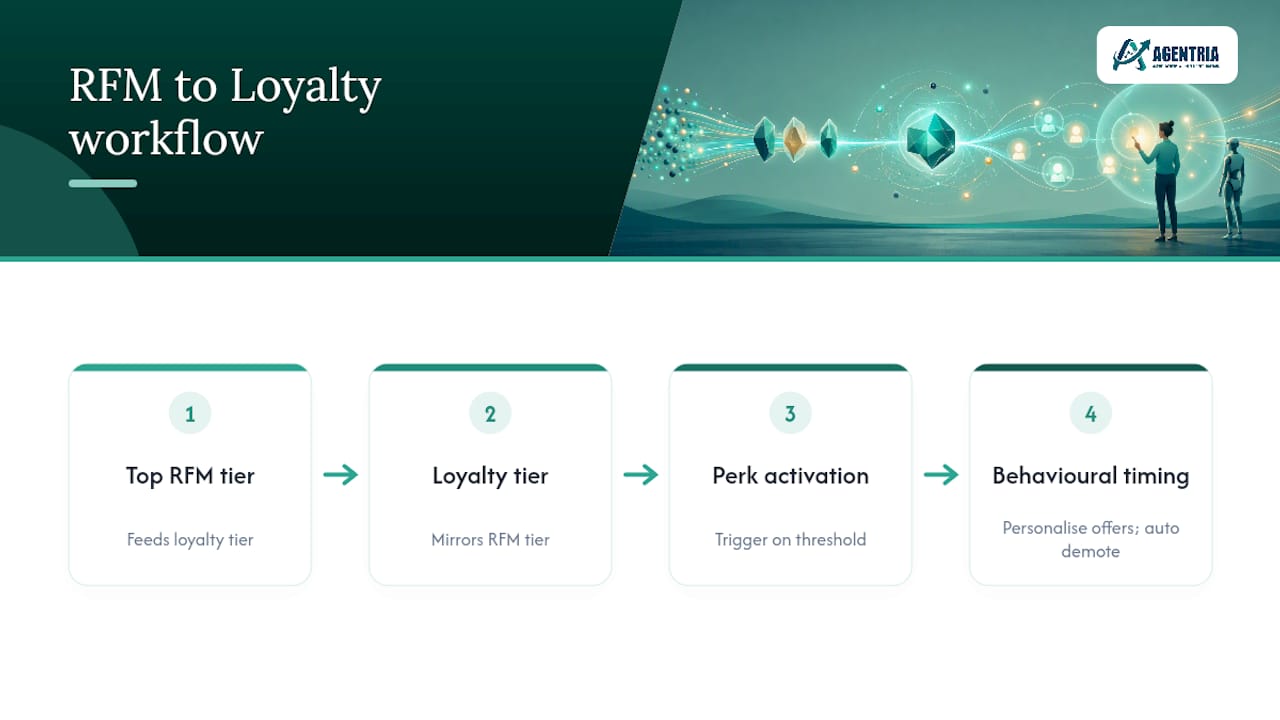
The mistake most loyalty programmes make is treating the VIP segment as fixed once someone qualifies. Tie the loyalty tier to the same time-bounded rules you used to define the VIP segment in the first place, and build in automatic demotion when activity drops, not just automatic promotion when it rises. A loyalty programme that only moves people up loses credibility fast, and it quietly inflates your VIP costs by keeping inactive accounts on premium perks. Personalisation should also extend to timing: a VIP who typically plays or shops in the evening shouldn’t get their exclusive offer at 9am, small scheduling details like this are often what separates a segmentation strategy that reads well in a deck from one that actually moves revenue.
Five mistakes that quietly wreck VIP segmentation
- No activation plan. Fix: define the owning team and channel before launch.
- Stale definitions with no time bound. Fix: force a recency cutoff.
- Too many micro-segments. Fix: cap at 5 to 10.
- Skipping identity resolution. Fix: unify data first.
- Treating VIP outreach as discounts only. Fix: add service and access perks.
Bringing always-on VIP support into reach for operators
Running a layered VIP strategy is one thing, staffing it around the clock across email, live chat, SMS and Telegram is another problem entirely. A platform built for that gap pairs multiple AI providers with a staff review queue: with auto send off, AI-drafted replies on email, live chat and Telegram wait for staff approval before they reach a player, so a VIP getting a fast response at 3am still gets one a person has checked.
For operators managing VIP queues, that means quicker replies without losing the audit trail regulators expect, every AI-generated decision logged and reviewable. The platform’s features cover sentiment detection and escalation, so a VIP showing signs of frustration gets flagged before they churn, not after. Teams running responsible gambling checks alongside VIP outreach can also lean on automated detection and outreach suppression to keep high-value engagement compliant. If your VIP desk is stretched thin, the sensible next step is to book a demo and see the human-in-the-loop workflow on your own player data.
Sources
- What is customer segmentation? — Databricks
- AI customer segmentation — Shopify blog
- Customer segmentation 2026: RFM, behavioural, predictive — Digital Applied
- How Many Segments Are Optimal? — Decision Analyst
- How to Create a VIP Customer Segment and Reward Loyalty — Mailchimp