
The single most effective move you can make right now is to map every regulatory obligation to a named control owner, build one indexed evidence pack, and start a remediation tracker before the letter arrives. Regulators scope examinations through processes like the FDIC’s Pre‑Examination Planning, and a clean regulation-to-control map narrows that scope fast. This article gives you a 90/30/7 checklist, an evidence-pack template, and a working example of how platforms like Pitbot generate auditable records automatically.
TL;DR:
- Maintain a regulation-to-control matrix with clearly assigned owners, linked evidence, and review schedules to streamline examiners’ traceability and reduce audit duration.
- Prepare a concise, accurate evidence pack with an index, clear explanations, and secure, well-organized documentation to avoid delays and formal findings.
- Conduct a 90/30/7-day timeline with gap analysis, rehearsal interviews, and final assembly to ensure readiness before the regulator’s on-site examination.
- Use technology like evidence management systems and audit logs to automate evidence collection, improve accuracy, and enable quick retrieval during audits.
- Leverage AI support platforms for high-volume interactions to generate an automatic, searchable audit trail of communications, reducing manual logging efforts.
Table of Contents
- What regulators look for in compliance audits
- Build a defensible compliance framework: governance, mapping and ownership
- Building your 90/30/7-day audit-preparation timeline
- Evidence, documentation and pack preparation
- Engaging with regulators during the pre-examination and on-site phases
- Leveraging technology to shorten audits and improve evidence quality
- Post-audit: remediation tracking, follow-up and continuous readiness
- Practical example: an evidence-centric support platform in action
- Internal communication and staff training on audit expectations
- Establishing an audit liaison team or point of contact
- Conducting internal mock audits or readiness assessments
- Handling confidential or sensitive information during the audit
- A compliance officer’s week-before checklist
- An alternative approach worth considering for regulated operators
- Sources
What regulators look for in compliance audits
Examiners are not grading your policy manual for prose quality. They want two separate things: evidence that a process exists on paper, and evidence that people actually followed it. A policy that says transactions above a threshold get reviewed within 24 hours is worthless to an examiner unless you can produce logs showing that review happened, who did it, and when.
That gap between intent and execution is where most audits go wrong. Foley & Lardner’s guidance on international compliance self-checks makes the point directly: a defensible compliance programme is embedded in daily operations rather than sitting as a static binder on a shelf. Examiners have seen enough polished policy documents backed by nothing to know the difference immediately.
Three things shape how quickly an examiner moves through your file:
- Traceability — can a stranger follow a line from a specific regulatory requirement to the control that satisfies it, and then to the record proving that control ran?
- Named ownership — is there one person accountable for each control, or does responsibility blur across three departments?
- Version control — is the document you hand over the current, approved version, or an earlier draft someone forgot to update?
Miss any of these and the examiner doesn’t stop at your first answer. They ask a follow-up question, then another, and the review that should have taken a day stretches into a week. Regulators also weigh residual risk and consumer-harm indicators heavily, particularly in financial services and gambling, where a single unresolved complaint pattern can trigger deeper transaction testing regardless of how tidy your policy library looks.
Poor evidence presentation carries a cost beyond time. When an examiner has to hunt for proof, they tend to assume the worst about what else might be missing, and that assumption shapes the tone of the entire report. A regulation examination differs from a standard financial audit in this respect: examiners can evaluate statutory compliance and issue binding corrective orders, so a scattered evidence trail doesn’t just slow things down. It raises the odds of a formal finding rather than a verbal note to fix something quietly.
Good preparation, in other words, is less about producing more paperwork and more about producing the right ten documents in a form someone outside your organisation can verify in minutes rather than hours.
Build a defensible compliance framework: governance, mapping and ownership
Start with a single working document: a matrix that runs regulation, control, owner, and evidence across four columns. This sounds basic, and it is, but very few organisations maintain one consistently, which is exactly why so many audits stall on the same question repeated in different forms: “who actually owns this?”
Here’s how to build it properly:
- List every applicable regulatory requirement in plain language, one row per obligation, sourced from the actual rule text rather than a summary someone wrote three years ago.
- Attach the internal control that satisfies each requirement. If no control exists yet, mark the gap rather than leaving the cell blank.
- Assign one named owner per control. Not a department, not a team distribution list. One person whose job description includes that control.
- Link the specific evidence artefact that proves the control ran, such as a signed log, a system export, or a monitoring report, and note where it lives.
- Set a review cadence for each row, whether monthly, quarterly, or tied to a regulatory change trigger.
Governance sits above this matrix, not beside it. Every control needs a policy that has gone through a documented approval process, with a review cycle your board or senior management committee can point to. If your policy approval trail is thinner than your control matrix, an examiner will notice the mismatch quickly, because it suggests operational activity is running ahead of formal sign-off.
Pro Tip: Store all evidence in one repository with a naming convention that encodes the regulation reference, control ID, and date — something like AML-3.2_TransactionReview_2026Q1 — so anyone on the team can find the right file without asking you first.
Version control deserves its own discipline separate from storage. Keep a single source of truth for each policy document, retire superseded versions to a clearly labelled archive folder rather than deleting them, and stamp every current document with an effective date and approval reference. Foley & Lardner’s guidance on international compliance self-checks is consistent here: regulators rarely accept policy alone as evidence. They want named owners and demonstrable proof of execution, such as timestamps, signed logs and reviewer notes.
The payoff for doing this properly before an audit is scheduled is that you stop scrambling every time someone asks a routine question. The matrix becomes the answer key.
Building your 90/30/7-day audit-preparation timeline
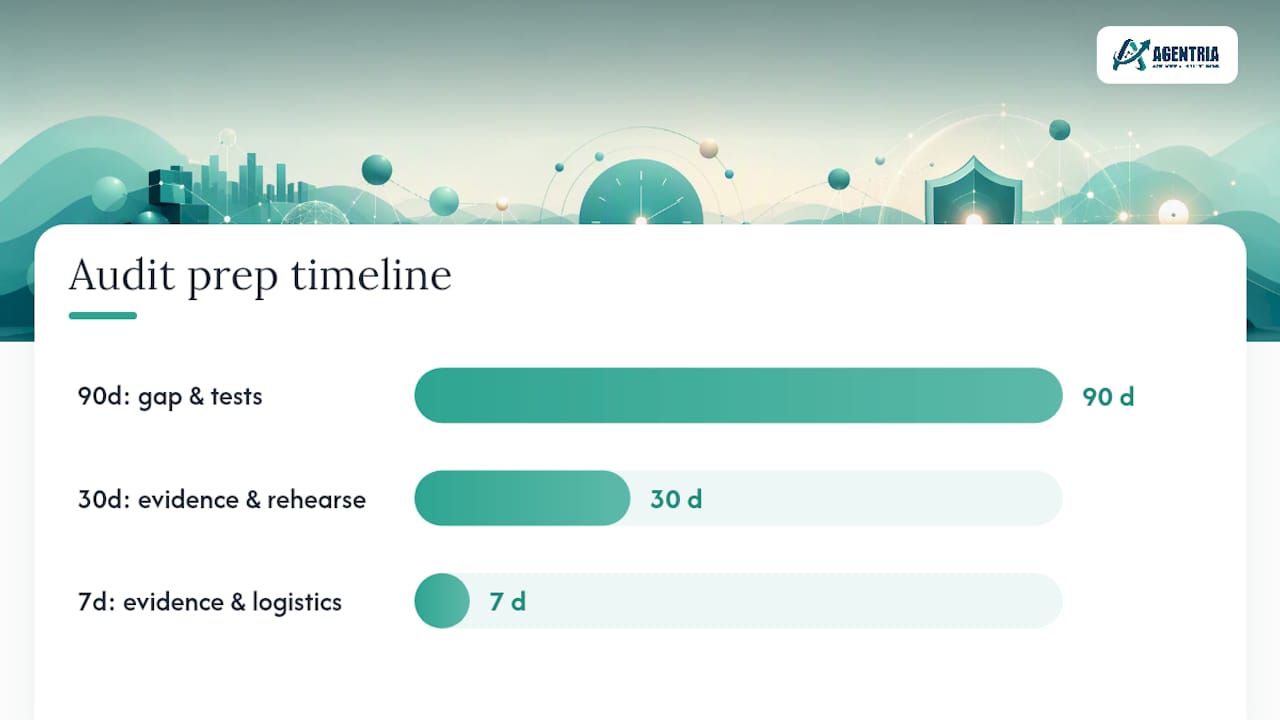
A structured lead time matters more than most compliance teams admit. Industry guidance treats 90 days as the recognised minimum for scheduled examinations, and teams that compress that window into a fortnight of panic almost always leave residual scope an examiner can pick apart.
At 90 days out:
- Confirm the scope of the examination with whatever notice or communication the regulator has issued.
- Run a gap analysis against your regulation-to-control matrix, flagging every control with weak or missing evidence.
- Begin initial testing on the highest-risk controls first, not the easiest ones to check off.
- Allocate resource properly, meaning named hours from named people, not a vague commitment to “look into it when we can.”
At 30 days out:
- Finalise the evidence pack for every control in scope, cross-checked against the matrix.
- Escalate any remediation still open on a critical control to senior management immediately, because 30 days is enough time to fix some things but not everything.
- Run rehearsal interviews with subject-matter experts who will face the examiner directly, using real questions pulled from your control matrix.
At 7 days out:
- Assemble the final evidence bundle in whatever format the regulator requires, whether that’s a secure portal upload or physical binders for an on-site visit.
- Confirm logistics: room bookings, IT access for the examination team, and a single point of contact who can field last-minute requests.
- Circulate a contact list naming who answers what, so nobody is improvising on the day.
- Run one final dry run of the walkthrough, treating it exactly like the real thing.
Vanta’s operational checklist for compliance audits follows a similar logic: understand scope, build a timeline, run a gap analysis, allocate resource, remediate, gather evidence, and build a working relationship with the auditor. When resources are scarce, and they usually are, prioritise the controls that reduce examination scope the fastest rather than the ones that are simplest to document.
Evidence, documentation and pack preparation
Your evidence pack needs specific artefact types, not a general folder of “compliance stuff.” At minimum, gather standard operating procedures, staff training logs with dates and attendance, monitoring and testing reports, a representative sample of transactions or interactions, closed corrective action records (CAPA closure evidence), and due-diligence files for any third parties in scope.
Presentation matters as much as content. One rule is worth repeating here: present every document as if a complete stranger is reviewing it for the first time. That means an index at the front of the pack, a one-line explanatory note on each artefact, and a direct pointer to the specific paragraph or line that proves compliance rather than expecting the examiner to read forty pages to find it.
- Index first — a contents page mapping each control to its evidence file and page reference.
- Excerpt, don’t dump — pull the relevant paragraph or transaction row into a short summary sheet, with the full document available if requested.
- Electronic submissions should use secure portals or read-only exports rather than editable files, and any screenshots should retain visible timestamps or query parameters showing exactly when and how the data was pulled.
- Retention and anonymisation — check your retention windows before submission, and anonymise personal data where regulation requires it, while keeping a clear chain-of-custody note showing who accessed the record and when.
Pro Tip: Build the index as a live spreadsheet rather than a static PDF. When an examiner asks a follow-up question mid-review, you can filter to the relevant control and hand over the exact file in seconds rather than searching through folders while they wait.
Engaging with regulators during the pre-examination and on-site phases
The pre-examination planning stage sets the tone for everything that follows. Examiners issue PEP interviews and a Compliance Information and Document Request (CIDR) to build what the FDIC calls the ARCH, their internal risk classification for what needs testing. Accurate, timely PEP responses can limit the transaction testing that follows, which makes this stage worth as much preparation time as the on-site visit itself.
For gambling operators the equivalents are the UKGC compliance assessment and the MGA compliance audit. The names and request formats differ, but the preparation logic is the same: a regulation-to-control map, an indexed evidence pack, and named owners who can explain how each control ran.
- Prepare subject-matter experts with a concise, one-page evidence summary per topic rather than sending them in with the full file.
- Rehearse likely questions using your control matrix as the script, and decide in advance who attends which interview based on who actually owns that control.
- Disclose any self-identified breach before the examiner finds it. Jersey Financial Services Commission guidance notes that proactive disclosure and clear documentary responses tend to reduce follow-up questions and can limit the severity of the eventual finding.
- Track every document request and its deadline in one shared log, and use secure transmission for anything sensitive.
- Note the factual accuracy period after on-site work ends, the window where you can correct the record before the report is finalised, and use it.
Leveraging technology to shorten audits and improve evidence quality
Manual evidence gathering is where most preparation time disappears. The right technology stack shortens that considerably across five categories: evidence management systems, immutable audit logs, monitoring and alerting tools, CAPA or ticketing platforms for remediation tracking, and secure file exchange for regulator communication.
When evaluating any tool in these categories, check for:
- Searchable exports that let you pull evidence by date, control, or keyword without manual filtering.
- Direct links between evidence and the control it supports, rather than a flat file dump.
- Role-based access so sensitive records are only visible to people who need them.
- Tamper-evident logging that proves a record hasn’t been altered after the fact.
Standardised, automated exports remove the repetitive manual work that introduces errors, the wrong version attached, a missing timestamp, a mislabelled file, that examiners flag disproportionately often relative to their actual significance.
Post-audit: remediation tracking, follow-up and continuous readiness
The audit doesn’t end when the examiner leaves. Findings need a remediation tracker with three fields for every item: a named owner, a defined acceptance criterion, and the specific evidence that will prove closure.
- Log every finding immediately, with a deadline tied to its severity rather than a generic 90-day default.
- Report remediation status to senior management on a fixed cadence, not just when something is overdue, so the tracker becomes a genuine governance tool rather than a compliance-team secret.
- Embed ongoing monitoring for the specific control area that triggered the finding, so the same gap doesn’t reappear at the next examination.
- Run independent internal testing periodically rather than waiting for the next scheduled audit to check whether remediation actually held.
Regulators tend to view repeat findings far more harshly than first-time ones, because they suggest the remediation was cosmetic rather than structural.
Practical example: an evidence-centric support platform in action
Consider how this plays out in a high-volume customer-interaction sector like online casinos. A platform such as Pitbot combines multiple AI providers with the option to hold AI-drafted replies for staff approval before they reach a player, capturing email, live chat, SMS, and Telegram interactions in one place. Every reviewed exchange creates a timestamped, retrievable record automatically, which cuts the manual effort of assembling interaction evidence for an audit. This approach suits regulated, high-volume sectors specifically. It isn’t a general answer for every compliance function.
Internal communication and staff training on audit expectations
Preparation fails quietly when the compliance team knows the plan and nobody else does. Staff on the front line, the ones actually running the controls your matrix describes, need to understand not just what they’re supposed to do but why an examiner might ask about it.
Build a short training module specific to the upcoming audit, distinct from your annual compliance refresher. Cover what the examination will look at, who from each team might be interviewed, and what “good evidence” looks like in practice, ideally with a real example from your own files rather than a generic template. Staff who have seen what a well-completed log looks like produce better logs going forward, not just during audit season.
Communication also needs to run upward, not just outward. Senior management should receive a short briefing on scope, timeline, and known gaps before the examiner arrives, so nobody in a leadership interview is caught contradicting the compliance team’s own gap analysis. That kind of internal inconsistency is one of the fastest ways to turn a routine question into an extended one.
Set a cadence for updates during the preparation window itself, weekly is usually enough, covering what’s closed, what’s still open, and what’s blocked. Keep the update format consistent so people can scan it in under a minute rather than rereading a long email every time.
Establishing an audit liaison team or point of contact
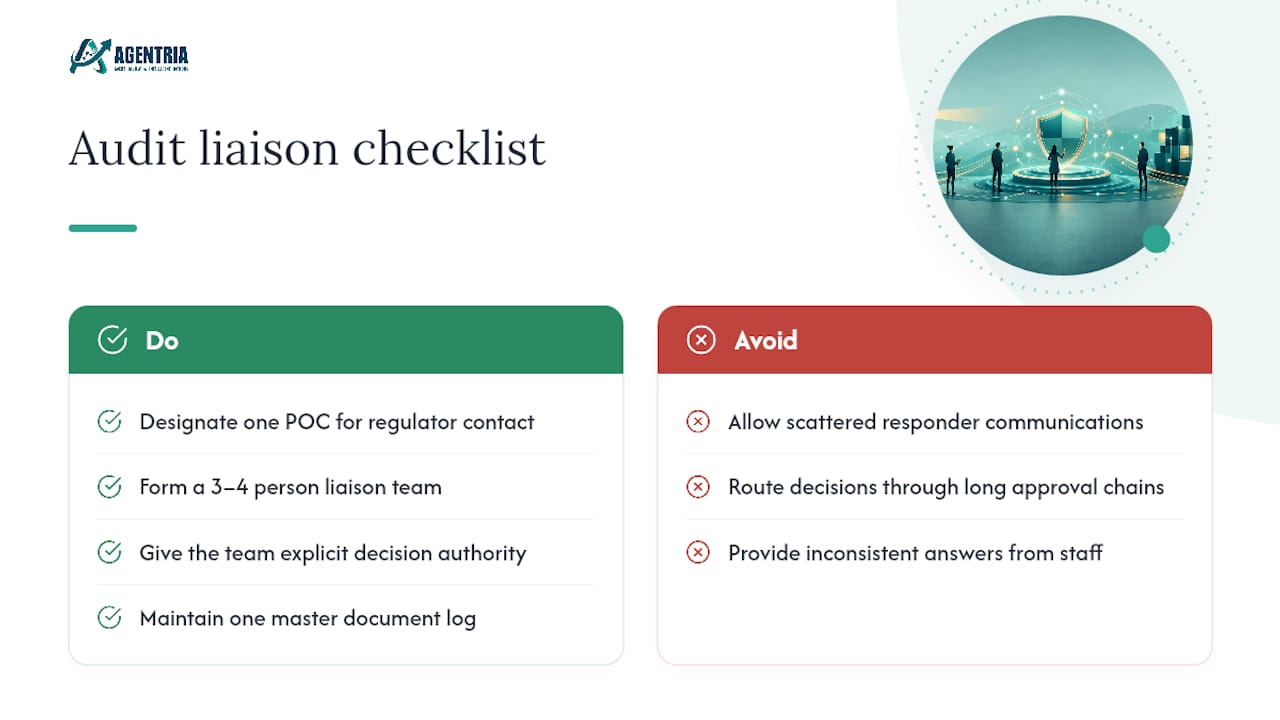
Every regulator interaction should run through one designated point of contact, not whoever happens to answer the phone that day. Scattered communication is one of the fastest ways to contradict yourself in front of an examiner, and inconsistent answers to the same question from different people read as a red flag regardless of intent.
The liaison team doesn’t need to be large. A core group of three or four usually works: the compliance lead who owns the overall relationship, a senior operational owner who can speak to control execution in detail, someone from IT or records management who can retrieve evidence on request, and a legal or risk representative for anything that touches disclosure decisions.
Give this team explicit authority to make quick calls during the examination window, such as which document to release first or how to phrase a clarifying answer, rather than routing every decision through a lengthy approval chain that frustrates the regulator’s timeline. Document who is on the team, their direct contact details, and their specific remit, and circulate that list internally before the audit starts so staff know exactly who to escalate a question to rather than guessing.
One person on the liaison team should own the master document log, tracking every request received, every response sent, and every outstanding item with its deadline. That single log becomes the definitive record of the engagement if a dispute arises later about what was asked or when something was delivered.
Conducting internal mock audits or readiness assessments
Running a mock audit before the real one exposes gaps a desk review never catches. Pick someone internal who wasn’t involved in building your control matrix, ideally from internal audit or a different business unit, and have them play examiner for a day using real PEP-style questions.
The value of a mock audit comes from its honesty. If your rehearsed subject-matter expert stumbles explaining a control they supposedly own, that’s a training gap you want to find in-house rather than in front of a regulator. Time the exercise the way a real examiner would, giving tight response windows rather than open-ended discussion, because time pressure reveals whether your evidence pack is genuinely quick to navigate or only looks organised on a calm afternoon.
Score the mock audit against the same criteria a real examiner would use: could the reviewer trace a requirement to a control to evidence without help, did the named owner actually know the detail, was the document version current. Feed every gap straight back into your remediation tracker with a deadline before the real audit window opens.
Run this exercise at roughly the 60 day mark within your 90/30/7 plan, early enough to fix what it uncovers, late enough that the evidence pack it tests is close to its final state.
Handling confidential or sensitive information during the audit
Audits routinely involve personal data, commercially sensitive material, or records covered by separate confidentiality obligations, and handling that carelessly creates a second compliance problem on top of the one you’re being examined for.
Set access controls before the audit starts, not during it. Decide who on your side can view unredacted records, whether the examiner receives full files or excerpted versions, and how sensitive fields get masked without undermining the evidentiary value of the document. Chain-of-custody logging matters here just as much as it does for standard evidence: note who accessed a sensitive file, when, and why, so you can account for every disclosure if a data-protection question arises separately from the compliance examination itself.
Secure transmission is non-negotiable for anything containing personal or commercially sensitive detail. Use encrypted portals rather than email attachments, and confirm the regulator’s own preferred secure channel rather than assuming your default method meets their expectations. If physical documents travel to an on-site review, control who carries them and log their return.
Anonymise or redact wherever the regulation allows it without weakening the evidence itself, a customer identifier can often be replaced with an internal reference number without losing anything the examiner needs to verify the control.
A compliance officer’s week-before checklist
In the final week, three things matter more than anything else: a completed final check on the evidence pack, rehearsed subject-matter experts who know their material cold, and a confirmed contact list with access tests already run. Do disclose known gaps early. Do rehearse with real questions. Don’t let one person carry the whole file in their head.
An alternative approach worth considering for regulated operators
Building the matrix, the evidence pack, and the remediation tracker described above works whichever sector you operate in. For online casino and iGaming operators specifically, though, there’s a structural advantage worth knowing about: a human-in-the-loop AI support platform generates the audit trail as a byproduct of daily operations rather than as a separate project every time an examiner asks for it.

With auto send off, a platform like Pitbot holds AI-drafted replies on email, live chat and Telegram for staff approval before they reach a player, and logs that review with a timestamp automatically. For a regulator asking how you supervise player communications, the answer isn’t a reconstructed summary assembled the week before the audit, it’s a live, searchable record that already exists. That fits operators handling high interaction volumes particularly well, where manually logging every support decision for audit purposes would otherwise consume real compliance hours. If your organisation matches that profile, it’s worth seeing how the AI support platform built for regulated player interactions handles evidence capture in practice. You can book a demo to see the audit trail generated from a real support queue.
Sources
For primary guidance beyond this article, start with the FDIC’s PEP and CIDR framework, which explains exactly how examiners scope a review before they arrive. The Jersey Financial Services Commission’s examination engagement guidance covers proactive disclosure in practical detail. Vanta’s seven-step audit checklist offers a useful operational baseline for teams building their first structured plan.
- FDIC: Pre‑Examination Planning (PEP)
- Foley & Lardner: What every multinational should know about conducting international regulatory compliance self-checks
- Jersey Financial Services Commission: Effective examination preparation and engagement
- Vanta: Preparing for a compliance audit — 7-step checklist
- Auditing Authority: Regulatory Examination Preparation for Financial Firms
- Compliance Seminars: How to prepare for a regulatory audit, proven steps