
Escalation to compliance is the structured process of routing a flagged issue, whether a suspected breach, a whistleblower report, or an anomalous transaction, to the right compliance handler within a defined timeframe. Compliance officers own the outcome; risk managers and frontline staff feed the intake. The immediate action is simple: check whether a documented escalation matrix and clear SLAs already exist, and if they do not, build a one-page version today.
TL;DR:
- Building a role-based escalation matrix with clear triggers, SLAs, and owner roles on a single page ensures quick reference and automated routing during crises.
- Using measurable, yes/no criteria for severity tiers prevents subjectivity and helps calibrate response times based on past incident data.
- Assigning escalation ownership by role rather than individual avoids failures caused by staff turnover, leaves, or conflicts, with clear recusal pathways for sensitive cases.
- Documenting every escalation with timestamps, basis, and actions creates a reliable audit trail that withstands regulator scrutiny and supports ongoing process improvements.
- Starting with a simple, tested, and monitored escalation process in weeks instead of months enhances compliance effectiveness and reduces bottlenecks.
Table of Contents
- What are the core components of an escalation to compliance workflow?
- How do you build an escalation matrix that actually works?
- What severity tiers and SLAs should you set?
- Who owns each escalation, and what happens during a conflict?
- How should you document and track every escalation?
- How do you implement escalation to compliance step by step?
- What mistakes undermine even a well-designed escalation process?
- What does effective escalation look like in a regulated, high-volume environment?
- What compliance leaders should prioritise this quarter
- How Pitbot supports escalation from intake to audit trail
- Sources
- FAQ
What are the core components of an escalation to compliance workflow?
Every reliable escalation process rests on four moving parts, and weakness in any one of them undermines the rest. Intake quality decides everything downstream.: a vague report with no date, no named parties, and no supporting detail forces triage staff to guess, and guessing is where delays start. Triage then applies fixed rules to sort what has arrived, which only works if the intake form actually captures the fields triage needs.
Escalation triggers vary by category. A data breach might trigger on discovery; a conduct complaint might trigger only once a second corroborating account appears. The DOJ’s guidance on evaluating corporate compliance programmes makes clear that prosecutors look at whether these triggers are actually followed, not just documented.
The workflow’s real components:
- Intake channels: email, hotline, live chat, or internal reporting tools, each logged with a timestamp
- Required intake fields: date, category, parties involved, description, any immediate risk
- Triage rules: who screens first, and what disqualifies a report from routine handling
- Triggers: category-specific thresholds that force immediate escalation rather than a queue
- Downstream links: how escalation connects to remediation actions and periodic reporting
How do you build an escalation matrix that actually works?
An escalation matrix maps report categories against severity and against the person or role responsible for handling them. Think of it as a grid: categories run down one side (financial crime, harassment, data privacy, regulatory breach), severity tiers run across the top, and each intersecting cell names who owns that combination.
Each cell needs five pieces of information to be useful under pressure. Templates recommended by compliance investigation specialists typically include:
- Owner role: the job title responsible, never a named individual
- Backup: who steps in when the owner is unavailable or conflicted
- Contact channel: exactly how the handler is notified, whether a shared inbox or an alert
- Trigger time: how quickly the case must be acknowledged after intake
- Resolution target: the SLA window for closing or escalating further
Keep the whole thing on one page. A matrix that needs three tabs and a legend will not get consulted at 11pm on a Friday, which is precisely when it tends to be needed. Once built, translate each cell into an automated routing rule inside your case management tool rather than leaving it as a static PDF nobody reopens.
What severity tiers and SLAs should you set?
A three or four tier model covers most organisations without becoming unwieldy. Tier definitions need to be measurable, not descriptive, so “high severity” should mean something specific: regulatory exposure, financial loss above a set threshold, or risk to a vulnerable person, rather than a handler’s gut feeling.
Pro Tip: Write tier criteria as yes/no questions (“Does this involve financial loss over £50,000?”) rather than adjectives. It removes the subjectivity that causes miscategorisation.
A workable starting point looks like this:
| Tier | Criteria | Acknowledgement | Investigation start |
|---|---|---|---|
| Tier 1 (Critical) | Regulatory breach, safety risk, senior management involved | Promptly | Promptly |
| Tier 2 (High) | Material financial or reputational exposure | Quickly | Quickly |
| Tier 3 (Moderate) | Policy breach, no immediate external exposure | In a reasonable time | In a reasonable time |
| Tier 4 (Low) | Minor procedural issue | Within several days | Within several days |
These figures are a starting template, not a fixed rule. Calibrate them against your own historic incident data: if Tier 2 cases have consistently blown past a 24 hour SLA for the last two quarters, either the tier definition or the resourcing behind it needs to change, not the SLA on paper.
Who owns each escalation, and what happens during a conflict?
Assign every matrix cell to a role, never to a named person. Staff move jobs, go on leave, and occasionally become the subject of the complaint they would otherwise handle. A role-based matrix survives all three; a name-based one breaks on the first.
Recusal needs its own defined pathway. If the implicated party sits on the escalation chain, whether a department head or a board member, the matrix should name a pre-agreed alternate rather than leaving staff to work it out mid-crisis. Practical drafting guidance on escalation steps recommends looping in legal counsel automatically whenever regulatory or criminal exposure becomes plausible.
Structuring roles properly means separating two functions that often get blurred:
- Notification recipients: who is told an escalation has occurred, for visibility only
- Investigation leads: who actually owns fact-finding and the decision on next steps
- Backups: named by role for every owner, reviewed at least twice a year
- Recusal trigger: any case where the assigned handler has a personal or reporting-line conflict
How should you document and track every escalation?
Every escalation needs a paper trail robust enough to survive a regulator’s questions months later. At minimum, that means capturing the date and time of escalation, the identity of the escalating and receiving parties by role, the stated basis for escalation, and the immediate actions taken, a standard laid out in guidance on building an auditable escalation matrix.
Spreadsheets manage this for a while, then quietly fail once volume grows. A centralised case-management system with automated alerts closes that gap, flagging approaching SLA breaches before they happen rather than after. The DOJ’s own evaluation framework treats this kind of documented, working system as direct evidence a compliance programme functions in practice, not just in policy.
Three metrics deserve a permanent place on any compliance dashboard:
- Time-to-escalate: the gap between intake and formal escalation
- Time-to-resolution: how long each tier actually takes against its SLA target
- Repeat escalations: the same issue or handler appearing again within a set period
How do you implement escalation to compliance step by step?
Building this from scratch does not need a year-long project. It needs a disciplined few weeks and a willingness to pilot before rolling out organisation-wide.
- Pull 60 to 90 days of past incidents. Use that history to calibrate realistic category definitions and tier thresholds, rather than guessing at what “high severity” should mean.
- Draft a one-page matrix. Fill every cell with an owner role, a backup, and an SLA, following the tier and ownership template described earlier.
- Agree owners and backups with department heads. Get sign-off before launch, not after the first dispute over who was supposed to act.
- Run a pilot across one business unit or one category for four to six weeks.
- Integrate the matrix into your case management system, automating trigger alerts rather than relying on someone remembering to check a spreadsheet.
- Run a tabletop test: simulate a Tier 1 case end to end and time every handoff.
- Schedule a review cadence, typically quarterly, to recalibrate tiers against new incident data.
Pro Tip: Run your first tabletop test on a Friday afternoon. If the matrix survives reduced staffing and slower response times, it will survive a real crisis too.
What mistakes undermine even a well-designed escalation process?
The single most common failure is routing everything through the Chief Compliance Officer personally. It looks thorough on an org chart and creates a bottleneck the moment two Tier 1 cases land in the same week. Role-based ownership across a small team fixes this; one overloaded gatekeeper does not.
Over-engineering the matrix is nearly as common. Twenty categories and six tiers might feel rigorous, but staff will not memorise it and will default to calling their manager instead, which defeats the entire point.
Watch for these recurring pitfalls:
- Single point of failure: escalation depending on one person’s availability or judgement
- Matrix sprawl: too many categories or tiers for staff to realistically apply under pressure
- No version control: teams working from outdated copies after a policy change
- Skipped tabletop testing: a matrix that has never been rehearsed under simulated pressure
- Stale ownership: backups who left the role a year ago and were never updated
What does effective escalation look like in a regulated, high-volume environment?
Online casino operators handle escalation at a pace few industries match. A player sentiment shift, a responsible gambling flag, and a VIP dispute can all arrive within the same hour, across email, live chat, SMS, and Telegram simultaneously. Missing one is not a minor process gap; it is a regulatory event waiting to happen.
Multi-channel intake only works if every channel feeds the same routing logic rather than five disconnected inboxes. Pitbot’s approach lets you hold AI-drafted replies for staff approval before they reach a player, which means every escalation decision carries a reviewable trail rather than a black box. Combined with responsible gambling detection built into the intake layer, that structure means:
- Sensitive cases surface automatically rather than waiting for a player to complain twice
- Thread assignment keeps a high-value dispute with a named owner instead of sitting in a general queue
- Staff approvals of AI-drafted replies are logged, supporting the audit trail regulators expect
What compliance leaders should prioritise this quarter
Start with the matrix, not the software. A documented, role-based escalation matrix with realistic SLAs is the single highest-leverage investment a compliance function can make, and it costs nothing but a few days of focused work. Audit committees increasingly judge escalation effectiveness by whether cases move on time, not by whether a policy document exists.
Pilot a one-page version this quarter. Track your time-to-escalate for 60 days, then bring the numbers to your next audit committee meeting rather than a policy summary.
— pitbot
How Pitbot supports escalation from intake to audit trail
Pitbot is built for operators who cannot afford a missed escalation to become a regulatory finding. Where a general helpdesk tool treats every message the same, Pitbot combines multi-provider AI drafting with a staff review queue: with auto send off, AI-drafted replies on email, live chat and Telegram wait for staff approval before they reach a player, so sensitive cases are flagged and routed rather than buried in a shared inbox.
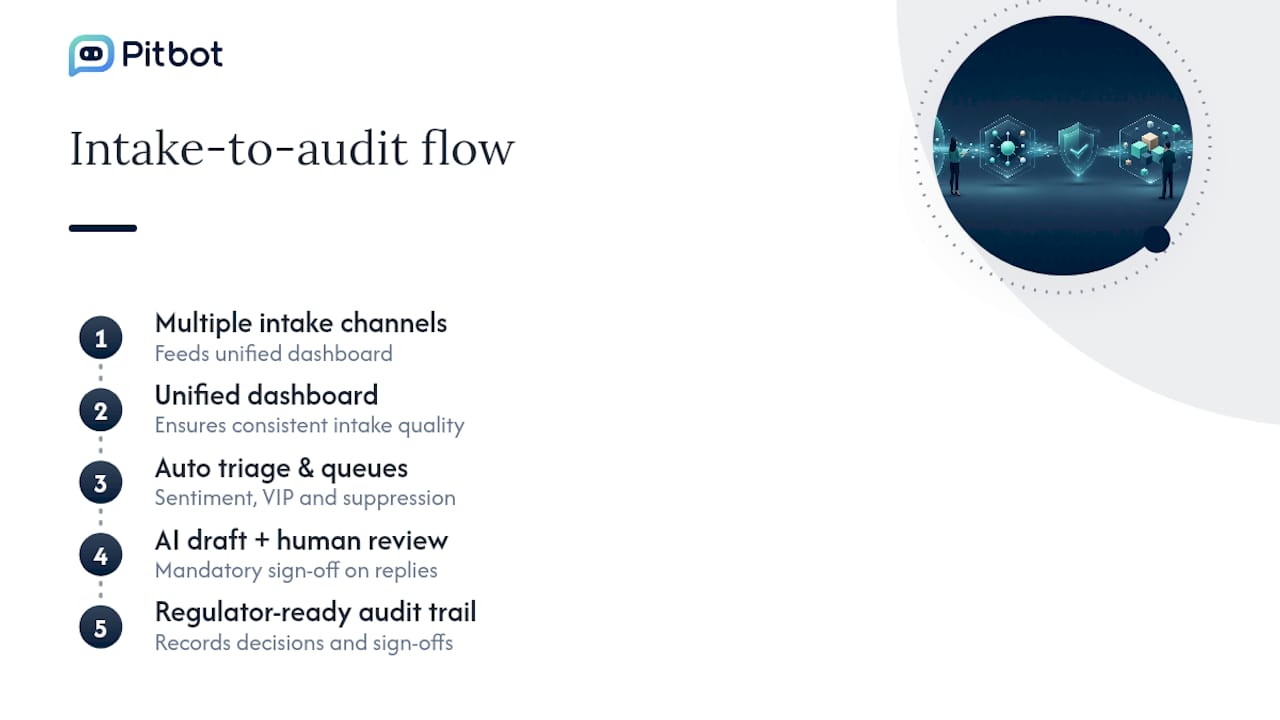
Every intake channel feeds into a unified dashboard, so intake quality does not depend on which channel a report happens to come through. Sentiment detection surfaces cases automatically, thread assignment keeps a high-value dispute with a named owner, and responsible gambling outreach suppression works alongside your escalation matrix rather than as a separate system. Each staff approval is logged, giving compliance teams the kind of audit trail regulators expect to see when they ask how a decision was made.
If you are building or refining your escalation matrix this quarter, see how Pitbot’s player support platform handles intake and routing, or book a demo to walk through your own tier structure with the team.
Sources
For primary guidance beyond this article, the DOJ’s Evaluation of Corporate Compliance Programs sets out what prosecutors actually look for in a working programme. The MHRA Inspectorate’s overview of escalation processes illustrates a real regulatory escalation pathway. For workflow design and board reporting cadence, Diligent’s compliance management workflow guide is a solid practical reference.
FAQ
How do you escalate a compliance issue politely but effectively?
Frame the escalation around facts and risk, not blame: state what was found, when, and why it meets the escalation threshold, then route it through the role named in your matrix rather than to a specific individual informally. Keeping language neutral and evidence-based avoids the friction that turns a routine escalation into a personal dispute.
What are the key areas a compliance escalation process should cover?
A well-built process typically spans financial crime, data privacy, conduct and harassment, regulatory breaches, and health and safety, each with its own severity criteria and named handler. The exact categories should reflect your organisation’s actual risk profile rather than a generic list.
What makes a compliance escalation process genuinely good?
A good process has a documented matrix, measurable severity tiers, role-based ownership with named backups, and SLAs that are actually tracked, not just written down. The DOJ’s evaluation framework treats evidence that a process runs in practice as far more persuasive than the policy document itself.
What does it mean when a complaint has been escalated?
It means the complaint has moved beyond routine handling to a designated compliance or senior handler because it met a defined trigger, such as regulatory exposure, repeat occurrence, or potential harm. The escalation should generate a timestamped record showing who received it and what action followed.
How does Pitbot help operators manage compliance escalation?
Pitbot routes flagged player interactions across email, live chat, SMS, and Telegram into one dashboard, and with auto send off, AI-drafted replies on email, live chat and Telegram wait for staff approval before they reach a player. That structure gives compliance teams a documented audit trail and automated alerts for sensitive cases, detailed on Pitbot’s features page.