

For casino operators, the answer is operational, not philosophical: live chat handles immediate, in-session fixes like cash-out questions and eligibility checks, while ticketing handles KYC, complaints and anything needing a written record. Neither channel wins alone. The best practice is integrating both into one system of record, then measuring first-contact resolution and repeat contact rate to prove it works.
TL;DR:
- Use live chat for quick, in-session fixes such as deposit checks or password resets, with clear escalation triggers for complex or compliance-related issues.
- Ticketing must handle cases requiring document uploads, formal complaints, disputes, or investigations, with comprehensive data fields to meet regulatory requirements.
- Implement an integrated, omnichannel system that logs all interactions into a single case record, linking transcripts, player IDs, and related data across channels.
- Measure operational KPIs like first-contact resolution, repeat contact rate, and channel switch rate to ensure channels work together effectively without causing duplicate efforts.
- Start pilot programs on high-volume or high-value paths, set explicit escalation and routing rules, and prioritize full case context preservation before scaling speed improvements.
Table of Contents
- When to use live chat: in-session, time-sensitive support that must be fast
- When ticketing is necessary: audit, documents and formal processes
- Designing an omnichannel architecture: one system of record for every channel
- Operational metrics and dashboards: KPIs that show whether your mix works
- Implementation checklist and routing rules you can apply this quarter
- E-E-A-T example: how integrated AI and human review supports speed and compliance
- Publisher perspective: prioritise integration, then speed
- How Pitbot brings chat and ticketing together for operators
- FAQ
- Sources
When to use live chat: in-session, time-sensitive support that must be fast
Live chat earns its place when a player is mid-session and the fix is operational rather than evidential. A player asking why a cash-out has not landed, querying a bet settlement, resetting a forgotten password or checking whether a deposit bonus applies to their account all fall into this category. The task is bounded, the agent usually has the access needed to resolve it, and the player wants an answer in minutes, not days.
Consider a player who deposits during a promotion and wants to confirm their free spins have been credited correctly. A chat agent with the right permissions can check the bonus engine, confirm the credit, and close the query in a single exchange. Compare that with a player disputing a settled bet’s outcome: that is no longer a quick check, it is a formal dispute that needs evidence, a timestamped record, and likely escalation.
Running chat well requires more than a widget bolted onto a website. A few technical and process features separate chat that resolves issues from chat that frustrates players:
- Presence and wait-time indicators so players know whether an agent is available and roughly how long they will wait.
- Operational permissions for agents, letting them check balances, bonus status and recent transactions without escalating for basic lookups.
- Transcript capture by default, so every chat session is logged and retrievable if the issue resurfaces.
- Clear escalation triggers, so agents know exactly when a query stops being a chat task.
That last point matters more than it looks. Chat agents should escalate to ticketing the moment a query touches identity verification, involves a formal complaint, or requires documents the player needs to upload. Agents without secure access to back-office compliance tools frequently have to redirect these cases to asynchronous channels anyway, since compliance and verification work typically needs the structured, document-ready environment ticketing provides.
The UX stakes are real. Players expect speed from chat, that is the entire premise of the channel, and a mismatch between expectation and delivery damages trust faster on chat than on email. Telling a player “your request has been escalated” without explaining why, or leaning on canned replies when the query needs a genuine look-up, reads as evasive. Academic research on live chat interactivity finds that satisfaction depends heavily on perceived information quality and system usability, not just response speed: a fast but vague answer performs worse than a slightly slower but precise one, according to research on two-way chat communication.
Pro Tip: Give chat agents a one-line escalation script (“I’m moving this to a ticket so our verification team can review it properly”) rather than a silent handoff. It preserves trust exactly when players are most likely to doubt the process.
When ticketing is necessary: audit, documents and formal processes
Ticketing is not the slower sibling of chat, it is the correct channel whenever a case needs a written, timestamped, attachable record. Four scenarios make tickets mandatory rather than optional:
- KYC and source-of-funds requests, where players must upload documents and compliance staff need to review, approve or query them over multiple exchanges.
- Formal complaint escalation, where a player has already raised an issue through chat or email and now wants a documented resolution path.
- Chargebacks and payment disputes, which require evidence of transaction history, communication logs and account activity.
- Investigations, including suspected fraud, collusion or responsible gambling concerns, where every step of the review needs to be reconstructable later.
What makes a ticket fit for purpose is its data model. A ticket that only captures a message and a timestamp is barely better than an email thread. A ticket built for regulated gaming needs, at minimum, a player ID linked to the account record, full timestamps for every update, attachment support for documents and screenshots, a visible case history showing every agent who touched it, and escalation notes explaining why and when the case moved queues. Each field exists because a regulator or an alternative dispute resolution (ADR) body may ask for it later. Guidance on complaint handling specifically requires operators to preserve evidence and timestamps so that ADR windows can be demonstrated and met, as set out in player complaints policy guidance.
The ADR clock is the detail operators most often miss. Guidance from iGaming Ontario’s player support framework confirms that regulators expect a clear complaint submission route and an escalation path once a player’s issue goes unresolved within the operator’s own process. If a complaint starts in chat, moves to email, and finally lands in a ticket days later with no linked history, the operator has effectively reset its own clock without realising it, and risks missing the window entirely.
SLA guidance should be published to players rather than left implicit. A sensible structure is a first-response window measured in hours for most ticket categories, with final resolution timelines stated separately for document-heavy cases like KYC (which depend on the player supplying correct files) versus complaint cases (which depend on internal review capacity). Publishing these expectations reduces repeat contacts, since players who know a case will take two business days are less likely to open a second chat session asking for an update the next morning.
The single biggest point of failure in ticket design is context loss. A player who raised an issue in chat and was told “we’ll create a ticket for this” expects the ticket to already know what they said. If the ticket starts from zero, the player repeats themselves, the agent re-asks questions already answered, and the case looks less credible to anyone reviewing it later for ADR purposes. Every chat-to-ticket handoff should carry the full transcript, the player ID, the session identifier and a note on why escalation happened.
Designing an omnichannel architecture: one system of record for every channel
The principle underneath all of this is simple to state and hard to build: every channel a player might use, chat, email, SMS, Telegram or WhatsApp, should write into the same case record rather than creating a parallel one. Disconnected channels do not just look messy, they actively drive repeat contacts and hide workload from the metrics that are supposed to catch it, according to analysis of omnichannel player support design.
Building this requires specific integrations, not just good intentions:
- PAM (player account management) integration, so any agent on any channel can see account status, balance and recent activity without switching systems.
- Payments integration, so cash-out and deposit queries can be resolved or escalated with real transaction data visible in the case.
- KYC and document storage, linked directly to the ticket so verification cases do not depend on emailed attachments living outside the record.
- CRM and messaging-app connectors, so a VIP conversation that starts on Telegram or WhatsApp becomes part of the same history as a chat session from the week before.
The architecture that makes this work in practice usually looks the same across operators: a chat widget wired into the helpdesk rather than a separate standalone tool, a message-to-ticket conversion step (often an API or webhook) that fires the moment a chat needs escalation, and transcript retention that keeps attachments linked to the right case rather than floating in a separate storage system.
The failure modes are specific and recurring. A VIP manager handling a high-value player over WhatsApp creates a new ticket every time the conversation restarts, because the messaging thread was never linked to the original case, so the player’s history looks thin even though the relationship is not. A player raises an issue in chat, closes the browser tab before the session logs, and the transcript is gone by the time a ticket gets created the next day. Worst of all, a complaint moves between chat, email and a support inbox with no shared case ID, and nobody notices the ADR clock is running until the window has closed.
A practical handoff policy closes most of these gaps. When a chat session needs to become a ticket, the handoff should transfer the full transcript, the player ID, the channel of origin, a timestamp for when the issue first arose (not when the ticket was created) and a named owner for the case going forward. Without an owner, tickets drift between queues and nobody is accountable for the SLA.
Pro Tip: Treat “which channel created this case” as metadata, not as the case’s identity. The case should be defined by the player and the issue, never by where it happened to start.
Operational metrics and dashboards: KPIs that show whether your mix works
Channel strategy is only as good as the metrics that validate it. A handful of KPIs tell operators whether chat and ticketing are actually working together or quietly fighting each other.
First-contact resolution (FCR) measures the share of cases closed without the player needing to come back. Repeat contact rate tracks how often the same player or issue reappears within a short window. Average handling time (AHT) shows how long agents spend per case, chat and ticket separately, since the two channels should never be benchmarked against the same target. Time to first response (TTFR) matters most for tickets, where players have no live indicator of progress. Ticket backlog and escalation rate flag whether specialist queues are keeping up with demand, and ADR clock compliance tracks whether complaint cases are resolved inside the regulator’s window.

The interpretation matters more than the raw number. A high FCR paired with a high repeat contact rate is a warning sign, not a success story: it usually means an agent is marking a case resolved in chat while the player is quietly reopening the same issue by email a day later, according to industry guidance on omnichannel KPI tracking. That combination means the channels are not actually unified, whatever the dashboard says.
Cadence matters too. Chat SLAs (wait time, response time) need daily monitoring because they drift fast when staffing dips. Backlog and ADR window compliance suit a weekly review, since these move more slowly but carry heavier consequences when missed. Broader trend reviews, comparing FCR and repeat contact month over month, work best monthly, where seasonal spikes (a new game launch, a promotional weekend) can be separated from genuine process problems.
| KPI | What it shows | Recommended target | Data source to instrument |
|---|---|---|---|
| First-contact resolution | Share of cases closed without a repeat contact | Reviewed against trend, not a fixed number | Case closure status linked to repeat contact window |
| Repeat contact rate | How often the same issue reappears | Reviewed against trend, not a fixed number | Case ID matching across channels within a set window |
| Average handling time | Agent time spent per case, by channel | Set separately for chat and tickets | Timestamped case open and close events |
| Time to first response | Speed of the first reply, especially for tickets | Published to players as an SLA | Ticket creation to first agent reply timestamp |
| ADR clock compliance | Whether complaint cases close inside the regulator’s window | Zero missed windows | Complaint flag timestamp to resolution timestamp |
Implementation checklist and routing rules you can apply this quarter
Turning this into practice does not require a system rebuild on day one. A staged rollout, piloted on a defined slice of traffic, surfaces problems before they scale.
- Map entry points and current failure modes. List every channel players actually use (chat, email, SMS, WhatsApp, Telegram) and identify where cases currently lose context or duplicate.
- Pick the system of record. Decide which platform owns the case history, usually the helpdesk or support platform, and treat every other tool as feeding into it rather than running in parallel.
- Define auto-escalation rules. Specify exactly which triggers move a case from chat to ticket: KYC requirement, complaint language, dispute over a settled bet, or a request for documents.
- Assign agent permissions by case type. Give chat agents the access needed for operational fixes, and route anything needing compliance tools straight to specialist queues rather than letting agents attempt a workaround.
- Pilot with VIP and high-volume paths first. These are the cases where context loss is most visible and most costly, making them the fastest way to prove or disprove the new routing.
Routing rules should be explicit rather than left to agent judgement. A chat session that touches KYC should auto-escalate to a ticket immediately, carrying the transcript. A VIP tag should route straight to senior agents regardless of channel. A responsible gambling flag should halt any marketing messaging to that player automatically and escalate the case to compliance, since continuing promotional contact with a flagged player is both a player-care failure and a regulatory risk.
Training needs to cover the handoff itself, not just channel-specific skills. Agents should practise cross-channel note-taking (writing updates that make sense to whoever picks the case up next), recognising when a seemingly simple query is actually a complaint in disguise, and attaching chat transcripts to tickets correctly rather than summarising from memory.
Before scaling beyond the pilot, measure three things over a 30-day window: first-contact resolution, repeat contact rate, and channel-switch rate (how often a case bounces between chat, email and ticket before closing). If channel-switching stays high despite the new routing rules, the system-of-record integration is the first place to check, not agent performance.
Pro Tip: Run the pilot on your highest-volume issue type first, not your rarest one. A routing rule that only gets tested twice a month will take months to prove itself.
E-E-A-T example: how integrated AI and human review supports speed and compliance
One way to see these principles applied concretely is through platforms built specifically for regulated casino support rather than adapted from generic helpdesk software. We use an approach that combines multi-provider AI drafting with staff approval: with auto send off, AI-drafted replies on email, live chat, SMS and Telegram wait for staff approval before they reach a player. Responsible gambling and regulator flags on those channels are a hard stop: the thread is escalated to a person instead of answered, and a sensitive case opens for someone to pick up.
The practical gains of this model are that agents review and approve a draft rather than writing from scratch, messages are grouped on the player’s conversation thread, with one active thread per player shared across email, live chat, SMS and Telegram, and thread assignment keeps a conversation with a named owner, with handover history, so context does not reset when a different agent picks it up. The provider and model used, and who approved each reply that was signed off, are logged, which gives a record to draw on when a case is questioned later.
None of this replaces the operational work of mapping these capabilities to a specific regulator’s complaint and ADR procedures. A platform that captures audit trails is only useful if the fields it captures match what an ADR body or regulator actually asks for, and that mapping differs by jurisdiction. Human oversight also still needs to sit on top of any automation touching sensitive cases, complaints, suspected fraud or responsible gambling concerns, since these are exactly the cases where a wrong automated response causes the most damage. Automation that drafts quickly is only as trustworthy as the review process sitting behind it.
Publisher perspective: prioritise integration, then speed
The instinct in most support teams is to chase speed first: faster chat replies, shorter queue times, quicker first responses. We would argue that gets the order backwards. A fast answer built on an incomplete case record creates more work later, when a player disputes it or a regulator asks for the history behind it. Unify the record first. Speed only counts once an agent can see everything that happened before they typed a word.
Automation deserves the same caution. It earns its place on routine, low-risk queries, but anything touching compliance or potential player harm needs a human in the loop, not as a formality but as the actual safeguard. Start small: pilot one high-volume path, measure first-contact resolution and repeat contact rate honestly, and only then scale. The operators who skip the pilot tend to be the ones explaining a missed ADR window six months later.
— pitbot
How Pitbot brings chat and ticketing together for operators
Most of the problems this article has discussed—context lost between channels, complaints hopping between systems, and VIP threads losing history on restart—come down to the record. Pitbot combines multi-provider AI drafting with the option to hold AI-drafted replies for staff approval, across email, live chat, SMS and Telegram, and keeps the conversation together on the player’s thread.
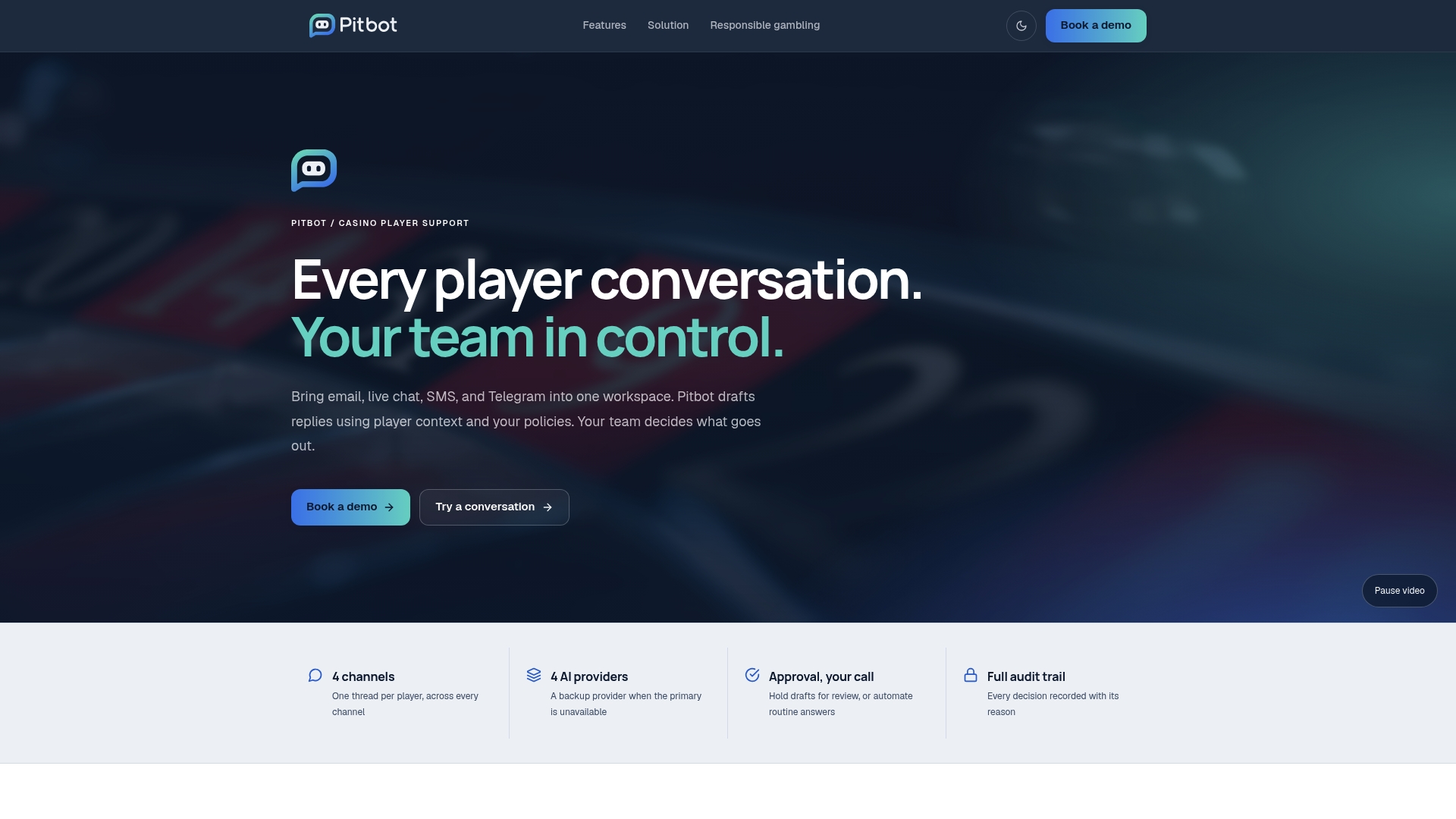
There is one active thread per player shared across email, live chat, SMS and Telegram, with sentiment detection, escalation and thread assignment to a named owner built in. Suppression rules keep marketing away from self-excluded and cooling-off players and from anyone with an open sensitive case. Pitbot does not run an ADR clock, so complaint deadlines remain part of your own process. If your team is weighing a channel redesign, our AI customer support platform for online casino operators is worth a look, and you can see the full capability set on our features page. The most direct next step is to book a demo and walk through your current routing against ours.
FAQ
Is live chat or ticketing better for casino player support?
Neither is better universally: live chat suits immediate, in-session tasks like cash-out queries or bonus checks, while ticketing suits KYC, complaints and anything needing a written record. The strongest setups run both channels into one system of record rather than treating them as competing options.
What response time should casino operators aim for on live chat versus tickets?
Chat should be monitored daily against wait-time and reply-speed targets since players expect near-immediate answers, while tickets typically carry a published first-response window measured in hours or days depending on case type. Publishing these expectations to players reduces repeat contacts from people checking on a case that is already progressing.
When must a casino support case become a formal ticket?
A case needs to become a ticket whenever it involves identity verification documents, a formal complaint, a payment dispute or an investigation, since these all require a timestamped, attachable record for internal and regulatory review. Guidance on player complaint handling specifically expects operators to preserve evidence and timestamps for these cases.
What metrics show whether a casino’s chat and ticketing channels are working together?
First-contact resolution and repeat contact rate are the two to watch together: a high resolution rate alongside a high repeat contact rate usually signals that players are being told an issue is solved on one channel while reopening it on another. Channel-switch rate and ADR clock compliance round out the picture for a fuller operational view.
Does using Pitbot replace the need for a dedicated ticketing system?
Not necessarily. Pitbot groups messages on the player’s conversation thread rather than issuing ticket IDs, with one active thread per player shared across email, live chat, SMS and Telegram, thread assignment to a named owner, and the option to hold AI-drafted replies for staff approval. It is not a document-management or dispute tool, so formal cases such as KYC uploads or chargebacks may still need the structured process a ticketing system provides.
Sources
- How to run omnichannel player support without losing context
- Effects of two-way communication via live chat (academic paper)
- Player support guidance — iGaming Ontario

