

For online casino operators, social messaging compliance means embedding identify, act and evaluate across chat, SMS, email and messaging apps, with immutable audit trails, timely automated measures backed by human review, and demonstrable evaluation. The authority for this standard sits with the Gambling Commission and, for record retention, FATF. Get the audit trail, human-in-the-loop review and suppression lists right first: everything else follows from those three controls.
TL;DR:
- Building an immutable audit trail that logs every message, decision, and reviewer identity is essential for compliance and must be established before automation.
- Suppression lists must be maintained, checked nightly against marketing systems, and stored with minimal personal data like hashed emails or phone numbers to prevent breaches.
- Human review should accompany all automated measures, with review logs and clear escalation pathways for high-risk interactions such as harm disclosures.
- Messaging logs must connect directly to transaction records, capturing customer details, behaviors, actions taken, and outcomes for AML and audit purposes.
- Regular testing and sampling of interactions prove system effectiveness, with evidence packaged for regulators rather than relying on sporadic checks.
Table of Contents
- The regulatory baseline: identify, act and evaluate for player messaging
- Practical controls for messaging channels: chat, SMS, email and apps
- Operational playbook: workflows, roles and escalation for compliance teams
- Records, retention and AML obligations for messaging logs
- Testing, monitoring and proving effectiveness to regulators
- Pragmatic steps for compliance officers today
- How an integrated platform meets social messaging compliance needs
- FAQ
- Sources
The regulatory baseline: identify, act and evaluate for player messaging
SR Code Provision 3.4.3 sets the framework every licensee must build into customer interaction systems: identify markers of harm, act on them, then evaluate whether the action worked. This applies directly to messaging, because chat, SMS and email are often where harm indicators surface first, whether through a player’s own words or a pattern the system flags.
The indicators licensees must monitor include:
- Spend that rises sharply or breaks a player’s usual pattern.
- Time spent gambling, particularly long or late-night sessions.
- Patterns of play such as chasing losses or rapid changes in deposit frequency.
- Customer-led contact, including messages that mention financial difficulty.
- Account indicators such as repeated deposit limit increases or failed payments.
Where indicators are strong, regulatory guidance expects timely action, which can include automated, real-time measures, but only where manual review sits alongside them and the player retains a route to contest the decision. The same guidance requires records that reconstruct what happened: the behaviour that triggered the interaction, the action taken and the eventual outcome. A messaging platform that cannot produce that trail on request is not compliant, regardless of how fast it responds.
Practical controls for messaging channels: chat, SMS, email and apps
Compliance in messaging is less about any single tool and more about what you can prove afterwards. Build these controls into every channel:
- Log every message and decision immutably, including the trigger, the automated or human response, the reviewer’s identity and the timestamp.
- Route every automated or real-time measure through a human reviewer before or immediately after it reaches the player, so speed never comes at the cost of oversight.
- Maintain a suppression and self-exclusion list as a separate datastore with strict write access, checked against every outbound marketing message before send.
- Reconcile suppression lists nightly against your marketing systems, because stale lists and manual workarounds are the most common cause of breaches.
- Adjust retention and logging detail by channel: live chat and in-app messages typically generate structured transcripts, SMS and Telegram need explicit linkage back to the player’s account ID, and email threads need to be preserved in full rather than summarised.
Pro Tip: Keep suppression data to the minimum needed to match records, such as a hashed email or phone number plus an opt-out flag, rather than retaining full marketing profiles.
Human review does not have to slow things down. A reviewer confirming or overriding an AI-drafted response within a short service window satisfies both the regulator’s expectation of timely action and the oversight regulators look for, provided the review step itself is logged with who reviewed it and when.

Operational playbook: workflows, roles and escalation for compliance teams
A compliant messaging operation needs a workflow that repeats the same way every time: trigger, triage, action, record, follow-up. A spend spike or a player message mentioning financial stress triggers triage, triage decides the action (an automated check-in, a human-led call, or an account restriction), the action and its outcome get recorded, and a follow-up interaction later evaluates whether it worked.
Set clear service levels:
- Automated messages flagged for review should reach a human reviewer within a defined, short window rather than sitting in a queue.
- High-risk escalations, such as explicit mentions of harm, should reach a senior staff member immediately, not at the next shift change.
- Audit logs need a named owner responsible for their completeness and retrieval during inspections.
Staff need training on what counts as an indicator, how to escalate, and how to document a decision in terms an inspector can follow. Regular dip-sampling, reviewing a sample of interactions each week or month, catches drift before it becomes a pattern regulators notice first.
Records, retention and AML obligations for messaging logs
Messaging logs are not just a customer service record; they are part of your anti-money laundering evidence base. FATF’s framework for casinos as designated non-financial businesses requires record-keeping detailed enough to reconstruct individual transactions, and messaging around deposits, withdrawals or unusual account activity often forms part of that reconstruction.
Each interaction log should capture, at minimum:
- The player’s identity and account reference.
- The behaviour or indicator that prompted the interaction.
- The channel used and the exact content sent or received.
- The action taken, who authorised it, and the final outcome.
These fields let compliance teams link a messaging event to the transaction and KYC record it relates to, which is what an AML reviewer or auditor will ask for. Keeping messaging logs siloed from transaction data is a common gap; the two need to be queryable together, not stitched manually after the fact.
Testing, monitoring and proving effectiveness to regulators
Requirement 13 of the Commission’s guidance expects licensees to evaluate whether their interactions actually work, not just that they happened. That means trialling different message types and measuring the result, not assuming a template email achieves the same outcome as a live chat conversation.
Build evaluation into routine operations:
- Dip-sample a defined share of interactions each month across each channel, not just the ones that triggered an escalation.
- Track metrics such as how many flagged players reduce risky behaviour afterwards, average review turnaround time and the proportion of cases escalated to a senior reviewer.
- Bundle this evidence, logs, trial results and metric trends, into a package ready for a regulatory return rather than assembling it under deadline pressure.
Well-structured, regular sampling gives regulators more confidence than occasional ad-hoc reviews, because it shows the system working continuously rather than only when tested.
Pragmatic steps for compliance officers today
If you are building this from scratch, get the audit trail and suppression lists working before you automate anything else. Automation without a trail just produces faster breaches. Resist the temptation to patch gaps with manual workarounds, since those are exactly what break auditability later.
Start with a small trial, measure its effect, show the regulator evidence of improvement, then scale automation with human review layered in from day one. That sequencing, not the sophistication of the technology, is what separates compliant operators from the ones that get flagged.
— pitbot
How an integrated platform meets social messaging compliance needs
Building the controls above from separate tools is possible, but it means stitching together chat logs, SMS records, suppression databases and review workflows by hand, which is where gaps creep in. We built our player support platform to keep these controls in one place. With auto send off, AI-drafted replies on email, live chat, SMS and Telegram wait for staff approval before they reach a player. Responsible gambling and regulator flags on those channels are a hard stop: the thread is escalated to a person instead of answered, and a sensitive case opens for someone to pick up.
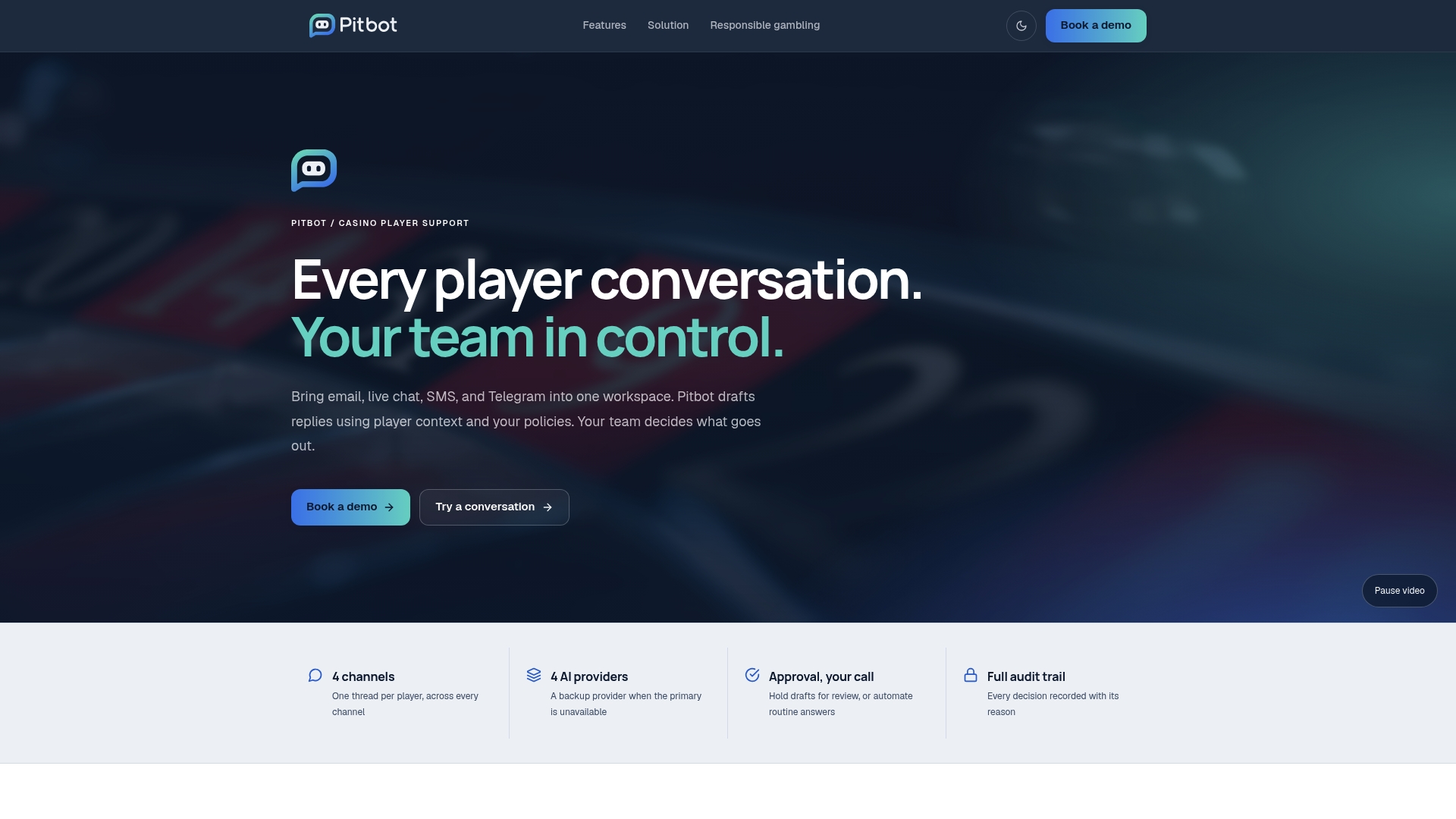
Our platform gives compliance teams tools to track and review messaging interactions across multiple channels and supports escalation workflows and suppression handling, alongside analytics to aid evaluation.
If your team is assembling these controls manually, our AI customer support platform for online casino operators is worth a look. You can see how the workflow fits your operation by booking a demo.
FAQ
What does social messaging compliance mean for casino operators?
It means every player-facing message, across chat, SMS, email and messaging apps, follows the identify, act, evaluate framework set out in SR Code Provision 3.4.3. In practice, that requires an audit trail, human review of automated actions and regular evaluation of whether interactions reduce harm.
Do automated messages need human review before sending?
Automated, real-time measures are permitted where indicators of harm are strong, but regulatory guidance expects manual review alongside them and a route for the player to contest the outcome. Reviewing shortly after an automated message goes out, rather than always before, can satisfy both the timeliness and oversight expectations.
How long must messaging and interaction records be kept?
Retention needs to be long enough to reconstruct a transaction or interaction history, which is the standard FATF’s recordkeeping framework for casinos points to. Operators should keep identity details, the behaviour that prompted contact, the action taken and the outcome in a retrievable format for as long as their licence conditions and AML obligations require.
What causes self-excluded players to receive marketing messages by mistake?
The most common causes are manual workarounds and suppression lists that fall out of date before a campaign goes out, according to Gambling Commission guidance. A separate suppression datastore with strict write controls and nightly reconciliation against marketing lists addresses both.
Can an AI support platform like Pitbot help meet these compliance requirements?
It can help with the controls, though the compliance programme stays yours. Pitbot lets you hold AI-drafted replies for staff approval and records who approved each reply that was signed off. Responsible gambling and regulator flags on email, live chat, SMS and Telegram are escalated to a person instead of answered, and suppression rules keep self-excluded and cooling-off players, and anyone with an open sensitive case, out of marketing outreach.

