
Yes, operators can and should automate routine player support, provided automation is paired with human review and regulatory controls. Some specialized platforms build this in by design, and Gambling Commission guidance sets the baseline for how automated decisions must be reviewed. Start with a quick audit of your current support workflow to find one low-risk, high-volume task worth automating first.
TL;DR:
- Automation is most effective for low-risk, high-volume tasks like password resets, transaction updates, and routine FAQs to improve response times and capacity.
- Key compliance controls include maintaining an audit trail for decisions, implementing manual review for high-risk cases, and integrating deterministic rules before responses reach players.
- Successful deployment requires careful vendor selection focused on auditability, human-in-the-loop review, and multichannel support, with continuous monitoring of safety and performance KPIs.
- Automation should enhance, not replace, human judgment, especially for sensitive issues like responsible gambling signals and VIP interactions that need contextual insight.
- Regulatory guidelines demand manual review of automation outcomes involving harm indicators, with clear escalation triggers and responsibility for human oversight built into the support workflow.
Table of Contents
- Quick wins and trade-offs from automation
- What automated casino support actually looks like
- Where automation beats manual handling, and where it shouldn’t
- Support tasks you can automate today
- Choosing the right automation tools and architecture
- Measuring success: KPIs, pilots and reporting
- Regulatory and research-backed controls worth building in
- Deployment roadmap and common pitfalls
- Pitbot’s perspective on balancing speed with compliance
- Ready to automate support without cutting corners on compliance
- Sources
- FAQ
Quick wins and trade-offs from automation
Automation earns its keep fastest on repetitive, low-risk tickets. Response times drop, agents stop drowning in password resets, and players get answers at 3am without waiting for a shift change. VIP queues also benefit: routing high-value players to the right handler immediately, rather than after a triage delay, tends to improve retention conversations.
The trade-offs sit on the compliance side. A chatbot that mishandles a responsible gambling signal, or gives a generic reply to a player showing signs of harm, creates regulatory exposure that no ticket-deflection number offsets.
- Faster resolution: routine queries get answered immediately instead of queuing behind complex cases.
- Ticket deflection: self-service and proactive alerts stop tickets forming at the source.
- 24/7 coverage: players in different time zones get consistent service without night-shift staffing.
- Sharper VIP triage: automated routing flags high-value players for human attention faster.
- New risk surface: automation can misjudge or delay escalation of RG signals if guardrails are weak.
Watch first-contact resolution and RG escalation rates together. If one improves while the other worsens, the pilot needs adjustment before it scales.
What automated casino support actually looks like
Automated casino support isn’t one tool, it’s a stack. A chatbot or natural language layer handles the conversational front end, but underneath it sits a deterministic rules engine that enforces policy: things like withdrawal limits, self-exclusion status, or KYC blocks that must never depend on a model’s best guess. An orchestrator routes messages between channels and decides when to hand off to a human. A knowledge base feeds consistent answers, and an audit log records every decision for later review.

Integration matters as much as the AI itself. The stack needs to read from the CRM for player history, check payment and KYC systems for withdrawal or verification status, and write back into ticketing so agents see the full context when a case escalates.
Not every automated reply carries the same risk. Informational answers, like opening hours or bonus terms, are low stakes. Workflow automation, like triggering a password reset, is a step up. Deterministic compliance checks, like blocking a withdrawal for an unverified account, sit at the top: these must run on fixed rules, never on generative output alone.
Where automation beats manual handling, and where it shouldn’t
Manual ticket handling means an agent reads, categorises and responds to each query in sequence, which is reliable but slow at scale. AI-powered routing and context-aware replies can triage instantly, pulling account history so the first response is already relevant rather than a generic acknowledgement.
That speed advantage doesn’t apply everywhere. Some tasks are safe to automate fully; others need a person weighing context a model can’t reliably judge.
- Automate: password resets, balance queries, standard FAQs, promo terms, routine status updates.
- Keep human-led: disputes over withdrawals, any interaction touching a responsible gambling flag, VIP relationship management, complaints escalated more than once.
- Rebalance, don’t replace: agents shift from repetitive tickets toward exceptions, appeals and VIP conversations, which is where human judgement adds the most value.
The goal isn’t headcount reduction. It’s freeing agents to spend their time where a human is genuinely better than a script.
Support tasks you can automate today
Some automations are reactive, answering a player’s question the moment it arrives. Others are proactive, heading off the question before it’s asked. Both need guardrails built in from day one.
- Password and login resets: fully automatable with identity verification built into the flow.
- Withdrawal status updates: automated replies pulling live status from the payment system, with an explicit handoff if a withdrawal is delayed past a defined threshold.
- Transaction confirmations: instant, templated, low risk.
- General FAQs: game rules, bonus terms, account setup, answered from a maintained knowledge base.
- Promo queries: eligibility and terms handled automatically, with edge cases routed to a person.
- Proactive withdrawal notifications: alerting players before they ask, cutting inbound volume at the source.
- Session and spending alerts: automated nudges tied to account activity, not marketing.
- Churn-prevention outreach: light-touch, non-promotional check-ins for lapsed players.
Every one of these needs an escalation trigger: a defined point where the system stops answering and hands off to a human, logged with a timestamp and reason.
Pro Tip: Build your escalation rules before you build your chatbot flows. The trigger list is the part regulators will ask about first.
Choosing the right automation tools and architecture
Vendor selection should start with the compliance features, not the chat interface. A polished bot with no audit trail or human-in-the-loop workflow is a liability wearing a friendly avatar.
- Audit trail: every automated decision logged, timestamped and retrievable on demand.
- Human-in-the-loop review: a mechanism for staff to approve or override AI-generated replies before they reach players.
- Deterministic rule engine: hard-coded policy checks that sit ahead of any generative response.
- Multi-provider AI orchestration: the ability to route requests across AI models rather than relying on a single provider.
- Multilingual and multichannel coverage: consistent quality across email, live chat, SMS and messaging apps like Telegram.
Architecturally, the safest pattern runs rule-first checks for anything compliance-critical, layers model-augmented responses on top for conversational flexibility, and ties it together with a central orchestrator that keeps context consistent across channels. When you’re evaluating vendors, ask about data residency, the SLA for human escalations, and whether staff can edit AI-drafted responses before they go out. Pitbot’s feature set covers several of these: an audit trail, routing across multiple AI providers, and the option to hold AI-drafted replies so staff can refine or approve them before they go out.
Pro Tip: Ask every vendor to show you an actual audit log entry during the demo, not a mock-up. If they can’t, that tells you something.
Measuring success: KPIs, pilots and reporting
A pilot without clear metrics just delays the decision you were trying to make. Track both operational and safety outcomes from day one, not operational metrics alone with safety added later.
- Response time: average time to first reply, and to resolution.
- First contact resolution: percentage of queries closed without follow-up.
- Ticket deflection: volume of tickets resolved without reaching a human agent.
- CSAT: player satisfaction scores on automated versus human-handled tickets.
- RG escalation rate: how often automated flows correctly hand off to a human on risk signals.
- Audit-log coverage: percentage of automated decisions with a complete, retrievable record.
Choose a high-volume, low-risk flow for the pilot, such as withdrawal status queries, and run it alongside a manual control group so you can compare outcomes directly. When reporting to compliance teams or regulators, present the audit log itself alongside the KPI summary: a spreadsheet of response times means little without the underlying decision trail to back it up.
Regulatory and research-backed controls worth building in
LCCP condition 3.4.3 requires that where automated processes act on strong indicators of harm, the licensee must manually review how that automation performed in each individual customer’s case, and the customer must be able to contest the decision. This isn’t a suggestion to design around later, it’s a structural requirement: identify, act, evaluate, with manual review built into the loop from the start.
Academic research backs up why that review layer matters. Text-mining research shows that linguistic markers in customer-operator chats, combined with psychological coding, can generate near-real-time risk alerts for support staff. Separately, a systematic review of chatbot interventions for gambling disorder found genuine engagement benefits but limited robust trial evidence, concluding chatbots work best as a supplement to human care, not a replacement.
A text-mining model combining linguistic and psychological markers can flag risk signals in operator chats in near-real time, which is exactly the kind of alert that needs a human decision behind it, not an automated one.
Practical controls that follow from this:
- Run deterministic precedence for high-criticality policy checks, ahead of any generative reply.
- Set a defined SLA for human review on every flagged case.
- Keep a comprehensive audit trail covering every automated decision, not just escalated ones.
- Build responsible gambling signposting into flows automatically, not as an afterthought.
Deployment roadmap and common pitfalls
Roll out in four stages: audit your current ticket volume and categorise it by risk, pilot one low-risk flow with a control group, review the results against both KPIs and safety metrics, then scale with continuous monitoring in place.
Watch for the pitfalls that undo otherwise sound pilots: automating a high-risk decision without human review, missing or incomplete audit logs, responsible gambling messaging that reads as generic or dismissive, and staff who haven’t been trained to work alongside the new system. Pick one pilot, apply the vendor checklist above, and measure before you scale further.
Pitbot’s perspective on balancing speed with compliance
Automation should never be a shortcut around compliance, it should be the mechanism that makes compliance consistent. With auto send off, AI-drafted replies on email, live chat, SMS and Telegram wait for staff approval before they reach a player, which means speed and oversight aren’t competing goals, they’re the same workflow. Responsible gambling and regulator flags on those channels are a hard stop: the thread is escalated to a person instead of answered, and a sensitive case opens for someone to pick up. Combined with an audit trail that records the provider and model used and who approved each reply that was signed off, that structure gives operators a system built for regulated markets rather than retrofitted for them. Operators considering automation should start small: one flow, measured properly, reviewed honestly.
— pitbot
Ready to automate support without cutting corners on compliance
Speed and compliance don’t have to trade off against each other. Pitbot lets you hold AI-drafted replies for staff approval, keeps an audit trail of who approved each reply that was signed off, and covers email, live chat, SMS and Telegram from a single workspace, which is how it shortens response times without creating regulatory blind spots.
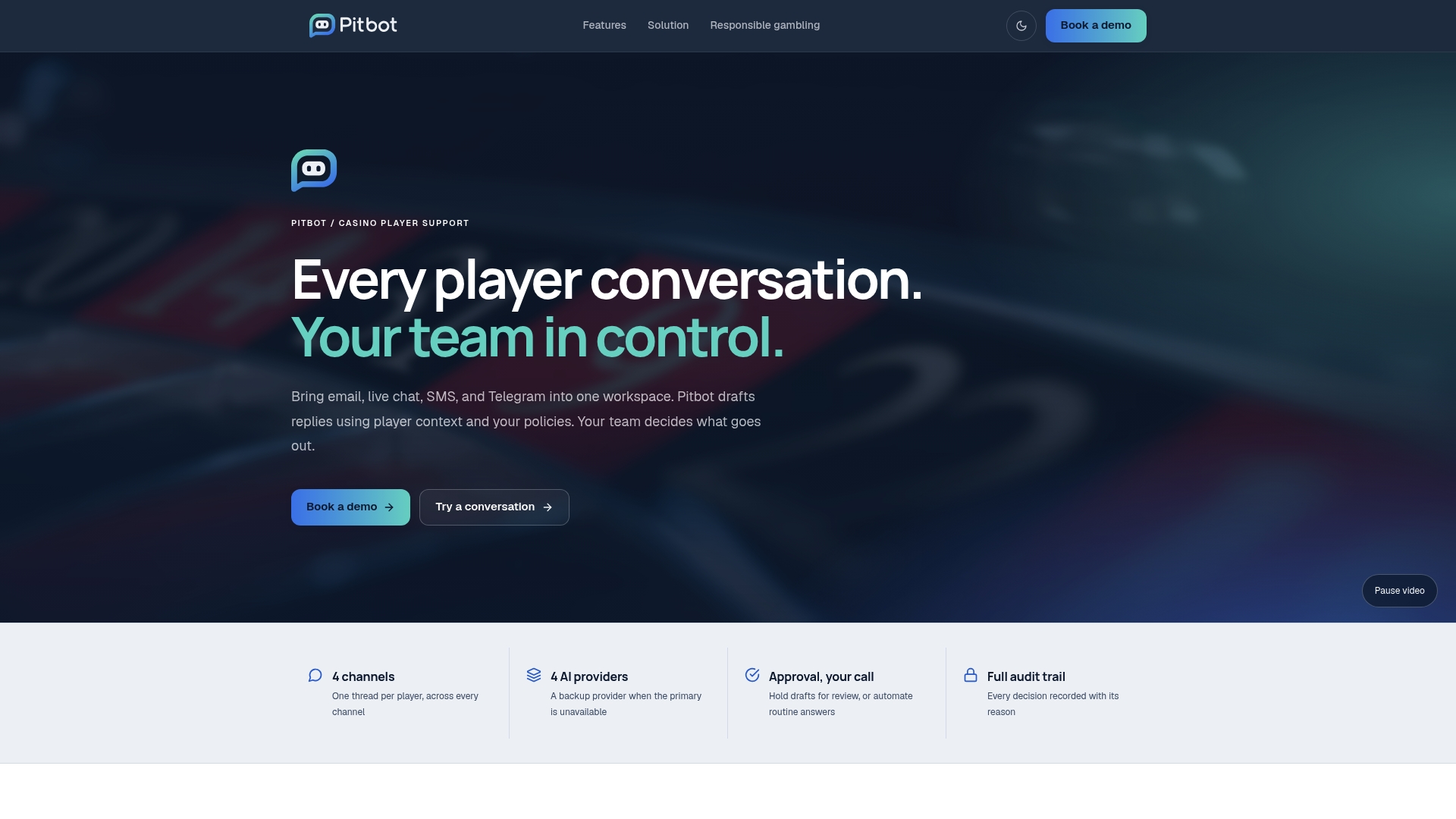
If you’re weighing up chatbots, self-service knowledge bases or an internal build, the practical difference with Pitbot is that staff approval of AI drafts and audit logging are built into the workflow from the start rather than bolted on afterwards. See how it fits your support stack on the AI customer support for online casino operators page, or go straight to booking a demo to walk through a pilot for your team.
Sources
- Detecting gambling addiction: text mining of customer–operator chats (Springer Medizin)
- The effect of chatbot interventions on gambling disorder: systematic review (Journal of Technology in Behavioral Science)
- Customer interaction guidance - for remote gambling licensees (Gambling Commission)
FAQ
What is automated customer support?
Automated customer support uses software, typically chatbots, rules engines and knowledge bases, to answer player queries and handle routine tasks without a human agent for every interaction. In regulated sectors like online casinos, effective systems still route higher-risk or ambiguous cases to a human reviewer.
How do I get my money back from a casino?
This depends entirely on the operator’s terms, the payment method used and the reason for the dispute, so the right first step is contacting the casino’s support team directly. If the issue involves a licensing or fairness dispute, your jurisdiction’s regulator, such as the Gambling Commission in the UK, can advise on next steps.
Do online slots remember your wins?
Online slots run on random number generators for each spin, so individual games don’t retain a memory of past wins or losses that influences future outcomes. What operators do track, separately, is account-level history and behaviour, which support and responsible gambling systems use for service and risk monitoring, not for adjusting game outcomes.
What are some examples of automated customer service?
Common examples include chatbots answering FAQs, automated password resets, withdrawal status updates, and proactive alerts sent before a player needs to ask a question. In casino support specifically, these automations work best when paired with human review for anything touching payments or player wellbeing; for automated processes that act on indicators of harm, LCCP condition 3.4.3 requires manual review in the individual case.

