

Player verification messaging must collect only the identity data a licence condition actually requires (typically name, address and date of birth), explain plainly why that data is needed, and leave an auditable record of the exchange. The Gambling Commission and MGA set the legal floor; a human-reviewed workflow is one way operators meet it without burying teams in manual checks.
TL;DR:
- Verification messages should request only the specific data required by license conditions, such as name, address, and date of birth, and clearly explain why each piece is needed.
- Templates must specify acceptable documents, include a submission method and timeframe, and identify a human reviewer before the message is sent.
- Recordkeeping must capture all message texts, document references, reviewer IDs, timestamps, and outcomes, retaining data for at least five years.
- Human review before sending every verification message is crucial to ensure consistency and compliance, especially across multiple channels and large volumes of cases.
- Using automation tools paired with human oversight can streamline verification workflows without compromising regulatory requirements.
Table of Contents
- Legal and UX principles behind verification messaging
- Templates and triggers for email, SMS, chat and Telegram
- Recordkeeping and audit evidence for verification cases
- Team workflows and SLAs for verification cases
- Cutting friction without losing the audit trail
- How Pitbot applies this in practice
- What the guide gets wrong about verification messaging
- See how Pitbot handles verification messaging
- Sources
- FAQ
Legal and UX principles behind verification messaging
Remote operators must verify a customer’s name, address and date of birth before letting them gamble or deposit, and must tell players what documents might be requested and how to submit them. That single requirement shapes almost every template a support or compliance team will write.
Two further principles sit alongside it. Data minimisation means a message asks only for what the licence condition needs, nothing more, and the MGA’s GDPR guidance expects privacy information to reach the player at the point of collection or, where data arrived indirectly, within one month or before first contact. Verification itself is not a one-off gate but a lifecycle: due diligence starts at onboarding and escalates to enhanced due diligence when risk signals appear, rather than relying on loose matching of initials or nicknames to confirm identity.
A quick approval checklist for message copy:
- Does it name the exact document types accepted, not a vague “valid ID”?
- Does it state why the data is needed, in one plain sentence?
- Does it include a submission method and a realistic timeframe?
- Is a human reviewer named or role-tagged before the message sends?
One authoritative document plus a supporting document, verified through independent or electronic means, is the good-practice standard regulators point to, and it is a useful baseline for any initial request template.
Templates and triggers for email, SMS, chat and Telegram
Three templates cover most verification scenarios.
- Initial verification request: names the required fields (name, address, date of birth), lists acceptable documents (one photo ID plus one supporting document), gives a submission link or upload method, and states an expected turnaround.
- Enhanced due diligence escalation: explains that additional checks are routine risk management, never framed as suspicion of wrongdoing, and avoids any wording that implies balances will be confiscated purely for a failed check.
- Temporary hold notice: confirms that funds are safe, states the hold reason in neutral terms, and gives a specific next step rather than an open-ended wait.
Channel notes matter as much as wording:
- Email and secure upload portals preserve the clearest audit trail and suit document submission.
- SMS and Telegram work well for short nudges and reminders but should link out to a secure upload rather than ask players to send documents inline.
- Live chat is useful for real-time reassurance during an EDD conversation, provided the transcript is captured in the same record as the rest of the case.
Common triggers include deposit thresholds, suspicious transaction flags, self-exclusion list matches and VIP account exceptions, each of which should map to a specific template rather than a generic “please verify” message.
Pro Tip: Keep EDD wording outcome-neutral: “we need one more document to continue reviewing your account” reads very differently from “your account has been flagged”.

Recordkeeping and audit evidence for verification cases
Regulators expect to see a complete, time-stamped record for every verification case, not just a final outcome. The Gibraltar remote AML code treats customer due diligence as an ongoing activity that escalates to EDD or FDD as risk rises, and both the actions taken and their outcomes must be recorded and retained.
A minimum record should capture:
- The exact message text sent to the player.
- Document file references, not the raw file where avoidable.
- The reviewer’s ID or role tag.
- Timestamps for request, submission and decision.
- The verification outcome and any escalation reason.
| Record field | What it should contain |
|---|---|
| Message log | Full text of each verification message sent |
| Document reference | File ID and type, not raw document storage |
| Reviewer ID | Staff member or role who approved the message |
| Timestamp | Request, submission and decision times |
| Outcome | Verified, escalated, on hold, or failed |
Retention periods commonly cited in AML guidance run to five years, and FATF’s recordkeeping expectations extend to supporting investigations or financial intelligence unit reports. For inspections, export logs in a consistent format and redact only what privacy law requires, keeping message hashes and reviewer IDs intact so the evidentiary chain holds. A DPIA checkpoint before launching any new verification flow, paired with a layered privacy notice at registration, keeps the GDPR and AML obligations working together rather than against each other.
Team workflows and SLAs for verification cases
A clear role matrix prevents verification cases from stalling between departments.
- First-line requester sends the initial template and confirms the fields requested match the licence condition.
- Reviewer checks AI-drafted or templated replies before they reach the player, confirming tone and factual accuracy.
- Compliance sign-off owns EDD escalations and any case touching self-exclusion or suspicious activity flags.
- VIP handler manages expedited cases, with every fast-track decision logged in writing.
Human review should sit before every outgoing message in a verification thread, not just the first one, and a realistic SLA gives standard cases a same-day acknowledgement with a short, named window for document review. Escalation rules should trigger automatically on repeated failed submissions or EDD flags, and any case update should be written back to the player record so support staff never ask for a document the player already supplied.
Useful KPIs include verification turnaround time, abandonment rate during document submission, the EDD escalation rate, and audit completeness, meaning the share of cases with a full record against the fields above.
Pro Tip: Track abandonment rate by channel. A high drop-off on one channel often points to a broken upload link rather than player reluctance.
Cutting friction without losing the audit trail
Progressive verification, asking for the essential document first and supporting evidence only if risk escalates, keeps onboarding quick for low-risk players while preserving the full lifecycle approach regulators expect. Layered privacy notices, a short summary at registration with a link to the full policy, reduce confusion without skipping the transparency requirement.
- Offer secure upload across channels (web portal, SMS link, Telegram bot) and log which channel was used for each submission.
- Keep multilingual templates for the same verification flow rather than translating on the fly.
- For VIP accounts, document any expedited review in writing so the fast-track decision is defensible later.
- Never ask for data already verified; re-asking is a common driver of complaints and drop-off.
Secure selfie-and-document checks or recognised eID schemes can speed up verification, provided the method and outcome are logged correctly against the player’s case.
How Pitbot applies this in practice
Pitbot is built specifically for online casino operators, and lets you hold AI-drafted replies for staff approval before they reach a player, which is the same checkpoint this guide recommends for verification threads. The platform runs across email, live chat, SMS and Telegram, keeping one active thread per player shared across those channels and logging who approved each reply that was signed off, rather than treating channels as separate logs.
For verification cases specifically, this means that with auto send off, a reviewer sees the AI-drafted document request before it sends, and the message and who approved it sit on the player’s thread rather than scattered across systems. Operators using this kind of reviewed workflow may see faster response times on routine verification requests, since staff are checking drafts rather than writing each one from scratch, alongside a clearer compliance record to show at inspection. The approach does not remove the need for trained compliance sign-off on EDD and self-exclusion cases, but it can narrow the gap between speed and documented care.
What the guide gets wrong about verification messaging
Most advice on verification messaging treats it as a legal copy problem: get the wording right and the compliance box is ticked. That misses the operational reality. The harder problem is consistency across hundreds of cases a day, across four or five channels, with different reviewers writing slightly different versions of the same request.
The conventional fix, a longer policy document, rarely helps. Staff do not reread a policy before every message; they need the right template surfaced at the right trigger, with a reviewer step that cannot be skipped under volume pressure. Retention periods and audit formats matter, but they are rarely where operators fail an inspection. They fail because the message a player actually received does not match what the system logged, or because an EDD escalation sat unreviewed for days.
If there is one priority, it is this: fix the human review checkpoint before polishing the templates. A well-reviewed, slightly blunt message beats a beautifully worded one that nobody checked before it sent.
— pitbot
See how Pitbot handles verification messaging
Operators already building templates, reviewer steps and audit logs for verification messaging by hand can use Pitbot to hold AI-drafted replies, including document requests, for staff approval before they reach a player, with a record of who approved each reply that was signed off.
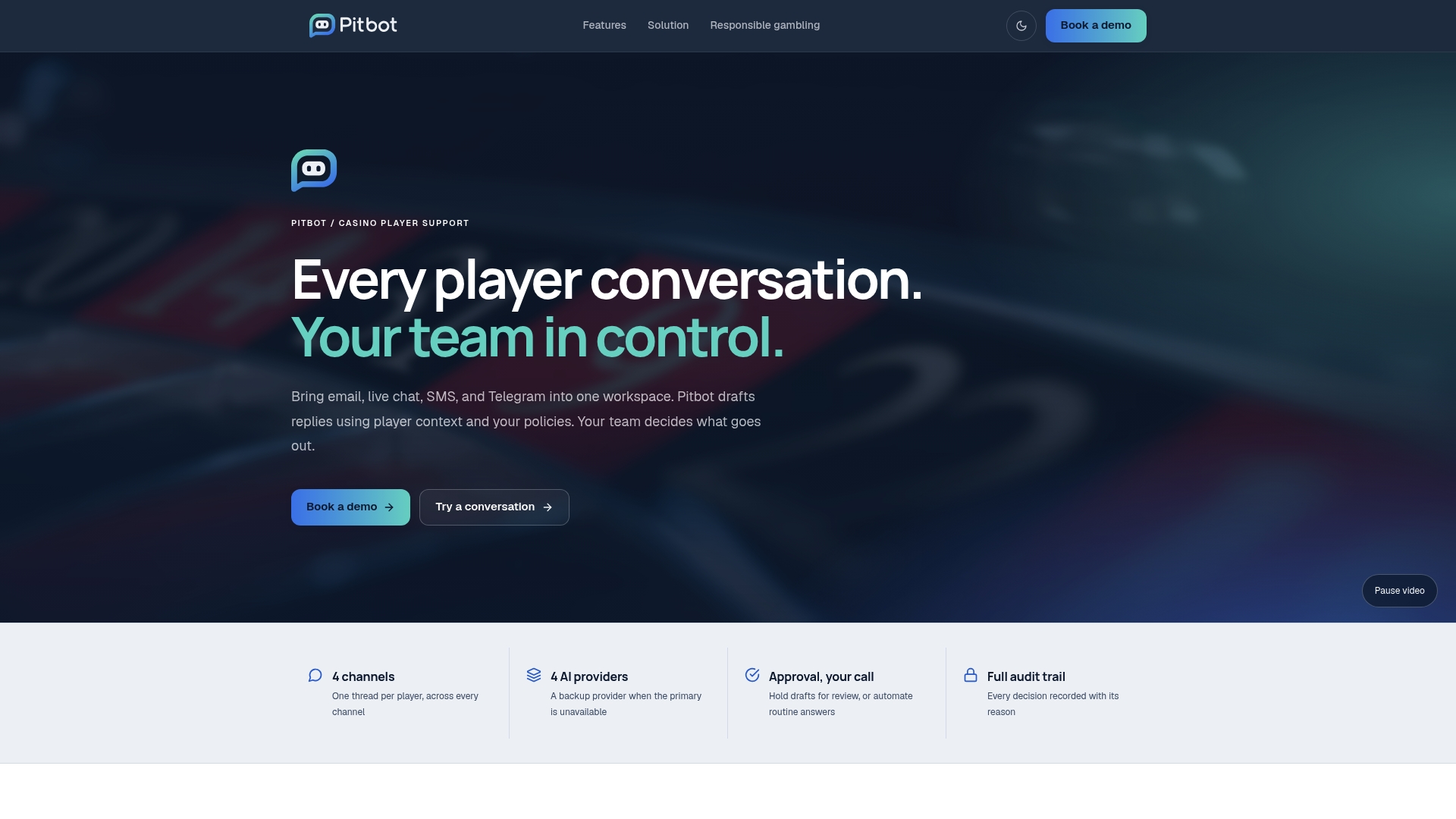
A demo typically covers:
- How AI-drafted replies are held for approval when auto send is off.
- The reviewer screen where staff approve, refine or escalate a draft before it sends.
- The audit log, including who approved each reply that was signed off.
- Analytics on time to first response and first-contact resolution by channel.
Book a demo to see the reviewer workflow against your own verification cases.
Sources
- Reminder of identity verification requirements for remote operators
- The General Data Protection Regulation (MGA guidance)
- Code of practice for the remote gambling industry (AML code update 2026)
FAQ
What data must player verification messaging request?
At minimum, name, address and date of birth, with one authoritative document plus a supporting document as good practice. Operators should also state clearly which document types are acceptable and how to submit them.
How long must verification records be retained?
Retention commonly follows a five-year expectation set out in AML guidance, covering message text, document references and verification outcomes. Operators should confirm the exact period against their own licence conditions, since requirements can vary by jurisdiction.
When should a privacy notice be shown during verification?
Privacy information should reach the player at the point of data collection, or within one month if the data was not collected directly, per MGA GDPR guidance. A short, layered notice at registration with a link to the full policy satisfies this without slowing down the message.
Can verification messaging be automated without losing compliance?
Yes, provided a human reviews each message before it reaches the player. Pitbot can hold AI-drafted replies for staff approval and logs who approved each reply that was signed off, which helps keep automation inside the documented-process expectation regulators apply.

