

Intent-based routing sends a player’s message to the right team or reply path according to what the player is trying to achieve, not according to the channel it arrived on or the menu option they clicked. In an online casino, a message about a delayed withdrawal, a bonus query and a hint of problem gambling all need different handling, at different speeds, by different people. This guide explains how the routing works, which rules operators can set, how it behaves across live chat, email, SMS and Telegram, and where human review and compliance fit.
TL;DR
- Intent-based routing classifies each player message by goal (payout, bonus, account, complaint, responsible gambling) and sends it to the matching queue, reply path or specialist.
- Good routers can say “none of these”. Messages that fit no intent, or that the system is unsure about, should reach a person.
- Sensitive intents such as withdrawals, disputes, self-exclusion and AML flags need a human approval gate and a full audit log.
- Judge success by repeat contact and genuine resolution, not by how many chats never reached an agent.
- Under data protection rules, restrictions or similarly significant outcomes for a player need meaningful human control.
Table of Contents
- What intent-based routing means in casino support
- How the system identifies a player’s intent
- Information and rules operators can use to direct enquiries
- Routing across live chat, email, SMS and Telegram
- Combining routing with human review, escalation and audit
- Data protection and gambling compliance
- Benefits and limits to plan for
- A starting plan for operators
- Perspective
- See intent routing in a casino support workspace
- FAQ
- Sources
What intent-based routing means in casino support
Traditional routing looks at the surface of a request: the phone number dialled, the email address written to, or the button pressed in a menu. Intent-based routing looks at the meaning. A player who writes “I asked to cash out on Monday and nothing has arrived” has a payout intent, whatever channel they used and however they phrased it.
That distinction matters more in a casino than in most retail settings, for three reasons:
- Money is involved in most contacts. Deposits, withdrawals, bonus wagering and verification all touch funds, so a wrong answer has a real cost.
- Some messages are not ordinary support. A player describing losses they cannot afford, or asking to take a break, needs a different route from a player asking about a free-spin promotion.
- Players differ in value and need. VIP communication usually has its own queue, tone and response-time target.
In practice the router does three jobs: it decides what the message is about, it decides how risky or complex it is, and it decides who or what should handle it next. Those decisions can be made by an AI model, by rules, or by a mix of both.
How the system identifies a player’s intent
The most dependable pattern is a closed set of intents. Rather than asking a model to interpret free text and hope for the best, you define the list of things a player can want, and the system returns a probability for each. Published documentation on intent routing describes this approach: the answer is always one of your defined intents, never free text to parse, and a reserved “other” option lets the system say a request fits no intent instead of forcing the least wrong one. Its fallback action is to escalate, so “other” reaches a person too.
For a casino, a starting intent set might include:
- Withdrawal status or delay
- Deposit problem
- Bonus or promotion terms
- Account verification (KYC) documents
- Login and account access
- Technical or game issue
- Complaint or dispute
- Responsible gambling concern, limit or self-exclusion request
- Other
The same documentation shows how this ties into rules: a complaint intent can be set to escalate, and so can a request whose estimated complexity is too high. It also suggests escalating when confidence in the complexity estimate is low, on the principle that if the system cannot tell how hard a request is, it should not automate it.
Routing is more than one decision
Production systems usually chain several steps. One published multi-agent design from a regulated betting operator shows the order clearly. A customer message passes through guardrails and a responsible gaming classifier before it reaches a supervisor agent, which decides which tools to invoke based on the customer’s intent. The safety check comes before the intent-driven work, not after it.
A useful way to think about the sequence in a casino:
- Risk screen. Does the message mention self-exclusion, distress, fraud, a legal threat or a payment dispute? If so, route to a trained person immediately.
- Intent detection. What does the player want? Assign a primary intent and, where relevant, a secondary one.
- Context lookup. Pull the account state: verification status, pending withdrawals, bonus balance, VIP tier, registered licence.
- Draft or assign. Either draft a reply for review or place the case in the right queue.
- Review and send. A human approves, edits or takes over.
- Log. Record every step.
Information and rules operators can use to direct enquiries
The message text is only one signal. Operators can combine several to classify and route, and the more reliable the signals, the less the system has to guess.
| Signal | Example | Typical routing effect |
|---|---|---|
| Detected intent | Withdrawal delay | Payments queue with account state attached |
| Sentiment | Anger, distress, repeated frustration | Priority queue or senior agent |
| Player segment | VIP tier, account manager assigned | VIP queue with its own response target |
| Account state | Verification pending, bonus active | Reply grounded in live account data |
| Jurisdiction | Licence under which the player is registered | Rules and wording for that regulator |
| Responsible gambling flags | Limit changes, self-exclusion mention, concerning language | Dedicated escalation and marketing suppression |
| Channel | Live chat, email, SMS, Telegram | Format, length and speed of reply |
| Confidence | Low model certainty or ambiguous request | Human review or escalation |
Example rule set
The documentation referenced above gives the shape of policy-based rules, which translate neatly to casino support:
- IF intent is a complaint THEN escalate.
- IF intent is a technical issue AND complexity is above a set level THEN escalate.
- IF confidence in the complexity estimate is low THEN escalate.
Add casino-specific rules on top. Any reply involving money, eligibility or account status should require a live account lookup rather than a generic answer. Intents such as withdrawals, disputes, self-exclusion and AML flags should require human approval before anything is sent. A responsible gambling signal should do two things at once: route to the right person and suppress promotional outreach to that player.
Abstention is a feature
A router that never admits uncertainty will misroute. Set thresholds so that low-confidence cases transfer to a person, then review the transfer rate alongside task success. You are not aiming for the highest raw classification accuracy. You are aiming for the right balance between speed and safety, and in a regulated product that balance leans toward handing over.
Routing across live chat, email, SMS and Telegram
Players do not stay in one channel. They start in live chat, follow up by email, and sometimes reply to an SMS or a Telegram message from a VIP host. If each channel has its own queue and its own rules, the player repeats themselves and the operator loses the thread.
Intent-based routing helps because the intent travels with the conversation, not with the channel. A withdrawal question is a withdrawal question whether it arrives as a one-line chat message or a three-paragraph email. What changes by channel is the delivery:
- Live chat: speed matters most. Short drafts, quick review, clear handover when a person takes over.
- Email: players write longer and often include several questions. The router should detect multiple intents in one message and split or sequence them, and email needs special attention when you measure resolution because players often return later.
- SMS: short, tightly regulated, and easy to misuse. Marketing suppression for at-risk players matters most here.
- Telegram: informal, often used for VIP relationships, where tone and the assigned host matter as much as the answer.
The practical requirement is a single view of the player conversation across channels, so that context, sentiment and any responsible gambling flags follow the player wherever they write next. This is how AI customer support built for online casino and iGaming operators is meant to work: one workspace, many channels, the same routing logic and audit trail.
Combining routing with human review, escalation and audit
Routing decides where a message goes. Human review decides what leaves the building. In a regulated market you want both, and you want them visible to a compliance officer.
A workable handoff looks like this. The system retrieves relevant policy content, checks live account state, drafts a reply, and a person edits or approves it before the player sees it. Every step is written to an audit log. Roles typically split into:
- Support reviewer: approves or edits routine drafts.
- Compliance reviewer: signs off on anything touching payouts, self-exclusion or dispute language.
- Escalation officer: takes cases the model cannot resolve confidently.
- Engineering: keeps the knowledge index and account-state connections running.
- Data operations: maintains the policy content and its mapping to clauses.
This is the model we use at Pitbot: every AI-generated reply is reviewed by staff before it reaches a player, and every decision is recorded. Our article on human reviewed AI for regulated markets goes deeper into the compliance side.
Responsible gambling is a separate lane
Responsible gambling signals should never be handled as ordinary retention routing. In the betting operator design described by AWS, a classification agent evaluates every message against a compliance-approved framework, and high-severity classifications trigger an immediate transfer to a human agent with full conversation context. The principle carries over to any casino: detect early, escalate to a trained person, pass on the whole conversation, and stop marketing to that player while the case is open.

What to log
For each routed message, record the original message, the detected intent and confidence, the retrieved policy clause, the account-state call, the draft, any human edit, the reviewer, the final action and the timestamp. That record lets you debug a bad routing decision, answer a regulator, and settle a dispute with a player.
Data protection and gambling compliance
Intent detection is profiling of a kind, so treat it as a data protection matter from day one. The Malta Gaming Authority’s guidance on data protection is a useful reference point for operators across Europe. In summary, it points to a documented lawful basis, purpose limitation, data minimisation, secure access and retention controls, disclosure of relevant profiling, and protection of data-subject rights. It also notes that support logs may be used to manage disputes with players and to direct players to responsible gaming support.
The most practical point for routing concerns solely automated decisions. Article 22 of the GDPR covers decisions with legal or similarly significant effects, so where a routing outcome could restrict a player or have a comparable effect, meaningful human control is important. KYC, AML, complaints handling and responsible gambling escalation remain the operator’s responsibility and must be recorded and reviewed under the rules of the relevant jurisdiction.
A compliance checklist for a routing launch:
- Every policy-based answer traces to a specific clause.
- Replies involving money, eligibility or account status call live account data.
- High-risk intents (withdrawals, disputes, self-exclusion, AML flags) require human approval.
- Decision logs cannot be altered after the fact.
- Responses reflect the rules of the licence under which the player is registered.
- Payment data is kept out of plain-text transcripts.
Because rules differ by country and licence, confirm the specifics with your compliance team and regulator. This article is not legal advice.
Benefits and limits to plan for
The operational gains are real when routing is well designed: faster first responses, fewer misdirected tickets, VIPs reaching the right host, risky cases surfacing sooner and cleaner data for analytics. Agents also spend less time re-reading and re-asking because context arrives with the case.
The discipline is in measurement. European Gaming’s October 2026 analysis of AI resolution rates separates containment, automation and true resolution, and points out that a conversation can be counted as contained even when the player gives up or comes back later. So track:
- Repeat contact on the same issue within a set period.
- Resolution as you define it, including difficult channels such as email.
- Transfer rate to humans, by intent.
- Time to first reply and time to resolution, split by channel and VIP status.
- Reviewer edit rate, which shows where drafts need improvement.
For more on how to measure quality, see our piece on support accuracy benchmarks for AI in online casinos.
A starting plan for operators
- Pull a sample of recent tickets and tag them by intent. Most operators find a small number of intents account for most volume.
- Define the closed set plus “other”, and write the escalation rules for each.
- Mark the human-only intents: withdrawals disputes, self-exclusion, AML flags and complaints.
- Connect account state so replies are grounded in live data.
- Run with full human review first, then loosen review only where edit rates are consistently low and compliance agrees.
- Review weekly: misroutes, transfers, repeat contacts and reviewer edits.
For a deeper look at which queries suit automation, see how to automate five routine queries and escalate risk.
Perspective
Intent-based routing is often sold as a way to take people out of support. We see it the other way round. Its real value in a casino is putting the right person in front of the right message at the right moment.
That is why every reply in Pitbot passes through human review before it reaches a player. Speed comes from the AI drafting, the routing and the context. Safety comes from a person approving what goes out, and from an audit trail that shows who decided what.
We also think responsible gambling detection belongs inside the routing layer, not beside it. When a message signals risk, the right outcome is an escalation to a trained person and a pause on marketing, in the same step. Combining multiple AI providers with human oversight gives operators fast replies and the records that regulated markets expect.
pitbot
See intent routing in a casino support workspace
Pitbot is an AI-powered support platform built for online casino operators. It brings email, live chat, SMS and Telegram into one dashboard, with multi-provider AI drafting, human review of every reply, sentiment detection and escalation, VIP queue management, responsible gambling detection with outreach suppression, multilingual support and compliance-ready audit trails.
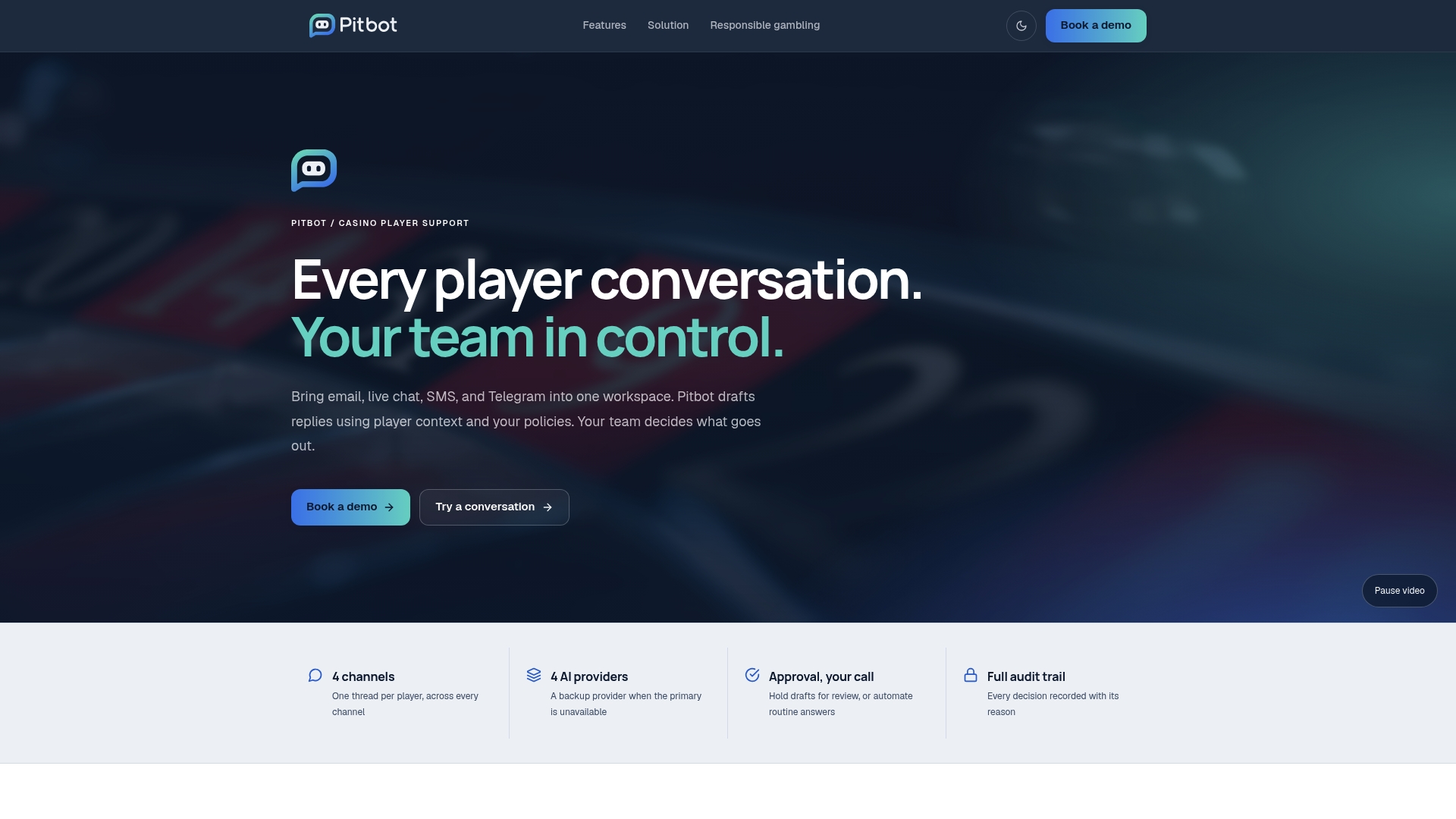
If you want to see how this would fit your queues and your licence conditions, start with the Pitbot overview for casino operators or explore the full feature list.
FAQ
What is intent-based routing?
It is a way of directing a message by what the sender wants, such as a withdrawal status or a complaint, rather than by channel or menu choice. The system classifies the message against a defined set of intents and sends it to the matching queue, reply path or specialist.
How is it different from keyword or menu routing?
Keyword and menu routing depend on the exact words or options a player picks. Intent-based routing reads the meaning, so different phrasings of the same request land in the same place. It also gives each intent a confidence level, so uncertain cases can go to a person.
Should every player message be routed automatically?
Not without limits. Messages that fit no intent, low-confidence cases, and sensitive topics such as disputes, self-exclusion and AML flags should go to a person or require human approval. Automatic routing works best for clear, low-risk intents.
How do you measure whether routing is working?
Look at repeat contact, genuine resolution, transfer rates by intent and reviewer edit rates, not only the share of chats that never reached an agent. Include email in the measurement, since players often return after a first reply.
Does it work across live chat, email, SMS and Telegram?
Yes, when intent, sentiment and flags are attached to the player conversation rather than to a single channel. Each channel then changes only the format and speed of the reply, not the routing logic.
Sources
- Intent routing documentation
- How Fanatics Betting and Gaming built a multi-agent customer support system, AWS
- AI resolution rates in iGaming: what operators should ask, European Gaming
- The General Data Protection Regulation, Malta Gaming Authority

