
Preserve every message tied to the disputed order today, then write a one-page evidence note before you do anything else. Reach out to the customer neutrally as soon as possible and log that attempt with a timestamp. Map what you already have to the likely reason code so you know what is missing before the deadline arrives.
TL;DR:
- Export and securely label all relevant transaction, delivery, authorization, and communication records within 72 hours of dispute notification.
- Use a clear, structured one-page summary highlighting the dispute reason, contact timeline, and resolution efforts, with timestamps and neutral language.
- Contact customers promptly within one to two business days using non-defensive channels and document every interaction, including metadata and promises.
- Assemble evidence aligned with the specific reason code from the issuer, ensuring all files are PDFs with explicit time zones and proper filenames for easy review.
- capturing and linking all chat, email, and message transcripts through automated platforms improves dispute success by ensuring records are complete, legible, and ready for review.
Table of Contents
- What is chargeback communication and why does it matter?
- Your first 72 hours: the action checklist
- The end-to-end chargeback communication workflow
- What evidence to collect and how to format it
- Templates and rules for each communication channel
- Tone and language that de-escalate disputes
- Deadlines, bank rules, and the withdrawal letter process
- Why communication records decide more disputes than merchants expect
- How Pitbot keeps your evidence dispute-ready from day one
- Sources
What is chargeback communication and why does it matter?
Chargeback communication covers every message exchanged with a customer before, during, and after a disputed transaction, and how a merchant packages that history into evidence. That includes email threads, live chat transcripts, SMS logs, and even call notes, but the raw messages themselves rarely win a dispute on their own.
What actually persuades a reviewer is a clean summary sitting on top of that raw material. Chargeback reviewers respond better to a concise communication note paired with exported transcripts than to a folder of unlabelled screenshots. Reviewers spend seconds, not minutes, on each case, so a summary that states what happened, when, and how it was resolved does more work than the transcripts underneath it.
This is also where most merchants go wrong. They treat chargeback communication as a formality, something to bolt on after the real dispute response is written. Flip that. The communication history is often the strongest single piece of evidence you hold, because it shows intent, timing, and good faith in a way a delivery receipt cannot.
Your first 72 hours: the action checklist
Speed matters more than polish here. The moment a dispute notification lands, work through this sequence:
- Lock the records. Export every email, chat log, SMS thread, and delivery confirmation tied to the order as timestamped PDFs before anything gets archived or deleted.
- Build the one-page note. Summarise the order, the issue raised, and every contact attempt with dates, ticket IDs, and outcomes.
- Send neutral outreach. Contact the customer without blame, explain the dispute has been filed, and offer a resolution path, refund, replacement, or clarification.
- Ask for a withdrawal letter if resolved. If the customer accepts your resolution, ask them to request a formal withdrawal from their issuing bank.
- Note every SLA timestamp. Record when you first responded, when you resolved the issue, and how that compares to your stated response times.
- Preserve attachments and tracking numbers. Shipping confirmations and tracking IDs disappear from courier portals fast, so pull them into your evidence folder immediately.
Pro Tip: Name your evidence folder after the ticket ID and order number together, not the customer’s name. Reviewers and your own team can locate it faster, and it avoids any appearance of selective record-keeping.
The end-to-end chargeback communication workflow
Treat chargeback communication as a cycle with five stages, not a single scramble when a notification arrives.
Prevention comes first. Use a recognisable billing descriptor so customers know the charge on sight, send order and delivery confirmations automatically, and put your refund policy where customers will actually see it before they buy, not buried in a footer link. A surprising number of disputes start simply because someone did not recognise the name on their statement.
Detection is the early-warning layer. Watch for signals that a routine query is about to escalate: repeated contact about the same order, a customer mentioning their bank, or a support thread that goes quiet after a refund refusal. Flag these orders internally so a second person reviews them before the customer’s frustration hardens into a dispute.
First outreach needs care. Once you spot a risk signal or receive a dispute notice, contact the customer within one to two business days. Use a calm, non-defensive channel, email or chat rather than a rushed phone call, and capture the metadata: timestamp, channel, agent name, and a summary of what was said.
Submission is where the packet comes together. Assemble your transaction record, delivery proof, communication exports, and policy acknowledgements, then align each item to the specific reason code the issuer cited. Evidence that answers the exact question the reason code asks carries far more weight than a thicker stack of loosely related documents, because reason-code alignment backed by timestamps and ticket IDs has stronger persuasive power than volume alone.
Post-resolution work closes the loop. Record any withdrawal letter received, reconcile the refund against your accounting, and note what triggered the dispute so your prevention layer improves next time. Skipping this step means repeating the same mistake with the next customer who has the same complaint.
What evidence to collect and how to format it
Reviewers are working through a queue, not reading your case in isolation. Formatting decides whether your evidence gets read properly or skimmed past.
Four categories carry the most weight in nearly every dispute:
- Transaction record: order confirmation, amount, date, and payment method used.
- Delivery proof: tracking numbers, signed confirmations, or digital access logs for services.
- Authorisation logs: IP address, device data, or 3D Secure confirmation where available.
- Communication exports: every relevant email, chat, or message thread converted to PDF with timestamps intact.
Your communication note itself needs structure, not prose. Open with a two-line summary of the order and the dispute reason, list a timeline of contact attempts with dates and ticket IDs, and close with the resolution offered or accepted. Keep the language neutral throughout; a note that reads as defensive or accusatory undermines its own credibility with a reviewer who has no stake in either side.
A few formatting rules matter more than they seem:
- Convert every export to PDF, since raw email files and chat logs from different platforms rarely open consistently for reviewers.
- Use consistent filenames across the whole packet, ideally order number plus document type.
- State time zones explicitly on every timestamp, since a support log in one zone and a bank record in another can look contradictory if you don’t.
- Redact unrelated personal data from screenshots before submission.
| File name | Contents |
|---|---|
| ORD1043_transaction.pdf | Order confirmation, amount, payment method |
| ORD1043_delivery.pdf | Tracking number, signed delivery confirmation |
| ORD1043_chat_export.pdf | Full chat transcript with timestamps and agent name |
| ORD1043_summary_note.pdf | One-page communication summary and timeline |
Properly exported messages paired with a short summary make an evidence packet more readable and more persuasive than raw attachments dropped in without context, and many merchant guides recommend keeping these records for at least 18 months to cover common dispute windows.
Templates and rules for each communication channel
Every channel has its own export quirks, and getting them wrong at submission time is a common way to lose otherwise strong evidence.
- Email: keep full headers intact, including sender, recipient, and timestamp, and structure your first outreach in one line: acknowledge the order, state the issue raised, and offer a next step.
- Chat and in-app messaging: capture the session ID and agent name alongside the transcript, since many platforms strip this metadata on export unless you request the full log.
- SMS and phone: request call logs and transcripts from your provider promptly, as many systems purge them after a set retention window, and verify any verbal agreement in a follow-up text or email.
- Sample outlines to adapt: a neutral outreach message (“We’ve noted a dispute on order #X and want to help resolve this directly”), a refund offer message, and a withdrawal-letter request once the customer confirms they’re satisfied.
Pro Tip: Ask your payment processor which chat and SMS export formats their dispute portal accepts before a case is live. Some portals reject proprietary transcript formats, and discovering that on a deadline day costs you evidence you already had.
Automating the capture and linking of transcripts to order IDs before a dispute is filed improves win rates, because it proves SLA adherence and good-faith handling without anyone scrambling to reconstruct a timeline after the fact.
Tone and language that de-escalate disputes
How you phrase the first message often decides whether a customer withdraws a dispute or digs in.
Negotiation research recommends a soft start-up: state the issue without blame, use “I” or “we” statements rather than “you” accusations, and paraphrase the customer’s concern back to them before offering a solution. Reframing the interaction away from blame reduces escalation and can avert a chargeback altogether, and the same behavioural research on conflict points to short, specific language over vague complaints as the difference between a defensive reply and a cooperative one.
Practical moves that work:
- Open with acknowledgement, not defence: “I can see why that timing was frustrating” beats “Our policy states…”
- Offer a concrete repair attempt, a partial refund, a replacement, or an extended deadline, rather than a flat no.
- Build in a short cooling-off window before pushing for a decision when a customer is clearly upset.
- Document every refund offered as the pragmatic resolution, even ones the customer declines, since that record itself becomes evidence of good faith.
Deadlines, bank rules, and the withdrawal letter process
Evidence deadlines are strict and vary by card network, but missing one almost always results in an automatic loss, regardless of how strong your evidence was.
- Submit evidence through your acquirer’s dispute portal, never by contacting the customer’s bank directly. Merchants cannot approach the issuing bank about a chargeback; that channel is reserved for the cardholder.
- If a customer agrees the dispute was a mistake, they must request a withdrawal letter from their own issuer. A chargeback can only be cancelled through an official bank letter, not a verbal or written promise to you.
- Submit that letter through the same acquirer portal you use for standard evidence, alongside your transaction record, so the withdrawal is tied to the case file rather than sitting separately.
Why communication records decide more disputes than merchants expect
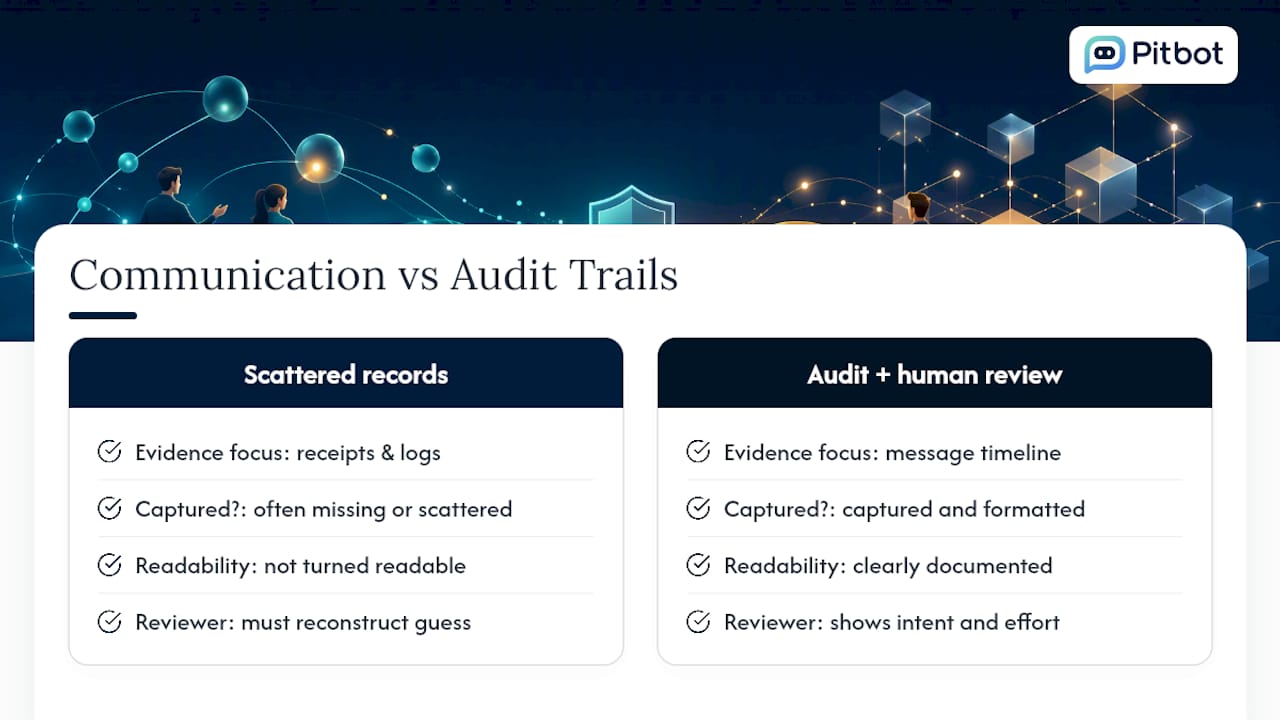
Most merchants still treat the customer message thread as background noise next to the “real” evidence: delivery confirmations, transaction logs, terms of service. That ranking is backwards. A reviewer working through a stack of near-identical cases responds to a clear timeline of human contact faster than to another shipping receipt, because it shows intent and effort in a way a system log cannot.
The gap between merchants who win consistently and those who lose isn’t the strength of their case. It’s whether their communication was captured at all, and whether someone turned it into something readable before the deadline. Multi-channel operators, particularly in regulated industries like online casinos, generate huge volumes of chat, SMS, and email that never make it into a usable format until a dispute forces the issue, and by then, half of it is gone or scattered across three systems.
Platforms built with audit trails and human-in-the-loop review solve a real structural problem here: with auto send off, AI-drafted replies on email, live chat and Telegram wait for staff approval before they reach the player, which means the record you hand to a reviewer months later reflects an actual decision chain, not a guess reconstructed from memory.
How Pitbot keeps your evidence dispute-ready from day one
Pitbot is a player support platform, not a dispute tool, but it removes the part of chargeback work that hurts most: the conversation record exists before the dispute does, instead of being reconstructed under deadline pressure after a chargeback lands. Every email, live chat, SMS, and Telegram exchange is captured and timestamped on the player’s thread, and with auto send off, AI-drafted replies on email, live chat and Telegram wait for staff approval before they reach the player.
That combination matters most for online casino and iGaming operators, where regulatory audit requirements and dispute volume both run high, and where a single missing transcript can mean losing a case you should have won. If your support team handles multi-channel player contact and needs a consistent, exportable record for every interaction, explore Pitbot’s platform features or book a demo to see how the audit trail works before your next dispute deadline arrives.