
Good withdrawal communication means telling players, at every stage, exactly where their money is and what happens next. The single change that fixes most complaints is a player-facing withdrawal tracker with published service level agreements attached to it. The regulatory baseline underneath that tracker is simple: deposit balances belong to the player, and verification should happen long before they try to cash out.
TL;DR:
- Implement a player-facing withdrawal tracker that maps each stage to an internal state machine, providing clear reference IDs and estimated timelines.
- Conduct KYC verification at registration or first deposit to prevent delays, ensuring risk checks do not block routine payouts.
- Use explicit, reason-coded hold labels and publish all fees and restrictions upfront on cashier and deposit pages to promote transparency.
- Ensure every withdrawal message explains what happened, why, and the next step, using channel-appropriate communication and embedded CTAs for player self-help.
- Leverage technical infrastructure like event-driven messaging and audit trails, supplemented by AI with human review, to deliver consistent, compliant, and efficient withdrawal communication.
Table of Contents
- What does effective withdrawal communication actually require?
- What operational steps and SLAs should support teams run?
- What should withdrawal messages say, and when?
- What product and technical capabilities support this?
- How does AI with human review change withdrawal communication?
- What does compliance-first player experience actually mean in practice?
- How Pitbot supports compliant withdrawal messaging
- Sources
- FAQ
What does effective withdrawal communication actually require?
Withdrawal communication covers every message and process tied to a payout request: status updates, verification prompts, delay explanations, and troubleshooting when something fails. Get the principles wrong and support queues fill with the same question asked a hundred different ways: “where is my money?”
A few rules hold everything together.
- Always show the next step and an ETA. A “pending” status with no timeframe reads as a stall, even when the delay is routine.
- Use reason-coded, player-safe hold labels. “Under review, additional ID requested” tells a player more than “processing” ever will, without exposing internal risk terminology.
- Publish cashier-level readiness and any processing fees before deposit, not at the withdrawal screen. The UK Gambling Commission is explicit that any processing fee must be disclosed before the initial deposit, and that wagering requirements cannot be applied to deposit balance withdrawals.
- Trigger primary KYC at registration or first deposit. Save step-up verification for genuine risk triggers, not routine payouts.
- Expose a reference ID and an explicit next action on every screen — upload, cancel, edit, or contact support.
The Malta Gaming Authority’s Directive 2 reinforces this from the other direction: withdrawal restrictions have to sit in clear, intelligible language on cashier and deposit pages. Bury them in the terms and conditions and they risk being unenforceable anyway.
Pro Tip: Write your hold reasons as if a player will screenshot them and post them on a forum. If the wording would embarrass your compliance team out of context, rewrite it before it goes live.
What operational steps and SLAs should support teams run?
Messaging is the visible layer. Underneath it, withdrawals move through a life cycle that needs named owners at every step, or the tracker on screen becomes a lie.
- Request submitted — player initiates, system logs timestamp and method.
- Identity check — risk team confirms KYC status; only step up if the account is flagged.
- Funds review — payments team checks balance composition (deposit vs. winnings vs. bonus).
- Documentation request (if needed) — the step most likely to lose players, according to GetBanked’s iGaming operations playbook, which flags it as the highest-friction point in a typical seven-step withdrawal flow.
- Approval — assigned reviewer signs off, decision logged.
- Payout initiated — reference or transaction hash generated.
- Funds received — confirmed and closed.
Each pend needs a documented reason, an assigned reviewer, and a re-review date. The Gambling Commission’s own guidance on account withdrawals is blunt about this: operators shouldn’t ask for information at the point of withdrawal if it could reasonably have been requested earlier, and any additional-information request needs a clear reason attached.
SLA bands should differ by verification status:
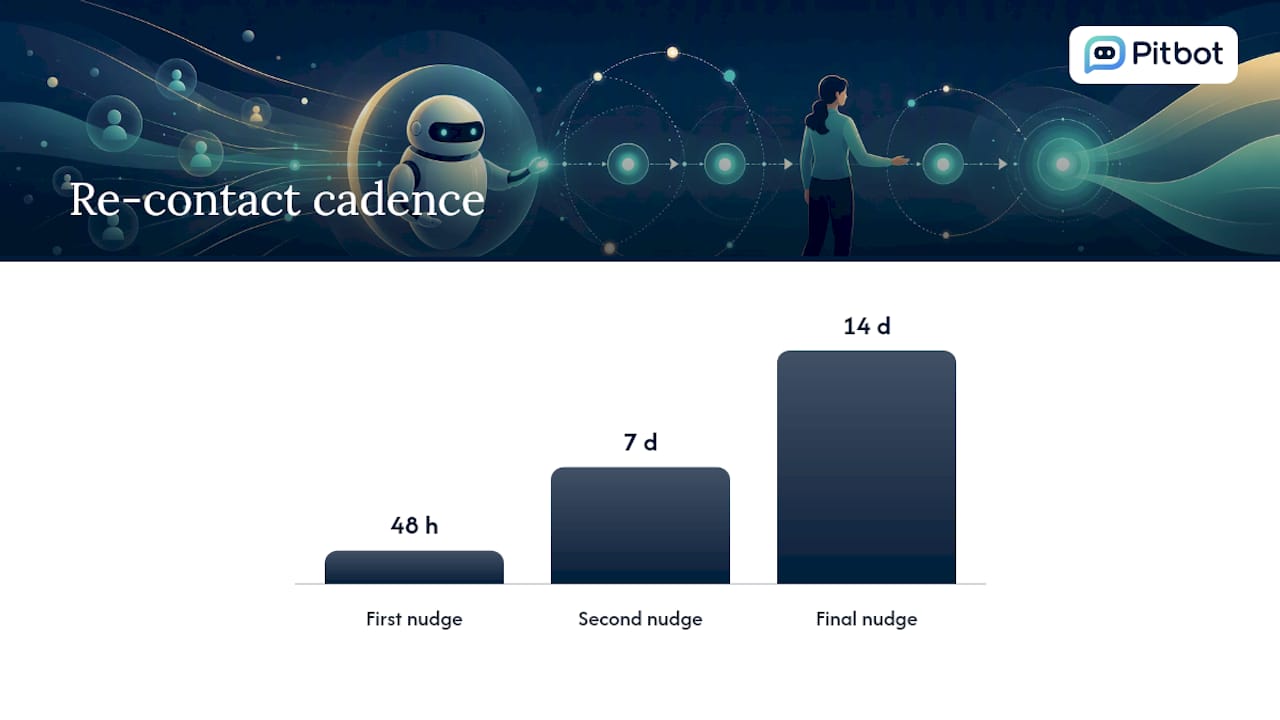
Track P50 and P95 time-to-paid, and tag every ticket by reason code so you can see which stage generates the most contact volume. Abandoned verifications deserve a re-contact cadence too: a nudge at 48 hours, another at 7 days, and a final one at 14 days recovers players who started an upload and never finished it.
What should withdrawal messages say, and when?
Every message needs three things: what happened, why, and what to do next. Skip any of the three and the player writes in anyway.
- Request received — confirm receipt, state the reference ID, give the SLA window.
- Verification required — name the exact document or field needed and the reason, in plain language.
- Review started — confirm it’s in progress and give an ETA.
- Review delayed — acknowledge the delay honestly and issue a revised ETA. Never leave a pend silent.
- Payout initiated — send the reference or transaction hash immediately.
- Failure — explain the one fix required (wrong IBAN, expired card) with a direct retry link.
- Completed — send a receipt confirming amount, method, and closure.
Channel choice matters as much as the copy. Routine confirmations belong on-site and in email; SMS or Telegram should be reserved for VIP or high-value alerts where speed genuinely matters, not blasted for every state change. Spinlab’s research on withdrawal communication found that a small set of event-triggered messages, each carrying a next action and an ETA, prevents the majority of simple status enquiries before they become tickets at all.
Give players a way to help themselves from inside the same message: upload a document, cancel the withdrawal, edit payout details, or retry a failed transaction. A CTA buried three clicks deep gets ignored; one sitting inside the notification gets used.
Pro Tip: Draft your “review delayed” template before you need it. Teams that improvise this message under pressure tend to either overpromise a new ETA or say nothing useful at all.
What product and technical capabilities support this?
None of the above works without infrastructure behind it. A tracker that shows “processing” without a matching internal state machine is decoration, not communication.
- A player-visible withdrawal tracker mapped one-to-one to the internal state machine, showing reference IDs or transaction hashes at every relevant stage.
- Secure in-flow document upload with progressive verification, so step-up checks only trigger when risk actually requires them.
- Event-driven messaging that fires automatically on state changes, with throttling so a single withdrawal doesn’t generate five notifications in ten minutes.
- A full audit trail for every decision, paired with dashboard alerts when an SLA is at risk of breach.
- Payment-method coverage mapping, with guardrails around which details a player can still edit or cancel once a payout has started.
Separate internal processing time from payment network transit time in every message. Players routinely conflate the two and blame the operator for delays that sit with the payment rail, not the casino.
How does AI with human review change withdrawal communication?
An AI-powered platform can combine multiple AI providers with a staff review queue so AI-drafted replies on a withdrawal query can be held for approval before they are sent. This structure delivers speed without handing compliance decisions to an unsupervised model.
Operational gains include consistent reason-coded language across channels, faster first-response times, and thread assignment so a stalled withdrawal stays with a named owner. An audit trail behind each reply can provide compliance teams a documented record of approvals.
What does compliance-first player experience actually mean in practice?
The regulatory guidance and the operational data point in the same direction, and most operators still treat them as separate problems. That’s the gap worth closing.
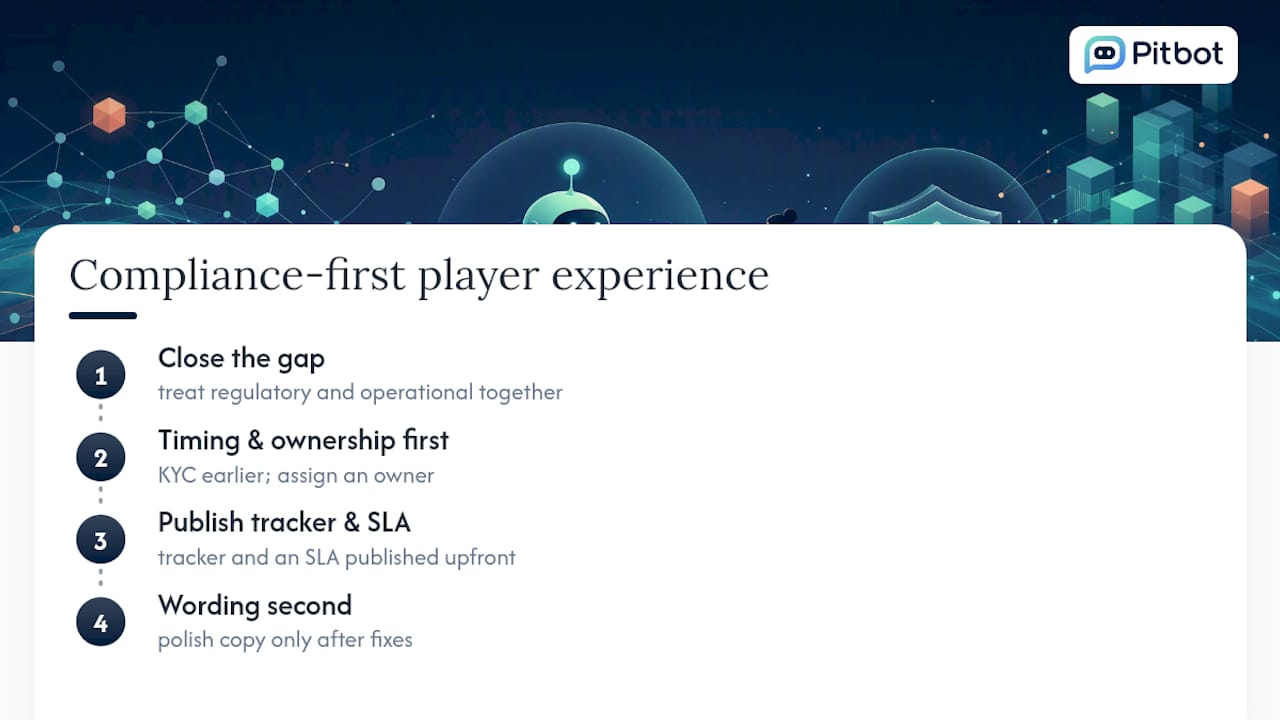
Conventional advice treats withdrawal communication as a support-team wording exercise: soften the tone, add an apology template, done. It rarely is. The UK Gambling Commission and Malta Gaming Authority guidance both point at the same underlying issue: withdrawals fail communication tests when KYC happens too late and pends have no owner, not when the copy is unfriendly.
Fix the timing and the ownership first. A tracker and an SLA published upfront do more for player trust than any amount of polished apology language after the fact. Operators who treat withdrawal screens as a compliance afterthought, bolted on after the deposit funnel gets all the design attention, are the ones who end up firefighting tickets that a clear status page would have prevented. Prioritise the state machine and the reviewer ownership behind it. The wording matters, but it’s the second problem, not the first.
— pitbot
How Pitbot supports compliant withdrawal messaging
Such platforms can give operators a way to run this playbook without building it from scratch by combining omni-channel messaging across email, live chat, SMS, and Telegram with a staff review queue, so withdrawal updates, hold explanations, and verification prompts can be checked before they go out, with a full audit trail behind decisions.
If you’re mapping your own withdrawal states to a support platform, a demo is the fastest way to see the fit. Ask for withdrawal-state mapping against your current cashier flow and a walkthrough of the approval workflow behind AI-drafted replies. You can book a demo directly, or look through the full feature set first if you want the detail before the call.
Sources
- Restrictions on withdrawing deposit and deposit winnings (UK Gambling Commission)
- Directive 2 of 2018 (Malta Gaming Authority)
- How to reduce withdrawals support tickets by 40% (Spinlab Studios)
- iGaming withdrawal operations & AML playbook (GetBanked)
FAQ
What is withdrawal communication in an online casino context?
It covers every message and process tied to a payout request, including status updates, verification prompts, delay explanations, and troubleshooting guidance sent to the player.
When should KYC checks happen to avoid withdrawal delays?
Primary verification should trigger at registration or first deposit rather than at withdrawal, since the Gambling Commission expects operators not to request information at withdrawal that could reasonably have been collected earlier.
Can operators apply wagering requirements to deposit withdrawals?
No. Deposit balances must remain withdrawable without wagering requirements attached, and any processing fee has to be disclosed before the first deposit, per UK Gambling Commission guidance.
How much can a withdrawal tracker reduce support tickets?
Treating withdrawals as a product surface with explicit states and proactive messaging can cut related support tickets by around 40%, according to Spinlab’s research.
How does Pitbot help operators manage withdrawal communication?
Pitbot pairs multi-provider AI with human-in-the-loop review across email, live chat, SMS, and Telegram, producing consistent, compliance-checked withdrawal messaging with a documented audit trail for every reply.