

The most reliable way to prevent AI hallucinations is to stack four controls: ground every answer in retrieved evidence, force the model to abstain rather than guess, run automated verification against a citation contract, and route low-confidence outputs to a human reviewer. Start with grounding and abstention. They cost the least to implement and remove most confident fabrications before verification and human oversight catch what remains.
TL;DR:
- Implementing grounding and abstention methods in prompts is cost-effective and significantly reduces confident fabrications before verification and human oversight.
- Retrieval-augmented generation improves answer accuracy by anchoring responses in retrieved evidence, but source relevance and freshness are critical to prevent false confidence.
- Automated verification tools such as citation checking, entailment testing, and cross-referencing play a vital role in catching hallucinations without requiring human intervention for every output.
- Routinely testing, monitoring, and logging hallucination rates helps maintain control, detect drift, and refine thresholds for human review in high-stakes environments.
- Human review remains essential in regulated settings, with a focus on routing low-confidence responses to agents before disclosure, ensuring compliance and preventing hallucinations reaching users.
Table of Contents
- Why do AI models hallucinate in the first place?
- Which prompt engineering tactics actually reduce hallucinations?
- How does retrieval-augmented generation reduce hallucinations?
- What automated checks catch hallucinations before users see them?
- When should a human reviewer step in?
- How do you measure whether hallucination controls are working?
- How Pitbot applies human review to prevent hallucinated replies
- What’s the priority order for implementing these controls?
- Does fine-tuning reduce hallucinations, or just mask them?
- Do bigger models hallucinate less?
- What governance principle actually holds up over time?
- Reduce hallucination risk in player support with human oversight
- Sources
Why do AI models hallucinate in the first place?
Large language models optimise for fluent probability, not factual truth. A model predicts the most statistically likely next token given its training. It has no built-in mechanism to check that token against reality. That gap is the root of almost every hallucination you will encounter.
Training data compounds the problem. Datasets contain noisy labels, contradictory sources, and a hard cutoff date, so a model asked about anything past its training window will often generate a plausible-sounding but invented answer rather than admit ignorance. Reinforcement learning from human feedback can make this worse: annotators tend to rate confident, detailed answers higher than hedged ones, so models learn that sounding sure gets rewarded even when the content is wrong.
Not every hallucination carries the same risk. A model inventing a fictional restaurant name in a creative writing exercise is harmless. A model inventing a bonus term, a withdrawal limit, or a regulatory deadline in a regulated support channel is not. Triage by risk first. It tells you where to spend your verification budget.
Which prompt engineering tactics actually reduce hallucinations?
Prompt design is the cheapest lever you have, and it works better than most teams expect. The single highest-leverage change is giving the model explicit permission to say “I don’t know” and rewarding that behaviour in your evaluation criteria. Prompting research on abstention techniques reports confident fabrications dropping by a measurable margin once models are told not to guess.
Five tactics consistently outperform generic “be accurate” instructions:
- Explicit abstention wording. Instead of “answer the question,” use: “If the provided context does not contain the answer, respond with ‘I don’t know based on the available information.’ Do not guess.”
- Delimited context fencing. Wrap retrieved documents in clear tags (e.g.
<context>...</context>) and instruct the model to answer only from what’s inside them, never from prior knowledge. - Chain-of-thought with a verification step. Ask the model to reason through intermediate steps, then add a final check: “Before answering, list which claims are directly supported by the context above.”
- Structured citation contracts. Require every claim to carry a source and a confidence label, formatted as
claim → source → confidence (high/medium/low). Low-confidence claims trigger a hold, not a guess. - Lower temperature for factual tasks. Sampling temperature above 0.3 to 0.5 measurably increases variance in factual outputs; drop it close to zero for anything answer-critical.
Pro Tip: Test your abstention prompt against a deliberately unanswerable question set before shipping. If the model still fabricates an answer more than a handful of times out of fifty, the wording needs tightening before you touch anything else in the pipeline.
How does retrieval-augmented generation reduce hallucinations?
Retrieval-augmented generation grounds a model’s answer in retrieved evidence instead of its own parametric memory. The typical topology is a retriever, a re-ranker, and a reader: the retriever pulls candidate passages from a vector or sparse index, the re-ranker filters them for factual relevance, and the reader model composes an answer constrained to what survived filtering.
RAG doesn’t eliminate the accuracy problem. It relocates it. Retrieval quality becomes the new bottleneck, and low-relevance or biased sources will get repeated back to the user with false confidence unless they’re ranked and filtered first. In one study of misinformation correction, a retrieval-backed system (Muse) that ranks sources for factuality produced reference links relevant to the generated text 96% of the time, against 76% for GPT-4 without that retrieval layer, which is the difference between a citation contract that holds up and one that quietly fails under load.
A working citation contract needs to enforce a few non-negotiables:
- Every factual claim must map to a specific retrieved passage, not a general topic match.
- If no passage supports a claim, the system abstains rather than filling the gap from memory.
- Retrieved passages carry freshness metadata so stale documents can be down-weighted or excluded.
- Fabricated or malformed citations (a source that doesn’t actually contain the claim) get flagged before the answer ships.
Stale corpora and fabricated citations are the two failure modes that undo RAG in practice, and both are catchable with the verification layer covered next.
What automated checks catch hallucinations before users see them?
Automated verification sits between generation and delivery, and it’s where most of the mechanical, repeatable defence lives. None of these checks require a human in the loop for every request. They’re designed to filter the majority of outputs automatically and escalate only what fails.
- Citation verification. Confirm the passage cited actually exists in the source corpus and contains the claim attributed to it.
- Entailment checking. Run a classifier that tests whether the cited passage logically entails the generated claim, not just that it mentions related keywords.
- Structured cross-referencing. For dates, names, and numbers, check against a structured database rather than trusting free text; for arithmetic or logic claims, execute the computation rather than accepting the model’s stated result.
- Self-consistency sampling. Generate the same answer multiple times at a moderate temperature and flag disagreement between samples as a hallucination signal, which research on prompting techniques finds more reliable than the model’s own stated confidence.
- Guardrail enforcement. Apply a policy layer on structured outputs to block responses that violate format, scope, or compliance rules regardless of what the entailment check says.
None of this needs to be exotic. Citation verification and entailment checks are genuinely automatable and belong in every serious pipeline, not just the ones handling regulated content.
When should a human reviewer step in?
Trying to reach zero hallucinations through model engineering alone is a losing bet. The more realistic engineering target is what’s sometimes called controlled failure: you accept that some outputs will be wrong, instrument the system to detect them, and route those to a human before they reach the end user. Supervisory agents that watch confidence signals and escalate below a set threshold are a well-documented pattern in production LLM design, and it beats chasing marginal accuracy gains in the base model.
A workable escalation rule looks like this:
- Score every output for groundedness (does the claim map to a retrieved source?) and answer correctness against a RAGAS-style metric.
- If either score falls below your threshold, hold the response and route it to a human queue instead of sending it.
- Set an SLA for that queue based on channel urgency. Live chat needs a faster human response than an email thread.
- Log the original output, the score, the reviewer’s edit, and the final decision in an audit trail.
Amazon Bedrock Agents demonstrate this pattern directly: a Lambda function scores outputs against a custom hallucination threshold and notifies human agents through SNS when the score fails rather than letting the response go out unreviewed.
Pro Tip: Set your groundedness threshold slightly stricter than feels comfortable in the first month. It’s far easier to loosen a threshold once you trust your reviewers’ throughput than to explain a compliance incident caused by a threshold set too loose from day one.
How do you measure whether hallucination controls are working?
You cannot manage what you don’t measure, and hallucination rates drift as models, prompts, and retrieval corpora change. Groundedness (whether an answer’s claims trace back to retrieved evidence) and factual accuracy (whether those claims are actually true) are related but distinct metrics, and tracking only one hides the other’s failures.
Build a fixed test set that includes adversarial prompts and synthetic misuse cases designed specifically to provoke fabrication, not just typical user questions. Run it every time you change a model version, a prompt template, or a retrieval index.
- Track groundedness and answer-correctness scores on a rolling dashboard, not a one-off audit.
- Set drift alerts that fire when scores move outside a normal band, not just when they cross an absolute failure line.
- A/B test retrieval or verification changes against the same fixed testbed so results are comparable across iterations.
- Sample disagreement rates between repeated generations as a leading indicator before user-facing errors climb.
How Pitbot applies human review to prevent hallucinated replies
Regulated support channels are exactly where the controlled-failure model earns its keep. With auto send off, AI-drafted replies on email, live chat and Telegram wait for staff approval before they reach a player. That single design choice removes the scenario every operator fears most: an AI system inventing a bonus term, a withdrawal rule, or a compliance statement that never existed.
- Staff approval before send stops hallucinated claims before they reach a player, not after a complaint arrives.
- Multi-provider AI routing with oversight means no single model’s blind spot becomes the operator’s liability.
- A complete audit trail logs the AI-generated draft, the decision that routed it, and any reviewer refinement, which matters directly when a gambling regulator asks for evidence of a decision.
The trade-off is latency. Full review on every message costs more time than sampled review on a fraction of low-risk traffic. Operators handling standard queries can weight review effort toward VIP communication and anything touching bonus terms or responsible-gambling triggers, and sample the rest.
What’s the priority order for implementing these controls?
Sequence matters more than completeness. Teams that try to build citation verification before fixing their prompts waste engineering time solving a problem abstention would have prevented for free.
- Immediate, low effort: add abstention wording, fence retrieved context, lower temperature for factual tasks.
- Medium effort: build a RAG pipeline with a factuality-ranked retriever and enforce a citation contract on every output.
- High effort: add entailment checks, self-consistency sampling, human-in-the-loop escalation, and a monitoring dashboard.
- Ongoing: log every escalated case and review it weekly to catch systemic gaps the fixed test set missed.
Pro Tip: Don’t skip step four. A monitoring system nobody reviews is a monitoring system that’s already failed, no matter how well it was built.
Does fine-tuning reduce hallucinations, or just mask them?
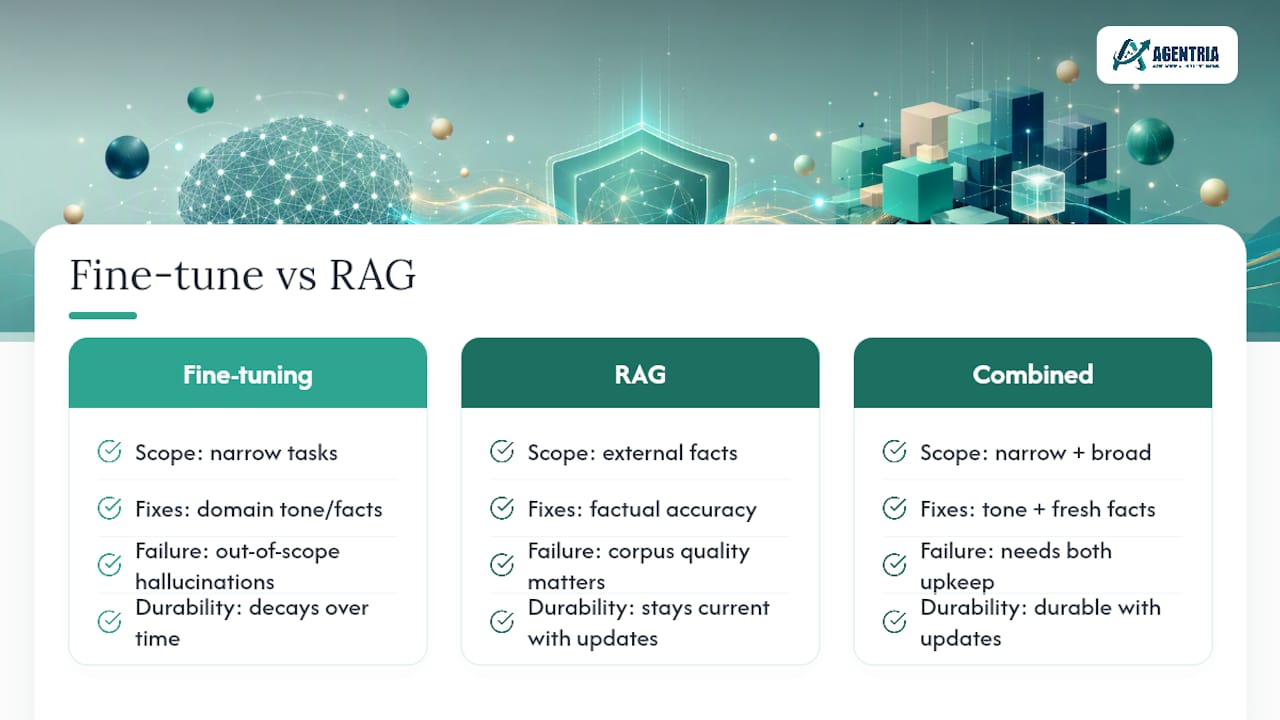
Fine-tuning helps, but it’s a narrower tool than most teams assume. Fine-tuning a base model on domain-specific, well-verified data can reduce hallucination rates on the tasks that data covers, because the model’s learned distribution shifts toward the patterns and facts it was actually shown. That’s genuinely useful for a support system that needs to reflect one operator’s specific bonus structure and terms rather than generic knowledge scraped from the open web.
Fine-tuning does not fix the underlying architecture problem. A fine-tuned model still generates by probability, not by fact-checking, so it can still hallucinate confidently on anything outside its fine-tuning distribution, and it will do so with the same fluent tone that made the original hallucination problem hard to spot. Fine-tuning without continual updates also decays. Product terms change, promotions rotate, regulations get amended, and a model fine-tuned six months ago will confidently repeat outdated rules unless it’s retrained or, more practically, paired with retrieval so current facts come from a live source rather than frozen weights.
The most durable setup treats fine-tuning as a tone and domain-familiarity layer, and treats RAG as the mechanism that keeps facts current. Continual updates matter less for the model’s core weights and more for the retrieval corpus underneath it, since that’s what actually goes stale.
Do bigger models hallucinate less?
Not reliably, and the relationship is less intuitive than most people assume. Larger models generally handle complex reasoning chains better, which reduces one class of hallucination: errors from losing track of a multi-step argument partway through. But scale doesn’t fix the core issue, because a bigger model is still optimising for fluent, probable text rather than verified fact, and a larger model’s fabrications tend to be more fluent and therefore harder for a human reviewer to catch.
Architecture matters as much as size. Models with longer context windows can hold more retrieved evidence in view at once, which helps grounding, but only if the retrieval and citation contract are enforced. Simply having a bigger context window and dumping more documents into it without ranking or filtering increases the chance the model picks up an irrelevant or contradictory passage and confidently misquotes it.
Smaller, task-specific models fine-tuned tightly on a narrow domain can sometimes out-perform a much larger general-purpose model on hallucination rate within that domain, precisely because they have less room to reach for tangential, unverified knowledge. That’s a meaningful consideration for anything handling a narrow, high-stakes vertical like regulated player support, where the value of a model that stays inside its lane can outweigh the appeal of a larger, more general one.
What governance principle actually holds up over time?
Chasing zero hallucinations is a trap. Accept controlled failure instead: instrument every pipeline to detect low-confidence output, and build the escalation path before you need it, not after an incident forces your hand.
Prioritise by risk, not by convenience. A regulated support pipeline handling bonus terms or compliance language deserves human review and a full audit trail long before a low-stakes internal tool does. Spend the monitoring budget where a mistake actually costs something.
None of this is a one-time build. Testbeds go stale, models get swapped, and thresholds that felt strict in month one loosen without anyone noticing unless someone is watching the dashboard.
Reduce hallucination risk in player support with human oversight
Pitbot gives operators the one thing a raw model integration can’t: the option to hold AI-drafted replies for staff approval before a player sees them. Where a standalone chatbot risks inventing a bonus term or a withdrawal rule under pressure, Pitbot routes each draft through a quality gate, holds it for approval when you require that, logs the decision, and builds the audit trail from day one.

Multi-provider AI routing means no single model’s blind spot becomes your liability, and the same oversight layer that catches a hallucinated response also powers responsible gambling automation for outreach suppression and escalation. Operators running several brands can require approval on the brands where the stakes are highest and let the rest send automatically, without losing the audit trail either way. If you’re weighing up how a human-reviewed AI support platform would fit your compliance requirements, book a demo and see the review workflow on your own use cases.
Sources
- Correcting misinformation on social media with a large language model (Muse)
- How to reduce AI hallucinations: what actually works
- Anti-Hallucination Toolkit: 12 Techniques to Fix AI — Future Factors
- How to Reduce LLM Hallucinations with Prompting — AI/TLDR
- Reducing hallucinations in large language models with custom intervention using Amazon Bedrock Agents — AWS Machine Learning Blog