

Player support reporting is the operational and compliance record of every interaction between an operator and a player, built to survive a regulator’s scrutiny. A compliant report must deliver three things: an auditable record of what happened, documented evidence of action taken (including responsible-gambling steps), and analytics that help the business improve. Support tooling can capture much of this from day-to-day support traffic.
TL;DR:
- Accurate case records must include unique identifiers, timestamps, agent or reviewer IDs, brief issue summaries, and escalation details, to ensure replayability.
- Records should be immutable, timestamped for every change, and searchable by case type and date to meet regulator expectations for audit trails and retention periods.
- MGA guidance requires keeping player interaction and responsible-gambling records for at least two years, so build easy export routines for review.
- Complaint and ADR records must document each stage with timestamps and sign-offs, or risk default resolution against the operator.
- Essential KPIs include response times, first contact resolution, escalation rates, and complaint closure within eight weeks, with detailed tagging to monitor trends effectively.
Table of Contents
- Essential fields and record structure every support interaction must capture
- How to build an auditable trail and retention policy inspectors will accept
- Complaints, disputes and ADR: what reporting must demonstrate
- Operational analytics and KPIs to derive from player support reporting
- Common challenges in player support reporting and mitigation strategies
- Examples of standardized player support report templates or formats
- Publisher perspective: combining AI speed with human review and auditability
- How to get started with Pitbot for compliant player support reporting
- FAQ
- Sources
Essential fields and record structure every support interaction must capture
A report is only as useful as the fields behind it. Every interaction record should capture enough detail that a reviewer who was not present can reconstruct what happened and why, without needing to ask the agent.
At minimum, each case needs:
- A unique case ID linked to the player ID and the originating channel (email, live chat, SMS or Telegram).
- ISO-format timestamps for when the message was received, responded to and closed.
- The agent or reviewer ID, plus a flag showing whether the response was AI-assisted.
- A plain-language summary of the issue and the actions taken to resolve it.
- Escalation status and any related transaction or session IDs.
Records should also note when contact was attempted but did not happen, and why, since the UK Gambling Commission’s customer interaction guidance treats a skipped interaction as a decision that itself needs justifying. The guidance is explicit that good record keeping shows the behaviour before an interaction, the reason contact happened, what was said or done, and how the case was followed up, rather than just the raw transcript.
On format, three habits separate audit-ready reporting from a pile of chat logs: immutable entries that cannot be silently edited after the fact, versioned notes where any correction is itself timestamped and attributed, and searchable metadata tags that let a compliance officer pull every case of a given type in seconds rather than hours.
Responsible-gambling triggers deserve their own structured field rather than a line buried in free text: the trigger type, the exact conversation excerpt that prompted it, the intervention offered and the player’s response all belong together, tagged so they surface in both case-level review and monthly reporting. Responsible gambling automation can take part of this off the agent. In Pitbot, responsible gambling and regulator flags on email, live chat, SMS and Telegram are a hard stop: the thread is escalated to a person instead of answered, and a sensitive case opens for someone to pick up. That reduces the risk of a borderline case going unflagged.
How to build an auditable trail and retention policy inspectors will accept
An audit trail is only credible if it cannot be quietly altered. That means every change to a case record, not just its creation, needs its own timestamp and the ID of whoever made it, including the reviewer who signed off on an AI-generated reply before it reached the player.
- Log every state change (new, in review, escalated, closed) with a timestamp and actor ID, never overwriting the previous entry.
- Record human sign-off on AI-assisted replies separately from the reply itself, so reviewer accountability is visible without opening the full transcript.
- Index records by case type, player ID and date so a regulator’s sample request can be answered without a manual search.
- Set a retention clock that matches your licence: the Malta Gaming Authority’s player protection directive requires player interaction and responsible-gambling investigation records to be kept for at least two years from the last interaction.
- Build an export routine (CSV or JSON) that preserves field structure, so a request for evidence does not turn into a formatting job.
Pro Tip: Run a quarterly export-and-restore test on a sample of old cases: if you cannot retrieve and read a record in the format a regulator would expect, your retention policy is theoretical, not operational.
Before an inspection or an ADR request, prepare a short checklist: confirm the retention window covers the period requested, redact personal data outside the regulator’s need-to-know scope, package the case with its full change-log attached, and have a named person ready to explain any gap. Searchable retention indexing, not just storage, is what turns a two-year archive into something you can actually use when asked.
Complaints, disputes and ADR: what reporting must demonstrate
Complaints reporting has its own timeline pressure. The UK Gambling Commission’s ADR guidance sets an eight-week threshold: if a complaint is not resolved within that window, the player must be offered an independent ADR route, and the operator needs records to prove the clock was respected.
A complete complaints file should include:
- The original complaint receipt with its timestamp.
- The full correspondence trail, including internal escalation notes.
- The final decision letter sent to the player.
- Evidence of the ADR referral, if one was made, and the operator’s response time to the ADR provider.
- Confirmation that the customer was notified at each stage.
ADR providers typically request this evidence in structured digital form rather than raw inboxes. The guidance is blunt about the consequence of missing records: an operator that cannot produce them risks the dispute being resolved against it by default. Signed-off timestamps at each stage, not just a final letter, are what demonstrate the process genuinely ran its course.
Operational analytics and KPIs to derive from player support reporting
Once the case-level data exists in a structured form, it becomes the input for the metrics that matter to retention, compliance and VIP handling.
The priority KPIs worth tracking monthly are:
- Average response time, broken down by channel.
- First-contact resolution rate.
- Escalation rate and average time-to-escalation.
- Share of complaints closed within the eight-week ADR window.
- Follow-up rate on responsible-gambling interventions.
- VIP service-level compliance.
Pro tip aside, the single figure worth watching most closely: the share of complaints resolved inside eight weeks, since the UK Gambling Commission’s ADR guidance ties this window directly to when ADR referral becomes mandatory, making it the clearest early-warning signal in the whole dataset.
Aggregating incident-level data into monthly compliance packs and an executive view works best with consistent tagging at the point of capture, not retrofitted afterwards. A practical dashboard skeleton has three layers: a weekly compliance view flagging open RG cases and approaching ADR deadlines, a monthly trend view covering response times and escalation rates, and a per-VIP activity view for account managers.
Human-review metrics belong in the same dashboard: the proportion of replies that were AI-assisted, the average reviewer turnaround before a reply went out, and the count of marketing-suppression events triggered by RG flags. Together these show not just what happened, but how much human judgement sat behind it.
Common challenges in player support reporting and mitigation strategies
The most common failure is inconsistent tagging. When agents describe the same issue type in different words, monthly reports undercount problems and trends disappear into noise. A fixed, short list of case-type tags, enforced at the point of logging, fixes this faster than any retrospective clean-up.
A second challenge is fragmented data across channels. Email, live chat, SMS and Telegram each tend to live in their own system, which makes a single player’s history hard to reconstruct quickly during a complaint review. Routing all channels into one case record at the point of contact avoids the reconciliation work later.

A third is reviewer bottlenecks: if every AI-assisted reply needs sign-off, volume spikes can delay responses. Prioritising sign-off queues by case sensitivity, so RG and complaint cases are reviewed first, keeps the highest-risk interactions moving without loosening oversight elsewhere.
Finally, retention and redaction are often handled manually, which invites human error exactly where regulators look hardest. Automating redaction rules at export time, rather than relying on someone remembering to apply them, removes the weakest link in the chain.
Examples of standardized player support report templates or formats
A workable case template fits on one screen, with full detail available a click away. The top line should show case ID, player ID, channel, timestamps and current status. Below that, a short summary field and an actions-taken field cover what happened and what was done about it, with a link through to the full transcript for anyone who needs it.
For responsible-gambling cases, the template should add dedicated fields for trigger type, intervention offered and follow-up outcome, since these are the fields auditors ask about most directly.
Complaints records benefit from a timeline format rather than a narrative one: receipt date, each escalation step with its own timestamp, the decision letter date and, where relevant, the ADR referral date. A standardized, one-screen summary with drill-down to full transcripts is considerably easier to inspect than notes scattered across systems, which is as much a practical efficiency point as a compliance one.
Monthly reporting templates typically roll case-level records up into a KPI table plus a short narrative covering any notable incidents, keeping the raw data available for anyone who wants to check the aggregate figures.

Publisher perspective: combining AI speed with human review and auditability
Good reporting is a governance habit, not a software feature. Pitbot combines multiple AI providers with the option to hold AI-drafted replies for staff approval, and records who approved each reply that was signed off, building an audit trail into the workflow rather than bolting one on afterwards. The practical addition worth making regardless of platform: appoint a named compliance owner, run monthly spot audits on a sample of cases, and tag by case type so reviews focus where risk actually sits.
— pitbot
How to get started with Pitbot for compliant player support reporting
Operators rebuilding their reporting from scratch usually spend months stitching together ticketing exports, chat logs and spreadsheets before they have anything a regulator would accept. Pitbot records the conversation, approvals and escalations as they happen, not after the fact.
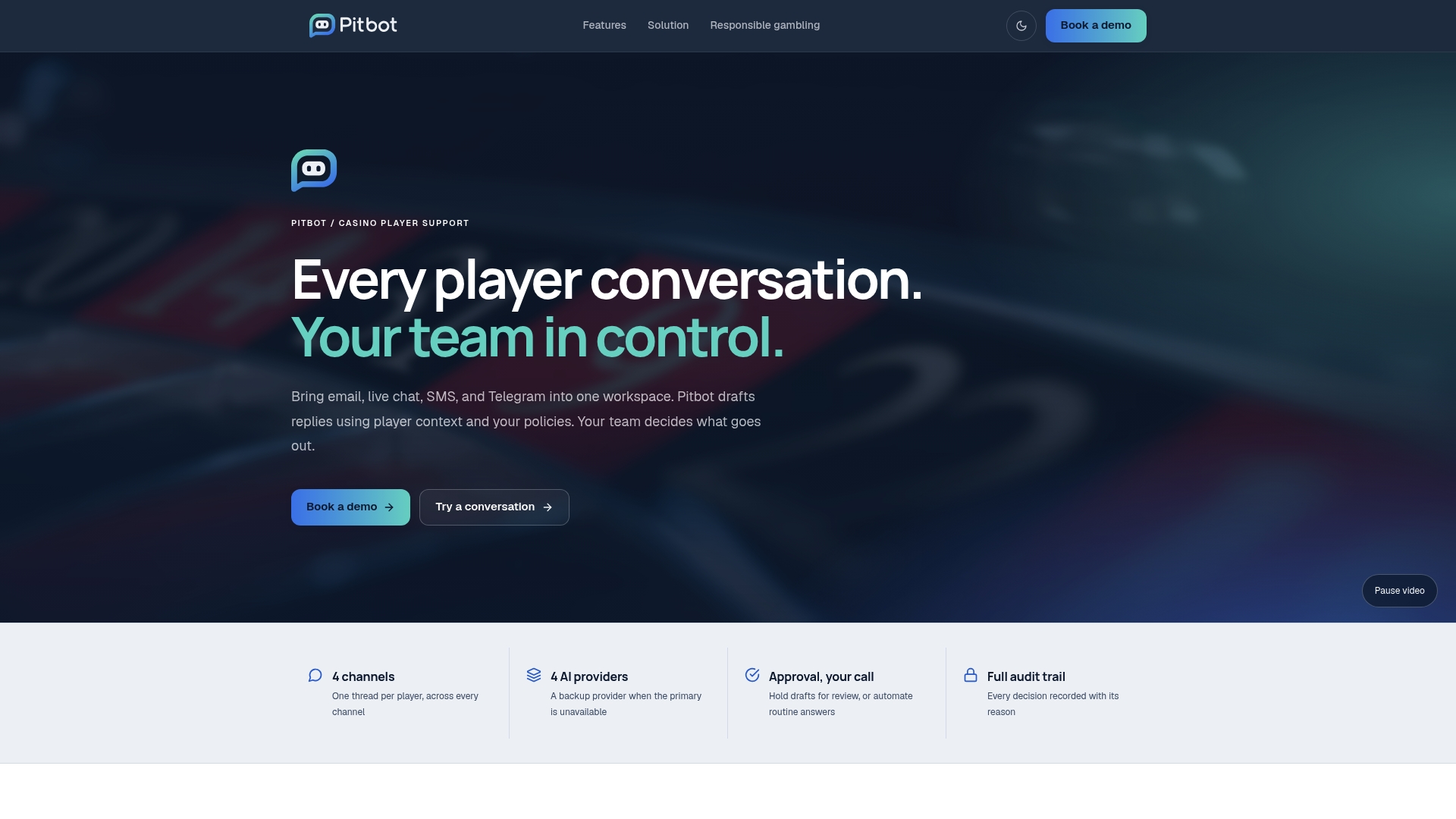
What it brings to the reporting problem described above:
- Multi-provider AI drafts that, with auto send off, wait for staff approval before they reach a player, with a record of who approved each reply that was signed off.
- Email, live chat, SMS and Telegram in one workspace, with one active thread per player shared across those channels, so history does not fragment across systems.
- A sensitive case opened when a responsible gambling or regulator flag escalates a thread, and a suppression log showing when a player was held out of outreach.
- Operational analytics covering time to first response, AI handle rate, first-contact resolution, and reopen and repeat-contact rates, sliceable by channel, VIP level and language.
If your team is weighing up how much reporting work to bring in-house versus how much to hand to a platform that records it as your team works, a demo is the fastest way to see the audit trail and dashboard in practice, or you can explore the full feature set first.
FAQ
What must a player support report include for compliance?
At minimum, a case ID, player ID, channel, timestamps for receipt and resolution, agent or reviewer ID, a summary, actions taken and escalation status. The UK Gambling Commission’s customer interaction guidance also expects records of why an interaction happened and what followed it.
How long must operators retain player interaction records?
Retention periods depend on the licence: the Malta Gaming Authority’s player protection directive requires at least two years from the date of the last interaction for player interactions and responsible-gambling investigations. Operators licensed elsewhere should check the equivalent rule for their own regulator rather than assume this figure applies universally.
When does a complaint need to go to ADR?
Under UK Gambling Commission guidance, a complaint not resolved within a defined reasonable timeframe must be offered an independent ADR route, with records showing the timeline was respected. Operators that cannot produce those records risk the dispute being resolved against them.
How does Pitbot support audit-ready reporting?
With auto send off, AI-drafted replies on email, live chat, SMS and Telegram wait for staff approval before they reach a player, and Pitbot logs who approved each reply that was signed off alongside the conversation thread. Its analytics cover time to first response, AI handle rate, first-contact resolution, and reopen and repeat-contact rates. Complaint and ADR records, including the eight-week window, stay with your complaints process.
What KPIs should appear in a monthly player support report?
Average response time by channel, first-contact resolution rate, escalation rate, the share of complaints closed within eight weeks, and responsible-gambling follow-up rate are the core figures most compliance and retention teams track monthly.
Sources
- Directive 2 of 2018 — Player protection directive (MGA)
- Customer interaction guidance - for remote gambling licensees (UKGC)

