

Compliant player dispute handling means every channel a player uses feeds one case record, any automated decision that affects a player is subject to manual review before it stands, and the full history is logged for audit. It also means being ready for alternate dispute resolution (ADR) if a case stays unresolved past the timeline set out in Gambling Commission complaints guidance, while LCCP 3.4.3 sets out how automated processes acting on indicators of harm must be reviewed.
TL;DR:
- Operators must unify all communication channels under a single case ID to prevent evidence fragmentation and ensure accurate timeline tracking.
- Automated decisions affecting player accounts or balances require human review and a full audit trail to remain compliant with Gambling Commission requirements.
- Support platforms should publish clear dispute procedures, ADR provider details, and response timelines, with eight weeks being the key deadline for offering ADR in the UK.
- Recording comprehensive metadata, including transcripts and transaction logs, is essential for defending dispute decisions and avoiding evidence gaps.
- Pitbot is not a dispute tool, but it keeps the player’s conversation thread across channels, can hold AI-drafted replies for staff approval, and logs who approved each reply that was signed off, which helps with audit readiness.
Table of Contents
- What an effective dispute-handling process looks like from intake to closure
- Regulatory timelines, ADR and required communications operators must publish
- Automating with safeguards: human review, audit trails and escalation rules
- Implementation checklist: steps support teams can follow this week
- What pitbot sees going wrong, and the fastest fixes
- Where Pitbot fits in dispute handling
- Sources
- FAQ
What an effective dispute-handling process looks like from intake to closure
A dispute rarely starts as a formal complaint. It usually begins as a live chat message, an email, or a comment on a delayed withdrawal, and how you handle that first contact sets the tone for everything after.
The starting point is consolidation. Whether a player writes in through email, live chat, a web form or phone, every interaction needs to land under a single player ID and a single case record. Treating each channel as its own ticket stream is one of the most common operational mistakes, and it risks resetting timelines that regulators expect you to track from first contact, not from whichever channel the complaint last touched.
From intake to closure, a workable process generally runs through these steps:
- Log the complaint against the player’s existing case record, or open a new one if none exists.
- Capture metadata: timestamps, transaction IDs, game round IDs, verification steps already completed, full chat transcripts and any attachments the player sends.
- Classify the complaint type (payment, bonus terms, account verification, responsible gambling, game fairness) to route it correctly.
- Apply escalation rules: routine queries proceed with standard handling, while anything touching balances, account status or bonus eligibility triggers a manual review checkpoint.
- Record the outcome, the reasoning and the evidence relied on, then close or escalate to compliance sign-off.
Skipping metadata capture at step two is the failure point most operators discover only when a case is challenged later and the evidence trail has gaps.
Regulatory timelines, ADR and required communications operators must publish
Support teams need to know the clock they are working against and what they are obliged to publish before a dispute ever reaches them.
- Complaints procedures must be fair, open and transparent, and published somewhere the player can actually find them, according to Gambling Commission guidance on handling complaints and ADR.
- If a complaint remains unresolved after eight weeks, the operator must offer ADR, and the same guidance requires a written final decision letter at that point (or sooner) explaining how to escalate.
- Once a case is referred, answer ADR enquiries promptly and within the timescale your ADR provider sets.
- Your terms and complaints policy must name the ADR provider, along with its contact details and website, so a player is never left guessing how to escalate.
The eight-week threshold is the working deadline your case management should be built around, because it is the point at which Gambling Commission guidance requires ADR to be offered and a final decision confirmed in writing.
Other markets set their own clocks. Curaçao’s CGA, for instance, sets its own complaint-handling and ADR expectations, so check the current guidance for each licence you hold. When ADR does request evidence, expect it to ask for the same fields your case record should already hold: transcripts, transaction logs, verification steps and the final decision letter.

Automating with safeguards: human review, audit trails and escalation rules
Automation speeds up first response, but any automated action that changes a player’s position (a bonus reversal, a withdrawal hold, an account restriction) needs to be contestable and reviewed by a person, not just logged. A related principle sits in requirement 11 of LCCP 3.4.3, which calls for licensees to manually review how automated processes acting on indicators of harm performed in each customer’s case, and for customers to be able to contest the decision.
A defensible audit trail needs to record:
- The original player message and the channel it arrived on.
- Which AI provider or rule generated the suggested reply.
- The human reviewer who approved, edited or rejected it, with a timestamp.
- The evidence linked to that decision: screenshots, transaction logs, verification records.
Operationally, this means setting conditional rules rather than blanket automation: routine informational replies can go out automatically, while anything touching balances, account status, bonus eligibility or responsible-gambling indicators is held for review. VIP cases and sensitive complaints typically warrant a lower automation threshold, given the reputational and compliance stakes involved.
Pitbot is not a dispute or chargeback tool; what it keeps is the conversation thread. With auto send off, AI-drafted replies on email, live chat, SMS and Telegram wait for staff approval before they reach a player, and the audit trail records the provider and model used and who approved each reply that was signed off. Pitbot keeps one active thread per player shared across those channels, and its responsible gambling controls apply suppression rules so flagged players are held out of marketing and reactivation outreach automatically.
Pro Tip: Set your automation threshold by outcome, not by channel: any action that could be contested later needs a human sign-off, regardless of whether it started as a chat message or an email.
Implementation checklist: steps support teams can follow this week
Most of this is achievable without a system overhaul, and the highest-value fixes are the cheapest to make.
- Unify every channel under a single case ID so no complaint gets fragmented across email, chat and phone.
- Publish your ADR provider’s name, contact details and website in your terms and your complaints policy.
- Make a complaint submission form or clear contact route available on the player-facing site.
- Set SLA timers for first response, escalation and final determination, matched to your licence’s published guidance.
- Draft templates for final determination letters and evidence bundles so staff are not writing them from scratch under time pressure.
- Dip-sample a portion of resolved cases each month and track outcomes, as Requirement 13 guidance recommends, rather than only keeping records.
- Train staff on escalation triggers, particularly around responsible-gambling indicators.
- Set a retention period for complaint and ADR records that meets your licence’s requirements.
| Control area | What to track | Why it matters |
|---|---|---|
| First response | Time to first meaningful reply | Sets the tone and starts the regulatory clock |
| Escalation | Manual escalations per complaint | Shows whether automation thresholds are calibrated |
| Resolution | Time to final determination | Must sit within the published timeline before ADR applies |
| Records | Retention period met | Evidences how a complaint was handled if challenged |
What pitbot sees going wrong, and the fastest fixes
The most frequent failure is treating each channel as its own ticket stream, which fragments evidence and risks resetting timelines a player didn’t even know were running. The second is an audit log that records outcomes but not reasoning. Enforcing single-case IDs, mandatory human review for contested automated actions, and a clearly published ADR contact fixes most of it within weeks, not quarters.
— pitbot
Where Pitbot fits in dispute handling
Operators rebuilding their dispute-handling workflow from scratch, or patching gaps in an existing one, need channels that talk to each other and automation they can defend later. Pitbot combines multi-provider AI with the option to hold AI-drafted replies for staff approval, so speed does not come at the cost of a defensible record. It does not replace your complaints or ADR process; it keeps the conversation that process draws on.
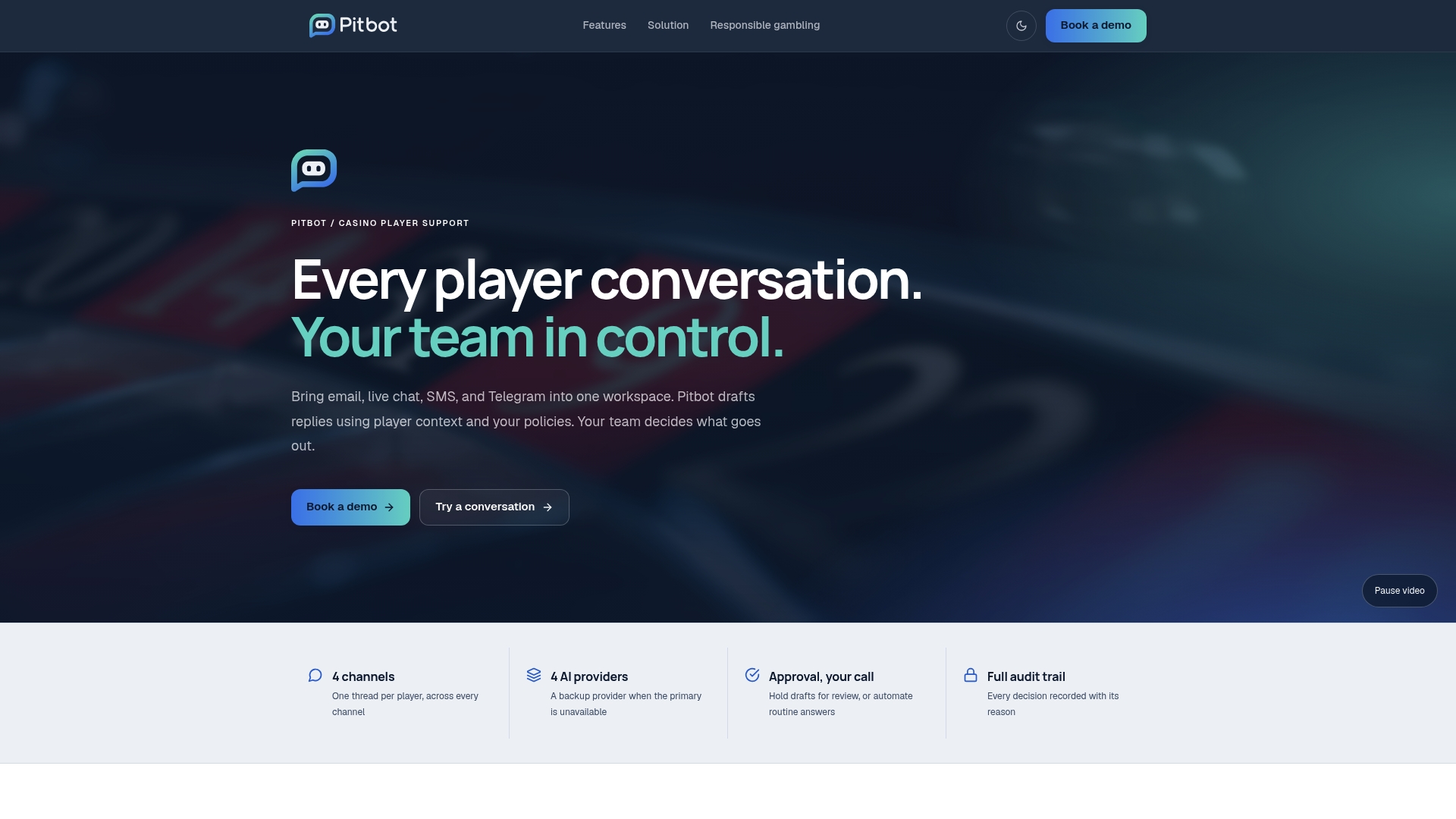
It brings together:
- Multi-provider AI drafts that, with auto send off, wait for staff approval before they reach the player.
- Omni-channel support across email, live chat, SMS and Telegram, with one active thread per player shared across those channels.
- An audit trail recording the provider and model used and who approved each reply that was signed off.
- Escalation rules and responsible-gambling suppression that hold flagged players out of marketing outreach automatically.
For teams that want to see this against a live workflow, the AI customer support platform for online casino and iGaming operators walks through the approval workflow in more detail, or you can book a demo to see the conversation thread and audit trail in action.
This article is general information, not a substitute for advice from a qualified lawyer. Consult a qualified legal professional about your own circumstances before acting on anything here.
FAQ
What counts as a compliant player complaint record?
A compliant record captures timestamps, transaction and game round IDs, verification steps, full transcripts and any attachments, all tied to one case rather than split across channels. Gambling Commission guidance warns that failing to retain sufficient records can see a dispute resolved in the player’s favour by default.
How long can a player complaint stay open before ADR applies?
Under Gambling Commission guidance, operators must offer ADR if a complaint remains unresolved after eight weeks, with a written final decision letter issued at that point or sooner. Other regulators set different clocks, so check the timeline that applies to your licence.
Why does an automated reply need human review?
Because an automated decision that affects a player’s balance, account status or bonus eligibility should be open to manual review in the individual case; LCCP 3.4.3 sets that expectation for automated processes acting on indicators of harm. In Pitbot, with auto send off, AI-drafted replies on email, live chat, SMS and Telegram wait for staff approval before they reach a player.
Does Pitbot help operators meet ADR and audit requirements?
Pitbot is not a dispute or ADR tool, so ADR timelines, decision letters and evidence bundles stay with your complaints process. What it does is keep the player’s conversation thread across email, live chat, SMS and Telegram, and log the provider and model used and who approved each reply that was signed off, which supports the record-keeping a dispute draws on.

