The most effective AI strategy for retaining VIPs is to combine propensity scoring with guarded, human-reviewed interventions and audit trails. Success looks like a measurable drop in VIP churn alongside a defensible compliance record, not just faster messaging. In regulated markets, human review of VIP outreach is one of the strongest controls an operator can show: it keeps automation fast without letting it act unsupervised.
TL;DR:
- VIP propensity models should be validated against separate holdout groups and regularly recalibrated to account for rapid behavior drift.
- Interventions must be prioritized based on risk signals and involve human review before message delivery to ensure compliance and appropriate tone.
- Measurement of success should focus on VIP churn rate, retention lift, CLV uplift, and time-to-intervention, with controlled experiments like holdouts or stepped rollouts.
- Suppression rules are essential to prevent outreach to VIPs exhibiting harm indicators, regardless of their predicted revenue potential.
- Platforms like Pitbot support an integrated workflow with human-in-the-loop review, multi-channel delivery, and audit-ready compliance features.
Table of Contents
- What AI VIP retention means and why it matters for CRM teams
- Core AI tactics proven to reduce VIP churn
- How to measure and prove impact for VIP retention programmes
- Operationalising AI: workflows, roles and playbooks for VIP interventions
- Human-in-the-loop, compliance and safer-gambling safeguards
- Implementation checklist and quick start plan for a pilot
- Author perspective: balancing retention with responsible play
- How Pitbot supports AI-driven VIP retention
- Sources
- FAQ
What AI VIP retention means and why it matters for CRM teams
AI VIP retention describes the use of predictive scoring, orchestration and automated drafting to identify high-value customers at risk of leaving and to prompt timely, personalised responses. The AI ranks players, suggests next actions and drafts outreach; a human reviews and releases anything that touches a VIP relationship. This is different from mass-market retention automation, where lower stakes make full automation more defensible.
VIPs concentrate value and risk in ways that ordinary customers do not. A small number of accounts can represent a disproportionate share of revenue, which means a single mishandled interaction, an inappropriate offer or a missed harm indicator carries outsized commercial and reputational consequences. VIP programmes also attract direct regulatory scrutiny: the Gambling Commission’s guidance on high value customer schemes describes tighter controls and more frequent independent checks specifically because VIP schemes have historically been linked to harm.
CRM teams therefore need two things at once: personalisation sharp enough to retain a customer who has other options, and a governance layer robust enough to satisfy regulators and internal risk teams. The operational detail on how to build that governance layer, including audit trails and escalation thresholds, is covered later under human-in-the-loop safeguards.
Core AI tactics proven to reduce VIP churn
Retention tactics for VIPs work best as a sequence: predict, personalise, time, filter, intervene, test. Each stage depends on the one before it, and skipping a stage tends to produce either noisy, irrelevant outreach or compliance exposure.
- Predictive VIP churn models: build propensity scores from features such as deposit frequency trends, session length changes, response rates to past offers, support contact sentiment and time since last VIP-tier interaction. Validate against a genuine holdout group rather than backtesting on the same data used to train the model, and recalibrate on a rolling window since VIP behaviour drifts faster than mass-market behaviour.
- Next-best-experience recommendations: rather than a single “next-best-offer”, rank a small set of contextually appropriate actions (a personal call from the VIP manager, a tailored non-monetary reward, a check-in message) and let the model suggest which fits the detected risk driver.
- Timing and channel orchestration: use engagement signals such as historical response times by channel and time of day to decide whether an intervention goes by SMS, live chat, email or a direct message on a channel like Telegram, rather than defaulting to whichever channel is easiest to automate.
- Dynamic segmentation and suppression: segment VIPs by risk driver, not just by value tier, and apply suppression rules so a customer flagged for safer-gambling indicators is removed from commercial outreach even if their propensity score suggests high revenue potential.
- In-the-moment interventions with clear escalation: when a model detects an acute risk signal (a sudden spend spike, a distressed support message), the system should draft a response immediately but route it to a named escalation owner rather than auto-sending, with a defined maximum time-to-review.
- AI-assisted experimentation: use the model to generate and test variants of offers and creative within pre-approved templates, so experimentation accelerates without every variant requiring fresh legal sign-off.
Academic and practitioner work on AI’s role in loyalty programme performance supports the general direction here: AI tends to improve engagement by activating customer data into more tailored rewards, rather than by replacing judgement about which reward is appropriate.
Pro Tip: Score risk drivers separately from revenue potential, so a high-value player showing harm indicators is never treated as a retention opportunity.
How to measure and prove impact for VIP retention programmes
Retention claims need to survive scrutiny from finance, compliance and senior leadership, which means the measurement approach matters as much as the tactic itself.
The core KPIs worth tracking are:
- VIP churn rate: the proportion of VIP-tier accounts that become inactive within a defined window, tracked monthly against a rolling baseline.
- Retention lift: the difference in retention between a treatment cohort receiving AI-driven interventions and a matched control cohort.
- CLV uplift: change in projected customer lifetime value for VIPs who received interventions versus those who did not.
- Time-to-intervention: the elapsed time between a risk signal firing and a human-reviewed action reaching the customer.
- Contact-to-resolution: how often an intervention actually resolves the underlying risk driver rather than just generating a reply.
Holdout groups remain the most defensible experiment design: withhold a small, randomly assigned share of at-risk VIPs from AI-driven intervention and compare outcomes. Stepped rollouts, where the intervention is introduced to one segment at a time, work well when a true holdout is commercially uncomfortable at VIP scale. Uplift modelling then estimates the incremental effect of treatment rather than raw response rates, which matters because VIPs who would have stayed anyway can otherwise make an intervention look more effective than it is.
AI agents are becoming a factor loyalty teams must plan measurement around. Forbes reporting on AI agents and customer loyalty notes that as personal AI agents act on customers’ behalf, brands will need to present transparent, easily evaluated value that both the human and their agent can assess, which changes what a “successful” VIP interaction looks like.
Audit-ready reporting means keeping the model version, the decision inputs, the human reviewer’s sign-off and the final message together in one record per intervention, not scattered across CRM notes and email threads.

Operationalising AI: workflows, roles and playbooks for VIP interventions
A model that scores risk is only useful once it is wired into a workflow with named owners at each step.
- Detect: the model flags a risk signal (churn propensity, spend anomaly, sentiment shift) and assigns a priority level.
- Draft: an AI system generates a proposed message or action, using approved templates and the player’s context.
- Human review: a named reviewer, typically the VIP account manager or a compliance-trained agent, checks the draft against tone, offer eligibility and any safer-gambling flags before release.
- Send: the reviewed action goes out on the appropriate channel.
- Monitor: the system tracks the customer’s response and behaviour change following the intervention.
- Escalate: if the risk signal persists or worsens, the case routes to a senior VIP manager or the compliance team rather than triggering another automated attempt.
Assigning an action owner per churn driver, rather than routing everything into a generic support queue, keeps interventions moving instead of stalling in a shared backlog. A payments-related risk signal goes to the payments team, an affiliate-sourced account anomaly goes to the affiliate manager, and anything touching harm indicators goes straight to compliance.
This workflow only functions with integrations across the CRM, the support desk, payment systems and, where relevant, AML monitoring tools, so that a signal detected in one system can trigger an action visible in another without manual re-entry. Because VIP decisions often need to happen inside a day rather than a week, models should be retrained on rolling data windows and served close to real time. Batch scoring run once a week is rarely fast enough for a customer showing acute risk signals today.
Human-in-the-loop, compliance and safer-gambling safeguards
Human review of VIP messages is not a courtesy layer bolted onto automation, it is the control that makes automation defensible. The Gambling Commission’s customer interaction guidance requires licensees to identify, act on and evaluate indicators of harm, to keep records of their interactions and, where automated processes are used, to manually review how they operate in each customer’s case. An AI system that drafts but does not send without sign-off fits that requirement far more naturally than one built to act independently.
Industry codes reinforce the same principle for VIP schemes specifically. The BGC code of conduct for high value customer reward programmes requires periodic assessments of VIP members, removal of benefits when assessment criteria are failed, AML checks and restrictions on presenting VIP tiers as aspirational, precisely to avoid incentivising excessive play.
Practical controls worth building into any VIP retention system:
- Suppression lists split by purpose: marketing suppression, safety suppression and a separate VIP-only escalation channel, so a single flag cannot accidentally silence a genuine safety concern.
- Escalation thresholds: defined triggers (spend spikes, time-on-site anomalies, distressed language in support chats) that force human review regardless of how confident the model is.
- Manual override on every VIP-level action: no automated message reaches a VIP account without a named person approving it first.
- Evidence capture: the model version, inputs, reviewer identity and final decision stored together, not reconstructed after the fact.
Pro Tip: Log the reviewer’s reasoning, not just their approval, since a one-word “approved” is far less useful in an audit than a short note on why the message was appropriate.
Implementation checklist and quick start plan for a pilot
A 90-day pilot is enough to prove whether AI-driven VIP retention works for a given operator, provided the data foundations are in place first.
- Confirm data readiness: behavioural events, identity resolution across channels, transaction history and existing safer-gambling flags all need to be accessible in one place before scoring is worthwhile.
- Build the minimum viable model: start with a small feature set (deposit trend, session frequency, support sentiment, response history) scored on at least a daily cadence, rather than an ambitious model that takes months to validate.
- Set staffing and governance before launch: assign named reviewers, define escalation owners and agree approval gates with compliance before the first automated draft is generated.
- Define success criteria upfront: agree the churn reduction target, the maximum acceptable time-to-intervention and the audit evidence required, so the pilot has a clear pass or fail line rather than a vague sense of improvement.
Post-pilot, the honest options are to scale the model to more VIP segments, retrain it on a wider feature set, or shelve it if the holdout comparison shows no meaningful lift. All three are legitimate outcomes of a well-run pilot.
Pro Tip: Run the pilot on one VIP segment first rather than the whole tier, so a flawed feature or a miscalibrated threshold affects a small, recoverable group of customers.
Author perspective: balancing retention with responsible play
The uncomfortable truth about AI VIP retention is that the same signals that predict a valuable customer is about to churn often overlap with signals that they are showing early harm indicators. Treating those as separate problems, one for the growth team and one for compliance, is where programmes go wrong.
The better posture is to build one system that treats retention and safer play as a single governance question, reviewed by the same people, with the same seriousness given to both outcomes. Automation should make that review faster, not replace it. Teams that keep asking whether an intervention helped the customer, not just whether it worked commercially, tend to build programmes that survive regulatory review and keep VIPs longer.
— Pitbot
How Pitbot supports AI-driven VIP retention
Pitbot combines multi-provider AI drafting with configurable human review. With auto send off, AI-drafted replies on email, live chat and Telegram wait for staff approval before they reach a player, which maps onto the sign-off model described above.
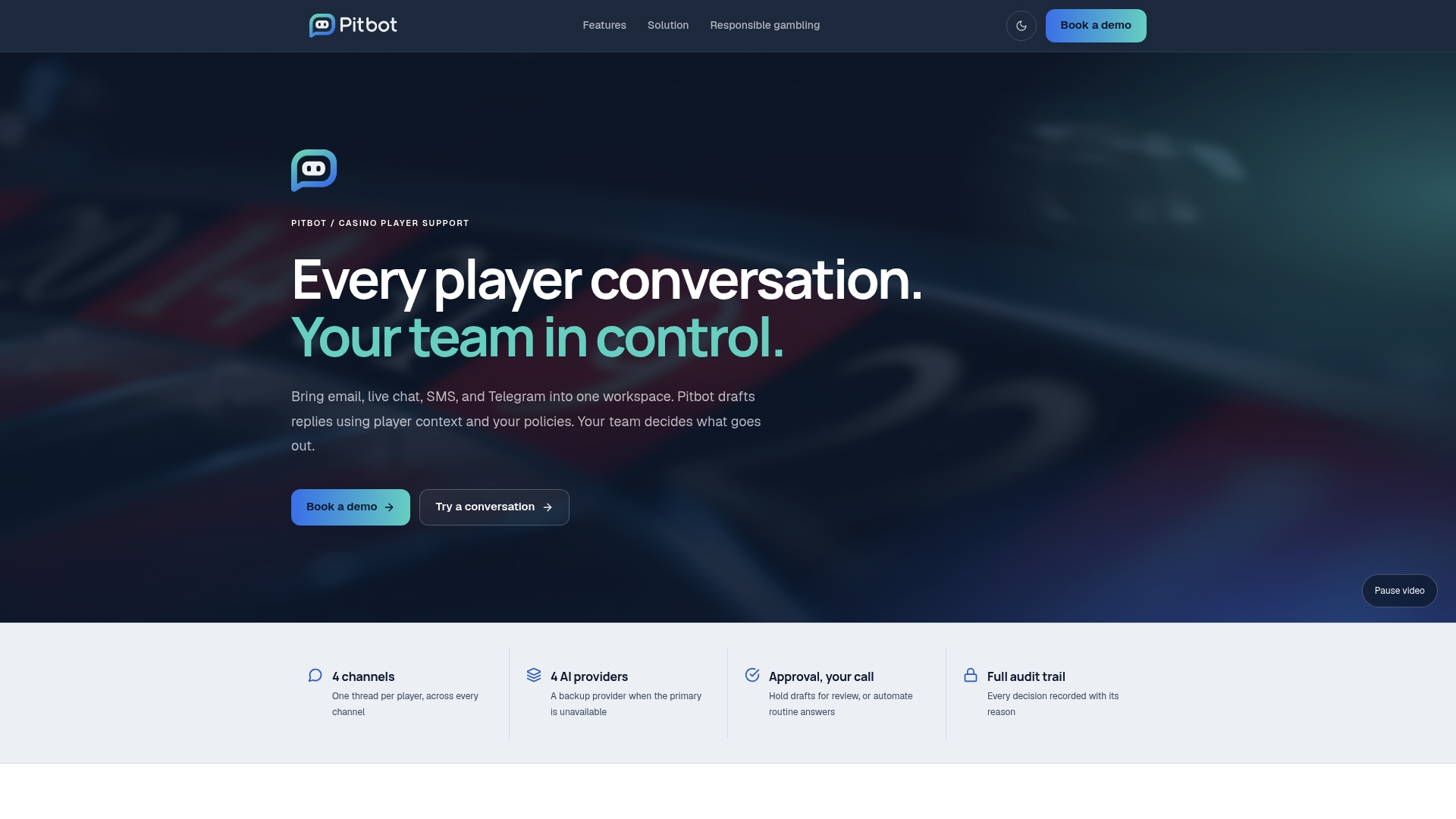
For operators building the workflow outlined earlier, several Pitbot capabilities line up with specific checklist items:
- VIP-aware replies draw on each player’s VIP tier, history and current sentiment, and VIP handling is tracked in the analytics, so high-value conversations are not treated like the general queue.
- One active thread per player shared across email, live chat, SMS and Telegram, so context follows a VIP who switches channel.
- An append-only audit trail and suppression rules that block marketing outreach to players with self-exclusions, cooling-off periods or an open sensitive case support the evidence Gambling Commission and BGC expectations call for, alongside responsible gambling detection and escalation to a person.
Pitbot does not score churn for you: the prediction model stays yours, and Pitbot handles the conversations, approvals and audit trail that follow from it.
Operators evaluating how this fits their existing online casino customer support setup, or wanting the full feature list including human review and multilingual support, can also see the responsible gambling automation tools in context. The most direct next step is to book a demo and see the review workflow against a live VIP scenario.
Sources
Teams building or auditing a VIP retention programme should start with the Gambling Commission’s customer interaction guidance, which sets out the required indicators and audit expectations, and its high value customer guidance on VIP scheme controls specifically. The BGC code of conduct on VIP reward programmes adds the industry-level assessment and AML requirements. For the broader direction of AI in loyalty, the Forbes analysis of AI agents and loyalty is worth reading alongside academic research on AI and loyalty programme performance.
This article is general information, not a substitute for advice from a qualified lawyer. Consult a qualified legal professional about your own circumstances before acting on anything here.
- High Value Customers: Industry guidance (Gambling Commission)
- Customer interaction guidance for remote gambling licensees (Gambling Commission)
- Code of Conduct: High Value Customer VIP Reward Programmes (BGC)
- AI agents will become the new gatekeepers of customer loyalty (Forbes)
FAQ
How does AI identify which VIPs are at risk of churning?
AI models rank VIPs using behavioural signals such as deposit frequency changes, session length trends, support sentiment and response rates to past offers, rather than a single metric. The strongest programmes validate these models against a genuine holdout group and retrain them on rolling data windows since VIP behaviour shifts quickly.
Why is human review required for AI-generated VIP messages?
Regulated markets require that automated processes remain manually reviewable, with Gambling Commission guidance requiring records of every interaction, manual review of automated processes and timely action on harm indicators. A reviewer checking tone, eligibility and safer-gambling flags before release keeps outreach both compliant and appropriate to the individual case.
What KPIs prove an AI VIP retention programme is working?
Core KPIs include VIP churn rate, retention lift measured against a control cohort, CLV uplift, time-to-intervention and contact-to-resolution. Comparing a treatment group against a genuine holdout or using a stepped rollout gives a more defensible read than simply tracking response rates.
How do suppression rules protect VIPs showing signs of harm?
Suppression rules remove a customer from commercial outreach the moment a safer-gambling indicator is flagged, regardless of their predicted revenue value. Industry codes such as the BGC’s VIP reward programme code require removal of VIP benefits when assessment criteria are failed, which is the same logic suppression lists enforce automatically.
Can a platform like Pitbot handle VIP-specific communication needs?
Pitbot drafts replies that reflect each player’s VIP tier and history, and you can hold AI-drafted replies for staff approval before they reach a player. Suppression rules and an append-only audit trail support the compliance requirements specific to VIP programmes.