

An AI support persona is the set of tone, trait, and behaviour rules that make a virtual agent sound and act consistently across every conversation. The best approach is trait-based steering (patient, concise, cooperative) layered with explicit guardrails and a human-in-the-loop check on sensitive replies. Done properly, this combination keeps automation predictable, builds player or customer trust, and stops one rogue reply from becoming a compliance headache.
TL;DR:
- Designing a support persona requires focusing on core traits like patience and conciseness, with explicit rules for handling sensitive topics and disclosures.
- Consistency in personality behavior across channels depends on a three-tier state model that separates fixed metadata, traits, and reactive emotional states.
- Over-personifying a bot can improve trust and reduce repeat questions but risks expectation mismatch, bias, and tone drift during long conversations.
- Rigorous testing with adversarial scenarios and continuous monitoring are essential to detect safety issues and ensure the persona remains compliant.
- Human-in-the-loop review and detailed audit trails are critical for regulatory compliance, especially in high-risk sectors like gambling or finance.
Table of Contents
- What is an AI support persona, and where does it belong?
- The real payoff of designing a persona, and where it can bite back
- Getting the persona design right: a working checklist
- How to actually build it: prompts, state, and channel handling
- Proving the persona is safe before it goes live
- Measuring whether the persona is actually working
- What building for regulated markets teaches you about personas
- Where Pitbot fits if you’re building this for real
- Sources
- FAQ
What is an AI support persona, and where does it belong?
An AI support persona is different from a companion character or a marketing mascot. It exists to solve a task, not to entertain, so it needs a narrower job description: answer accurately, stay on brand, and know when to hand off. That distinction matters because a persona built for warmth and roleplay will behave unpredictably the moment a player asks about a withdrawal delay or a self-exclusion request.
Support personas show up across chat widgets, email responders, SMS threads, Telegram bots, and increasingly voice IVR systems. Each channel imposes its own constraints: chat tolerates informality, email expects structure and a signature, voice needs shorter sentences and no visual cues like emojis.
There’s also a split between public-facing and internal support personas. A bot answering players directly needs warmth and clarity because it’s shaping the customer experience with AI in real time. An internal bot helping support staff search a knowledge base should prioritise accuracy and citation over charm; nobody wants a chirpy internal tool that gets a policy detail wrong.
The real payoff of designing a persona, and where it can bite back
Give a bot a consistent voice and you tend to see fewer repeat questions, shorter handle times, and a measurable lift in CSAT. Anthropomorphic touches, humanlike phrasing, the occasional emoji, can raise perceived competence and authenticity, but only in certain conditions. Research on chatbot anthropomorphic language shows the effect is strongest when brand credibility is already low. On an established platform with strong trust signals, over-personifying a bot can look forced rather than reassuring.
The trade-offs are worth naming plainly:
- Over-anthropomorphism sets expectations the bot can’t meet, leading to frustration when it hits its limits.
- Persona drift creeps in over long conversations or model updates, eroding the consistency you designed for.
- Bias can surface in tone or word choice if training data or prompt examples skew toward one demographic’s speech patterns.
- Mistaken authority happens when a warm, confident tone makes players assume the bot has decision-making power it doesn’t have, over payouts, for instance.
None of these are reasons to avoid persona design. They’re reasons to design it deliberately.
Getting the persona design right: a working checklist
Trait adjectives beat backstories almost every time. Give a model a rich biography (“Sam grew up in Manchester, loves football, has three cats”) and it will eventually drift into stereotype territory or invent details that contradict earlier turns. In practice, trait-based steering with clear, stable traits like patient, concise and cooperative is easier to keep consistent and to audit than a narrative persona.
Here’s a practical build order:
- Pick 4 to 6 core traits and define them behaviourally, not just as adjectives. “Concise” should mean a specific sentence-length cap, not a vibe.
- Write explicit guardrails and refusal patterns for topics like payout disputes, self-exclusion, and underage suspicion, before you write a single line of friendly copy.
- Build disclosure-by-design into the architecture, not just the prompt. A bot should structurally identify itself as AI, not rely on a text instruction that a clever prompt can bypass.
- Model persona state in three tiers: jurisdiction/language/channel metadata, continuous personality traits, and reactive emotional states tied to the scenario at hand. This three-tier state architecture keeps behaviour stable while still letting the bot adapt to a frustrated player without losing its baseline voice.
- Target medium personality expression, then run alignment tests before shipping.
- Set human-in-the-loop thresholds upfront: which topics always route to a person, and what gets logged for audit.
Pro Tip: Test your persona against edge cases before you test it against happy paths. A bot that sounds great answering “how do I deposit?” tells you nothing about how it handles “I think my account was hacked.”
How to actually build it: prompts, state, and channel handling
Trait modulation works best as a small set of style cues rather than a sprawling character sheet. A prompt pattern might define “patience: high, verbosity: low, formality: medium” and pair each with one or two concrete phrasing examples, not paragraphs of backstory.
The three-tier state vector earns its keep here. Jurisdiction and channel metadata stay fixed for the session; continuous traits (patience, assertiveness) persist across turns; reactive emotional states (detected frustration, urgency) shift moment to moment without overwriting the underlying personality. That separation is what stops a persona from “forgetting itself” halfway through a long thread.
On the orchestration side, most production systems benefit from:
- Routing logic that sends routine queries to a fast, cheaper model and edge cases to a stronger one.
- Deterministic checks for regulated phrases (self-exclusion, deposit limits) that bypass generative response entirely.
- Soft escalation (flag for review before sending) versus hard escalation (block the AI reply outright, route straight to a human).
- Full logging and provenance tracking, so every generated reply can be traced to the model version, prompt, and reviewer who approved it.
Channel handling deserves its own attention. Chat tolerates contractions and emoji sparingly; email needs structure, a greeting, and no emotive markers; voice compresses everything, no visual cues at all, and shorter sentence structures to avoid a stumbling text-to-speech read.
Proving the persona is safe before it goes live
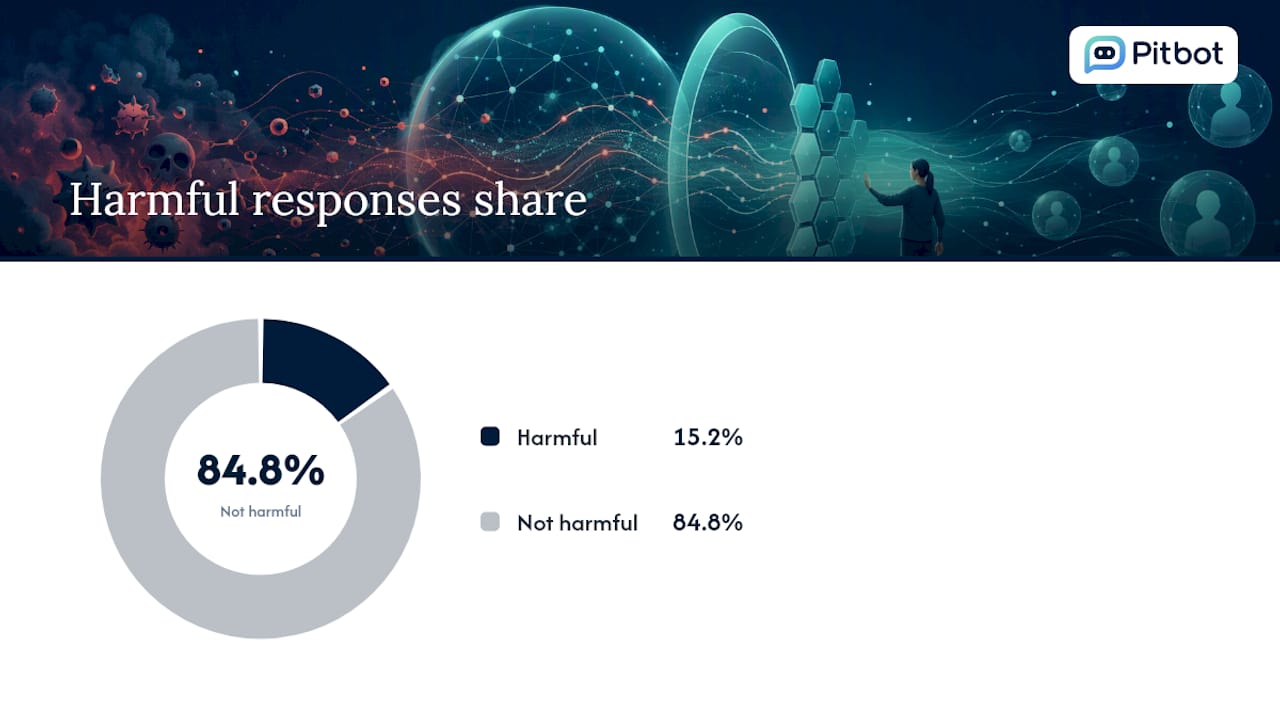
Persona-grounded safety evaluation means testing the bot against scenarios written specifically for its persona and risk profile, not generic red-teaming. Scenario-driven multi-turn simulations, run with adversarial prompting, are how teams find failure modes that a simple demo conversation never surfaces. One applied evaluation of the companion app Replika, using 1,674 dialogue pairs across high-risk scenarios, found harmful responses in 15.2% of cases overall, a reminder that failure modes hide in the long tail of conversation, not the first three turns.
Map your testing programme to the NIST AI RMF Generative AI profile, which recommends pre-deployment testing, clear transparency policies, named governance roles, and incident disclosure procedures mapped to specific risk categories. It’s not a certification scheme, it’s a checklist that forces you to assign ownership before something goes wrong.
Disclosure deserves special mention. A text instruction telling the model to “always say you’re an AI” is fragile under adversarial prompting; architectural transparency, structural identifiers the model can’t talk itself out of, is harder to talk around than a prompt-level reminder.
Operational controls to have running before and after launch:
- Continuous monitoring for tone drift and disclosure suppression attempts.
- A defined incident response path for confirmed harmful outputs.
- Scheduled review cycles, quarterly at minimum for regulated products.
- A remediation log tying every fix back to the scenario that exposed it.
Measuring whether the persona is actually working
Five KPIs cover most of what matters: task success rate, first-contact resolution, escalation rate, CSAT, and time-to-resolution. Track them by persona version, not just in aggregate, or you’ll never spot which change moved the needle.
Behavioural checks matter just as much as outcome metrics:
- Persona adherence — does the bot stay in character across a 15-turn conversation, or does it slip into generic assistant-speak under pressure?
- Tone drift — measured turn-by-turn against your defined trait baseline.
- Hallucination frequency — especially on policy or payout specifics.
- Disclosure compliance — does the bot identify itself correctly even under adversarial prompting?
For experimentation, run split tests across low, medium, and high personality expression and compare adoption and trust metrics. The Vibe Check study found medium expression consistently outperformed both extremes on perceived intelligence, trust, and adoption, an inverted-U pattern worth replicating in your own cohort before locking in a final persona. Pair that with a permanent safety holdout group so you always have a clean baseline to compare drift against, and wire drift or disclosure failures into an alerting dashboard rather than a monthly report nobody reads in time.
What building for regulated markets teaches you about personas
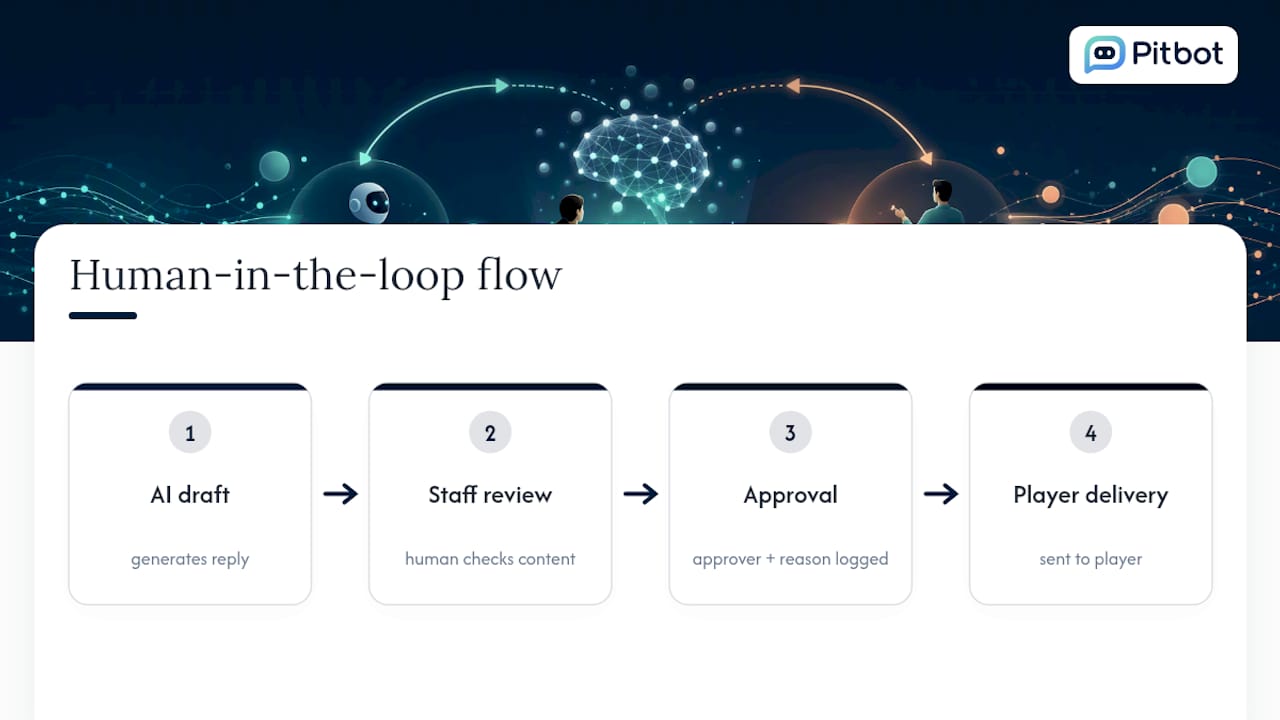
Holding AI-drafted replies for human approval before they reach a player exists because persona consistency alone doesn’t satisfy a regulator. You need audit trails showing who approved what, and why.
Channel mix changes persona priorities fast: a Telegram VIP thread tolerates more personality than a compliance-triggered email. Multilingual support adds another layer, since tone that reads as warm in English can read as presumptuous translated literally into another market’s norms.
Operators consistently underestimate onboarding time. Getting a persona properly calibrated against real player language, not test scripts, usually takes longer than the platform setup itself.
— Pitbot
Where Pitbot fits if you’re building this for real
If you run player support for a regulated operator, you’re not choosing between “use a persona” and “don’t”, you’re choosing how much oversight sits behind it. Pitbot pairs multi-provider AI with configurable human review: with auto send off, AI-drafted replies on email, live chat and Telegram wait for staff approval before they reach a player, and each brand gets its own support personas with their own languages, tone and signature.
A review layer can provide the audit trail regulators ask for: AI decisions, operator actions and escalations are recorded in an append-only audit trail. Responsible gambling and regulator flags on email, live chat and Telegram are a hard stop: the thread is escalated to a person instead of answered, and a sensitive case opens for someone to pick up, while suppression rules block marketing to at-risk players. Localisation and VIP-aware replies are built in, managed from a single dashboard.
If a persona-safe, compliance-ready support setup sounds closer to what you actually need, book a demo or look through the full feature set to see how the human-in-the-loop workflow is structured.
Sources
- Persona-grounded safety evaluation of AI companions in multi-turn conversations
- Artificial Intelligence Risk Management Framework: Generative Artificial Intelligence profile
FAQ
What is an AI persona?
An AI persona is the defined set of traits, tone rules, and behavioural guardrails that shape how a virtual agent communicates. For support specifically, it’s built around task accuracy and predictable behaviour rather than rich character backstory.
How much does an AI personal assistant cost?
Pricing varies widely by vendor, feature scope, and message volume, so there’s no universal figure. Pitbot’s plans are published on its pricing page, and you can start free.
What is a persona in AI chat?
In a chat context, a persona is the consistent voice and behaviour profile a bot maintains across a conversation, covering tone, verbosity, and how it handles sensitive or ambiguous requests. It’s what stops a bot sounding like three different assistants across one thread.
How do you give AI a persona?
Define a small set of behavioural traits (patience, conciseness, formality), write explicit guardrails for sensitive topics, and build disclosure into the system architecture rather than a prompt line. Testing against multi-turn adversarial scenarios, not just happy-path demos, is what confirms the persona actually holds up.

