

For casino operators, SMS is a regulated support channel, not a marketing afterthought. It sits inside your identify→act→evaluate compliance cycle alongside live chat and email, and the same duty of care applies whether the message is a support reply or an automated alert. A best practice starting move is to confirm with your SMS vendor that self-exclusion suppression propagates promptly across channels, and that SMS interactions are logged for audit with a manual review path for automated actions.
TL;DR:
- Self‑exclusion must take effect without delay (the MGA allows no more than 24 hours), and UK licensees must remove excluded players from marketing databases within two days, including on SMS, with regular testing to identify vendor delays.
- Interaction logs should include customer ID, trigger signals, actions taken, and measurable outcomes to meet industry and regulatory standards.
- Strong indicators of harm must be acted on through automated processes, and players must be able to contest an automated decision, which triggers a substantive manual review.
- Operators need integrated visibility into player risk profiles for SMS agents and enforce suppression enforcement through vendor contracts.
- Consistent auditing and compliance testing, including dip-sampling and failure scenario simulations, are essential to demonstrate effective SMS support regulation.
Table of Contents
- Sms support compliance requirements every operator must meet
- Building operational controls that hold up in daily use
- Message-level controls and audit logging for SMS
- Integrating SMS with risk systems and audit trails
- Testing and evaluating your SMS compliance programme
- What compliance teams get wrong about SMS support
- A compliance-minded option for SMS player support
- Sources
- FAQ
Sms support compliance requirements every operator must meet
The Gambling Commission’s customer interaction framework treats SMS the same as any other support channel: operators must identify signs of harm, act on them, and evaluate whether that action worked. Requirement 13 expects operators to evaluate whether their interactions work, keeping interaction records and using spot-checks and dip‑sampling to measure whether indicators of harm reduce, not just whether a message was sent.
The Malta Gaming Authority is strict on timing. Its player protection rules require self-exclusion to take effect forthwith, and its thematic review on self-exclusion states that anything beyond 24 hours from receipt does not meet that standard. An excluded player who still receives promotional SMS is exactly the kind of failure that review targets.
Every SMS interaction log should capture, at minimum:
- Customer identifier — the account reference tied to the message thread.
- Trigger — the behaviour or signal that prompted the interaction (a loss‑chasing pattern, a support query, a self‑exclusion request).
- Action taken — what the system or agent did in response.
- Outcome — the measurable result, checked back later.
These fields come straight from the Gambling Commission’s Requirement 13 guidance on interaction records.
On automation: Requirement 11 requires automated action on strong indicators of harm, and players must be able to contest any automated decision that affects them; a contest triggers a substantive manual review.
Building operational controls that hold up in daily use
Regulatory text is one thing. Making it work at 2am on a bank holiday, when your SMS aggregator has a partial outage, is another. Here’s how to build controls that survive contact with reality.
- Make suppression propagation real‑time, not batch. A self‑exclusion flag raised in your player management system should reach your SMS gateway within minutes, not at the next nightly sync. Test this monthly, not once at go‑live.
- Set clear escalation thresholds. Define what response time is acceptable for a routine SMS query versus a message that mentions financial distress or self‑exclusion, and write down when a case moves from bot to human to specialist team.
- Lock suppression enforcement into vendor contracts. Third‑party SMS providers and aggregators are a genuine weak point; the Gambling Commission is explicit that operators remain responsible when a third party handles marketing on their behalf. Contracts should require audit access, suppression enforcement, and defined data retention periods.
- Give staff integrated visibility. An agent handling an SMS thread needs the same player risk profile a live chat agent sees. Split systems create blind spots exactly where harm signals hide.
Jurisdictional rules are moving too. Mozambique’s tightened SMS regulations, introduced in 2026, now require mobile operators to provide blocking services and full traceability for bulk SMS traffic, a reminder that “compliant last year” doesn’t mean compliant now.
Pro Tip: Run a quarterly “suppression fire drill”: flag a test account as self‑excluded and time exactly how long it takes for every SMS, email and chat channel to stop contacting it. If any channel lags past 24 hours, you have a vendor problem, not a policy problem.
Message-level controls and audit logging for SMS
Not every text you send is the same, legally speaking, and your logging has to reflect that.
Support and transactional SMS (a password reset code, a withdrawal confirmation, a reply to a player query) sit in a different category from promotional texts, but that doesn’t mean they escape logging. A support message can still contain safer‑gambling signals worth capturing, and regulators expect the same audit standard regardless of message type.
Message-level handling should cover:
- Clear sender identification so investigators can trace a thread back to its origin without guesswork.
- HELP and STOP handling where applicable, alongside retained proof of consent, which international SMS compliance guidance from providers such as Cordial recommends keeping on file for audit purposes.
- Secure, accessible storage of full message threads, timestamps, and delivery status, held in a format a regulator can review without a translation layer.
- Separate handling for OTPs and urgent alerts so time‑critical transactional messages never get caught in a marketing suppression rule, while still respecting suppression for anything with promotional intent.
Get this wrong and you create two risks at once: a compliance gap if genuine support messages go unlogged, and an operational failure if a safety‑critical OTP gets blocked by an overzealous marketing filter.
Integrating SMS with risk systems and audit trails
SMS support cannot sit in isolation from your wider risk architecture. A message flagging distress needs to flow: SMS thread → interaction log → player risk profile → automated trigger → manual review queue, with every step timestamped and retrievable.

This is where platforms combining multiple AI providers with human oversight earn their place. With Pitbot, you can hold AI-drafted replies for staff approval before they reach a player, and every AI decision is recorded in an append-only audit trail. Separately, when your platform’s automated action blocks a deposit or restricts access, the full interaction thread plus the scoring logic behind that decision needs to be available to the reviewer, not just a summary.
That architecture delivers two concrete things:
- A preserved audit trail across SMS, chat, email and other channels in one place, not scattered across vendor dashboards.
- Suppression rules checked before every campaign, so players with self-exclusions, cooling-off periods or open sensitive cases are left out of outreach.
Whatever tooling you use, also track metrics you can hand to a regulator, such as time‑to‑manual‑review and suppression latency, to support a Requirement 13 evaluation.
Human‑in‑loop review isn’t a bottleneck here. It’s the mechanism that makes contestability real.
Testing and evaluating your SMS compliance programme
A policy document proves nothing to a regulator. Evidence of testing does.
- Design a dip‑sampling plan. Pull a defined percentage of SMS interactions each month, weighted towards cases involving intervention or escalation, and review them against the relevant LCCP social responsibility provisions and your own policies.
- Track the right KPIs. Suppression latency, interaction log completeness, time‑to‑manual‑review, and repeat‑intervention rates tell you more than raw message volume ever will.
- Tie outcomes to behaviour, not activity. Requirement 13 guidance points to measuring changes in spending patterns and uptake of safer‑gambling tools as the real success markers, not simply whether a message was sent.
- Run failure scenarios deliberately. Test what happens when your SMS vendor goes down mid‑session, when a player contests an automated block, and when suppression needs to hit three channels simultaneously.
- Keep the paper trail. Preserved logs, QA notes, and trial outcomes are what you hand over when a regulator asks how your interaction system performs, not just what it’s supposed to do.
What compliance teams get wrong about SMS support
Most SMS compliance failures aren’t policy failures. They’re integration failures: a suppression flag that updates the CRM but not the SMS gateway, or a log that captures the message but not the trigger behind it.
Treat SMS like any other regulated channel from day one, not a retrofit. That means one shared owner across operations, risk, and legal, because a suppression gap usually sits exactly between those three teams’ remits. If you do nothing else this quarter, test self‑exclusion propagation end‑to‑end, across every channel, and time it.
— Pitbot
A compliance-minded option for SMS player support
Pitbot is built around the exact gap most SMS compliance programmes struggle to close: keeping automation fast without losing the human review trail regulators ask for. It brings email, live chat, SMS and Telegram into one active thread per player and blocks marketing outreach to players with self-exclusions or open sensitive cases. With auto send off, AI-drafted replies on email, live chat and Telegram wait for staff approval before they reach a player.
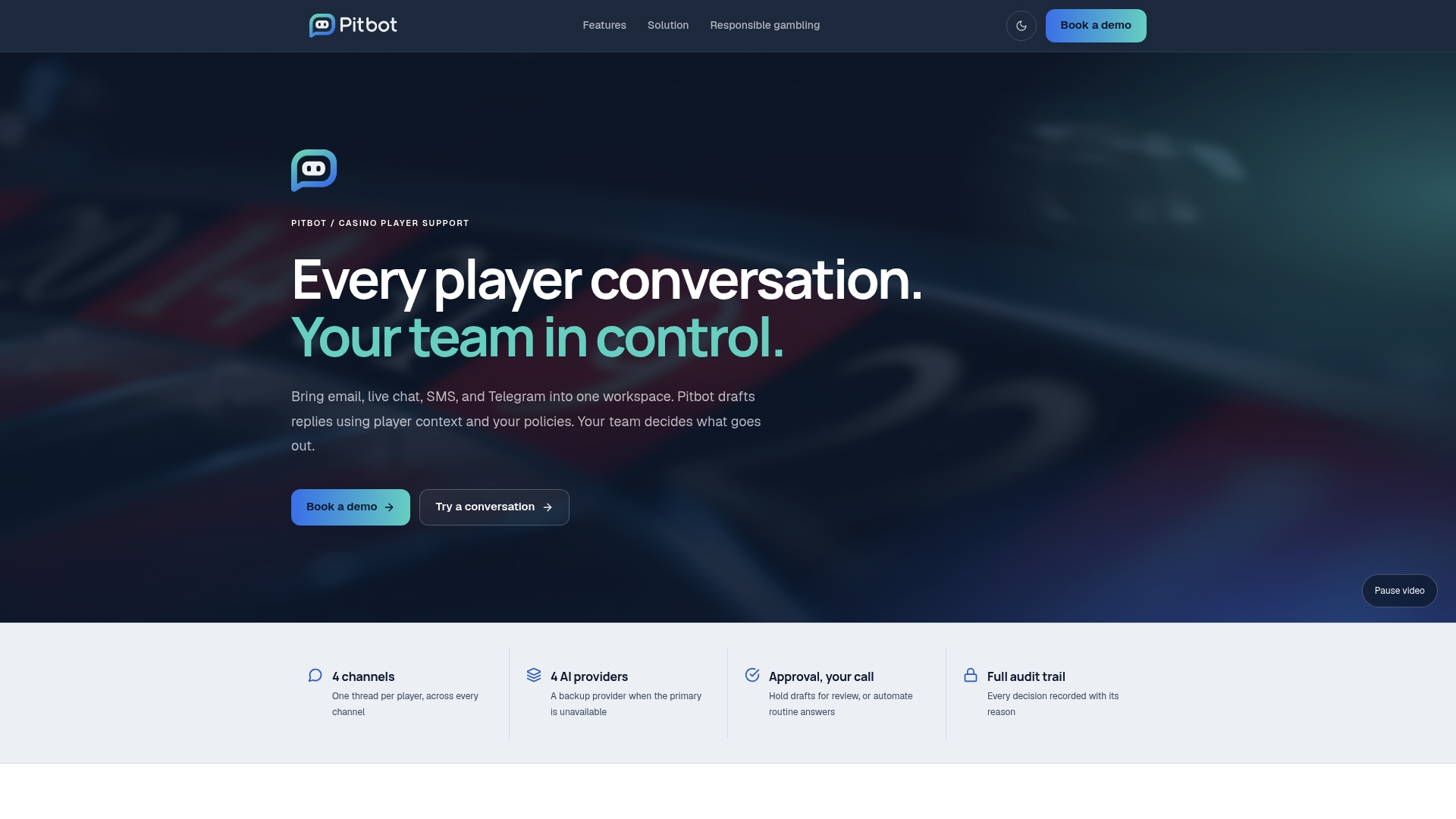
That review step isn’t friction for its own sake. It gives you a record of who approved what, plus a single audit trail across channels instead of four separate ones to reconcile. For teams weighing whether their current SMS setup would survive a regulator’s request for interaction records, checking integration readiness is a reasonable next step. You can see how the omni‑channel support platform handles this, review the platform’s features in more detail, or book a demo to walk through your own suppression and logging setup.
Sources
- Customer interaction guidance – Requirement 13 (Gambling Commission)
- Malta Gaming Authority – player protection
- The MGA publishes findings from thematic review on self-exclusion practices in the online gaming sector – Malta Gaming Authority
FAQ
What does SMS support compliance mean for a casino operator?
It means treating SMS as a regulated support channel subject to the same identify→act→evaluate obligations as live chat or email, including interaction logging and effectiveness evaluation. Suppression for self‑excluded players and contestable automated actions are core to it.
How fast must self-exclusion suppression reach SMS channels?
No regulator sets an SMS-specific window. The MGA expects a self-exclusion to take effect immediately and no later than 24 hours from receipt, and the UK Gambling Commission requires removal from marketing databases within two days. Operators remain responsible even when a third‑party SMS vendor handles delivery.
Can automated systems send SMS interventions without human review?
Yes. Requirement 11 requires automated action on strong indicators of harm, but the player must be able to contest the decision, and a contest triggers a substantive manual review.
What fields must an SMS interaction log include?
At minimum, a customer identifier, the behaviour that triggered the interaction, the action taken, and the outcome, as set out in the Gambling Commission’s Requirement 13 guidance on interaction records. These fields let compliance teams reconstruct any case for a regulator on request.
Does Pitbot help with SMS support compliance?
Pitbot brings SMS, live chat, email and Telegram into one active thread per player, blocks marketing outreach to players with self-exclusions or open sensitive cases, and records every AI decision in an append-only audit trail. With auto send off, AI-drafted replies on email, live chat and Telegram wait for staff approval before they reach a player. See pricing.

